Introducing: The Audemars Piguet Royal Oak Selfwinding Perpetual Calendar Openworked

Last year, Audemars Piguet introduced the revolutionary in-house caliber 7138. The movement introduced a completely new, user-friendly way to operate the perpetual calendar functions. It also lets users adjust the calendar forward and backward, which is a huge plus if they mistakenly set it too far ahead. After the release of last year’s Royal Oak and Code 11.59 models with this movement, we knew it would only be a matter of time before we saw openworked versions. In particular, the Royal Oak Selfwinding Perpetual Calendar Openworked has long been a fan favorite. Now, a little less than a year after the introduction of the new caliber, we get a refreshed Royal Oak Selfwinding Perpetual Calendar Openworked and a new Code 11.59 Selfwinding Perpetual Calendar Openworked. Let’s find out more.
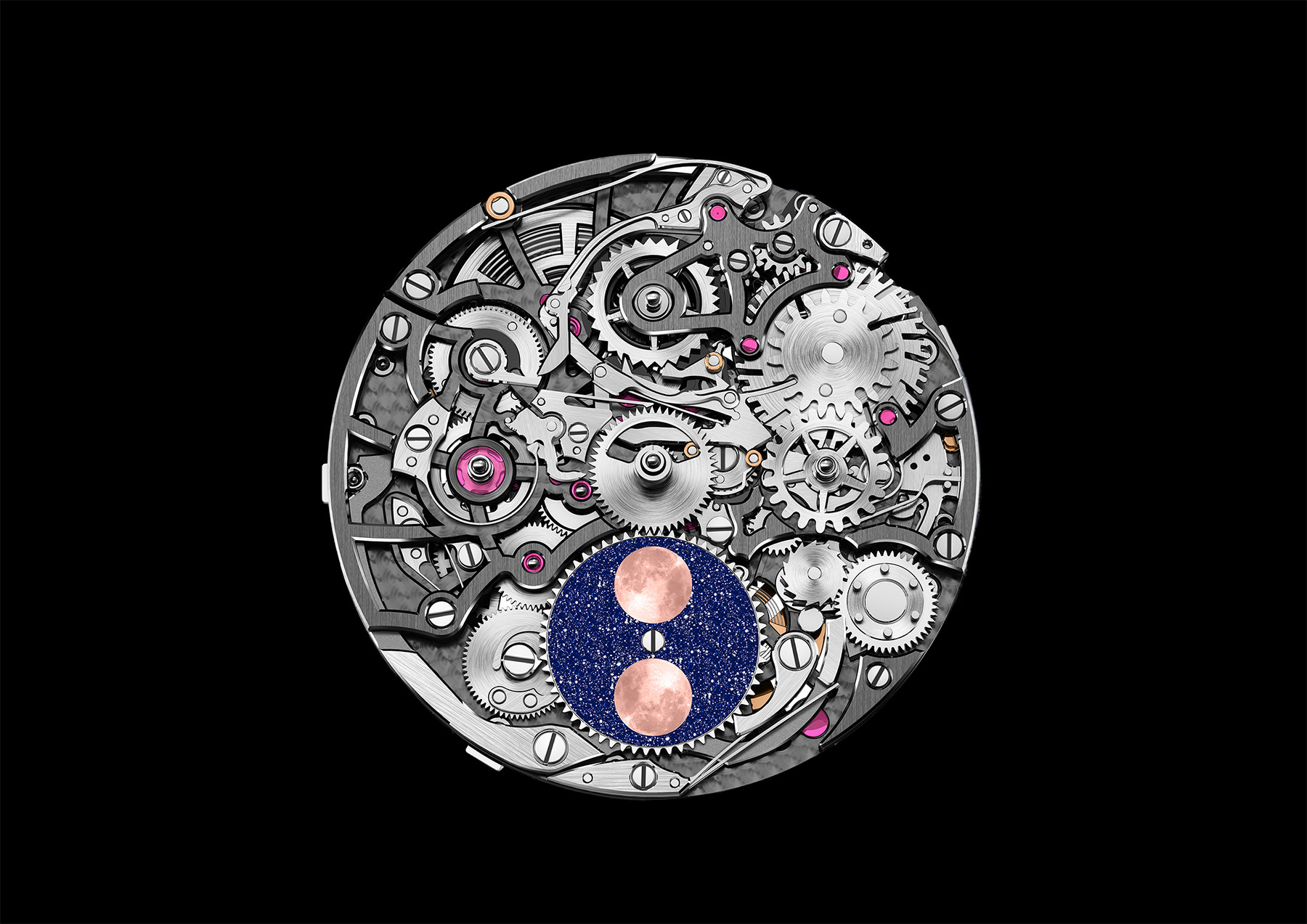
The new movement is the biggest news here. AP’s in-house self-winding perpetual calendar caliber 7139 is a modern take on the classic art of skeletonization. The caliber takes the intuitiveness of last year’s revolutionary caliber 7138 and presents it in a new aesthetic, giving the wearer a beautiful view of its mechanical heart. Audemars Piguet unveils two watches utilizing this movement. The first is a Royal Oak made of titanium and Bulk Metallic Glass (BMG). The second is a white gold and ceramic Code 11.59, the first openworked perpetual calendar in the Code 11.59 lineup.

The Audemars Piguet Royal Oak Selfwinding Perpetual Calendar Openworked
Let’s kick things off with the Audemars Piguet Royal Oak Selfwinding Perpetual Calendar Openworked. As mentioned, this watch’s case consists of a combination of lightweight titanium and Bulk Metallic Glass (BMG). The latter is a metallic alloy composed of 50% palladium. When rapidly cooled during production, the material develops properties similar to those of glass, including incredible strength and an amorphous structure. Audemars Piguet uses a proprietary BMG alloy that is highly resistant to corrosion and wear. On top of that, it has a remarkable reflective sheen.

That’s why the watchmakers in Le Brassus gave the BMG bezel and bracelet studs a contrasting mirror finish. Additionally, they chose to apply a satin finish to the titanium case, crown, and bracelet links. As a result, there is great visual interplay between the materials. On top of that, the mix of finishes also emphasizes the Royal Oak’s sculptural design. With its 41mm diameter, this is no wallflower of a watch, but its 9.5mm thickness keeps it reasonably slim.
The details of the new Royal Oak are remarkable
While the combination of materials is rather extraordinary, the new caliber 7139 takes center stage on both sides of the watch. On the front, it is framed by a black inner bezel displaying the week numbers and a transparent gray minute scale containing pink gold hour markers. Thanks to a clear sapphire dial, you get a great view of the caliber’s openworked bridges and wheels, alternating dark and light gray shades. The three sub-dials at 3, 6, and 9 o’clock contain smoked sapphire rings that display the perpetual calendar’s information. On top of that, the sub-dials feature pink gold frames and hands, matching the centrally mounted lume-filled pink gold hour and minute hands.

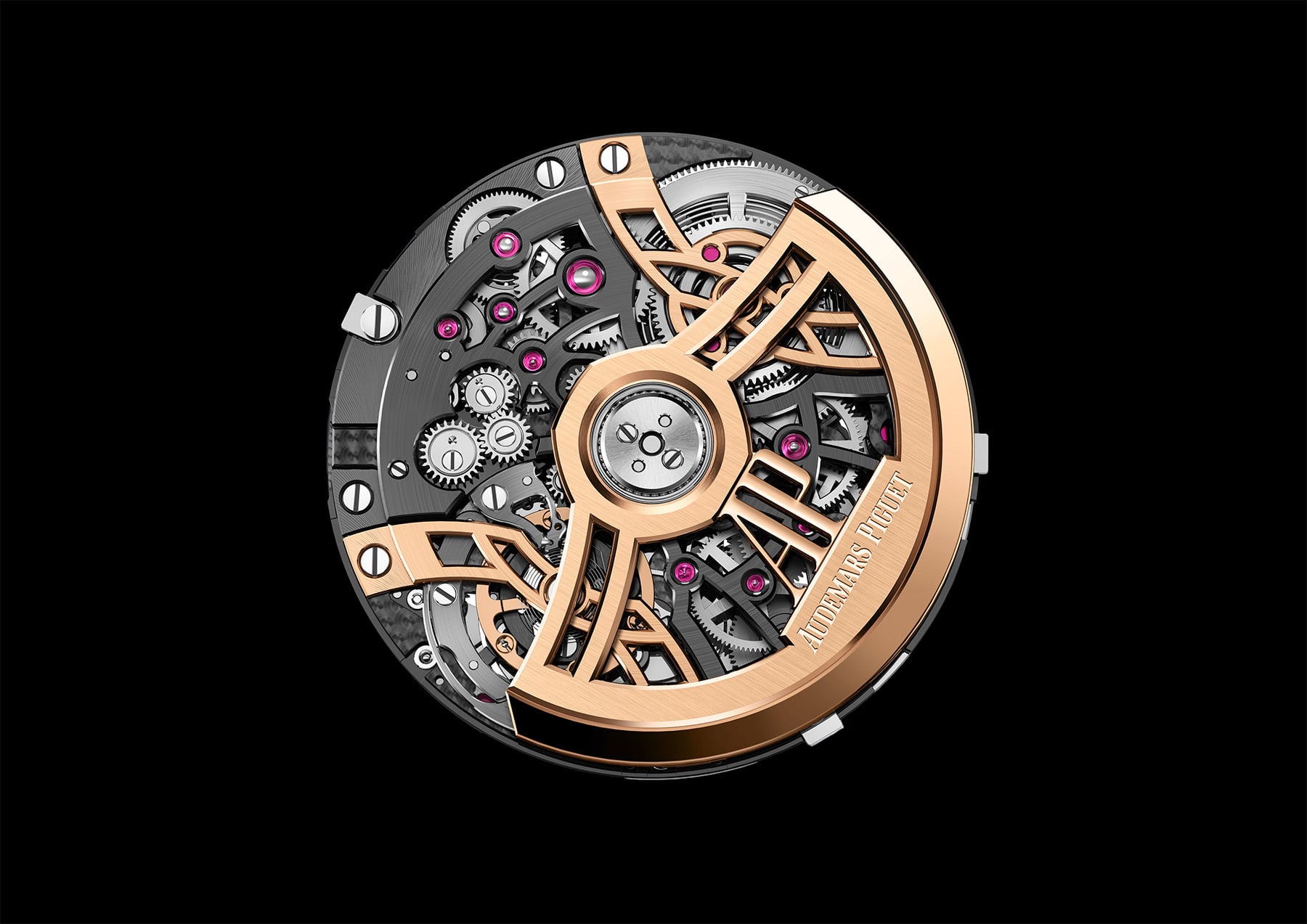
If you turn the watch around, the combination of gray and pink gold elements continues. The sapphire display in the circular-brushed and polished BMG case back highlights the wonderful skeletonized rotor, barrel bridge, and balance wheel bridge, all executed in pink gold. Once again, the finishing is meticulous, and there is a multitude of nice little details that make it a joy to behold. My favorite is the engraved Royal Oak logo on the BMG case back. It’s a great reminder of the special watch that you are holding in your hands.

The Code 11.59 Selfwinding Perpetual Calendar Openworked
The new Code 11.59 Selfwinding Perpetual Calendar Openworked presents a similar layout, as it houses the same caliber. Here, though, the overall aesthetic is quite different. The watch features the familiar three-part case construction that we know from the Code 11.59. The bezel and case back are 18K white gold, while the octagonal case middle is black ceramic. Topping it all, the curved sapphire crystal adds more character and visual drama. Lastly, the crown is made of a combination of white gold and black ceramic.

The case has a 41mm diameter and a 10.6mm thickness. It is beautifully finished with a mix of satin-brushed parts and polished chamfers. As with the Royal Oak, the case contains a black inner bezel with the week numbers. However, while the Code 11.59’s hour markers are also pink gold, they are plated with rhodium. Additionally, the sub-dials at 3, 9, and 12 o’clock feature smoked external zones, just like those in the Royal Oak. Hovering over the sub-dials are small 18K white gold hands with red tips for maximum readability. They match the open white gold hour and minute hands, both of which contain white Super-LumiNova. A beautiful detail is the dark moonphase indicator at 6 o’clock. It has a darker presence than the blue and pink gold one in the Royal Oak.

The same caliber 7139 in a very different watch
If you turn the watch over, you will see the skeletonized pink gold rotor. Additionally, the barrel bridge and balance wheel bridge are pink gold. Just like with the Royal Oak, you get a great view of the inner workings of the openworked caliber 7139. On top of that, it’s nice to see all the intricate details that make Audemars Piguet’s creations so appealing up close. The 423-part automatic caliber operates at 28,800 vibrations per hour, has 41 jewels, and offers a 55-hour power reserve.

Technically, the movement is based on last year’s regular caliber 7138, which Lex wrote about in detail. For the new openworked 7139, the additional challenge was to combine the pleasant user experience with great legibility. I believe AP succeeded in doing so, and the open-worked design benefits from strong symmetry, combining visual brilliance with an easy-to-navigate calendar layout. It follows the so-called European style, with the day at 9 o’clock, the date at noon, and the month at 3 o’clock. As mentioned, the week numbers are printed on the inner bezel. A change from the previous perpetual calendar caliber is that it now starts at “1” rather than “52.”

Final thoughts on the new Audemars Piguet Selfwinding Perpetual Calendar Openworked models
Audemars Piguet’s quest for symmetry has led to a pair of openworked dials that are easy to navigate. On top of that, they look gorgeous with the technically dramatic backdrop. But most of all, these are two impressive timepieces. They build on last year’s success of the regular perpetual calendar models. As we know, the openworked versions of the Royal Oak Perpetual Calendar are some of the most popular models in AP’s lineup. That’s why it makes sense to see a new version. But the choice of titanium and BMG is a great surprise. These materials give the watch a distinct look and feel, while the pink gold details add a touch of visual brilliance and aid overall legibility.
Additionally, it feels logical to introduce the Code 11.59 Selfwinding Perpetual Calendar Openworked. As the Royal Oak version is one of the brand’s star models, the openworked treatment could make this a hit within the Code 11.59 lineup. I like the look of this latest Code 11.59 variant. It has a technical, almost stealthy presence, and it is mechanically brilliant. Considering AP’s incredible eye for detail in achieving symmetry, the high level of finishing, and the impressive case, it’s hard not to applaud this release. It makes me curious to see what material and color combinations Audemars Piguet will surprise us with next.
Both of these watches’ prices are on request. Let us know in the comments what you think of the new Royal Oak and Code 11.59 Selfwinding Perpetual Calendar Openworked models.