A Deep Dive Into Minerva In The Montblanc Era

It’s October 9th, 2006, and this news flash appears on the Richemont website: “Richemont, the Swiss luxury goods group, is pleased to announce that it has acquired Fabrique d’Horlogerie Minerva SA in a private transaction from G. P. P. International SA, Luxembourg. The watch brand Minerva was established by Charles Robert in 1858 and is based in Villeret, Switzerland. It has 22 employees and is today specialized in the development and manufacturing of high-end mechanical movements.” Nineteen years later, we’re in Villeret, visiting the watchmaking atelier that has “Institut Minerva de Recherche en Haute Horlogerie” above the entrance. The manufacture is also known as Montblanc’s Movement and Innovation Excellence Center, and there are many fascinating things to discover inside. Let’s take a deep dive into Minerva in the Montblanc era.
I didn’t count the people working in the Institut Minerva de Recherche en Haute Horlogerie (Minerva Institute for High Watchmaking). Still, it seemed to me that the number of employees is about the same as it was 19 years ago when Richemont acquired the brand. However, Haute Horlogerie is about quality, not quantity. A visit to the watchmaking floor shows me five highly skilled watchmakers in action, working on highly complicated watches. These craftspeople are responsible for the watches that bear both the Montblanc and the Minerva names. Timepieces made in the Villeret atelier are the most exclusive timepieces in the Montblanc watch collection. Renowned for its chronographs and exceptional attention to detail, the spirit of Minerva remains vibrantly alive. Every movement is crafted in-house, hairsprings included, and each decorative step is executed by hand using time-honored techniques. Yes, Minerva is something special.

The Institut Minerva de Recherche en Haute Horlogerie in Villeret
A deep dive into Minerva in the Montblanc era: From Meisterstück to Minerva
Before we examine the Minerva-made creations that left the Villeret atelier under the Montblanc flag, a brief historical introduction to both might be helpful.
Montblanc’s origins trace back to Hamburg, Germany, in 1906, though the company was not formally registered until 1908, when it took the name Simplo. Montblanc began as a product line within Simplo, which introduced the first fountain pen bearing the Montblanc name in 1909. In 1913, the brand officially registered its white star emblem — symbolizing the snow-capped peak of Mont Blanc and its six surrounding valleys. Montblanc later joined the Dunhill Group in 1985. When the Dunhill Group merged with Cartier in 1993, it was rebranded as Groupe Vendôme, which was subsequently acquired by Richemont in 1998. Montblanc publicly entered the world of watchmaking in 1997 with the debut of its first timepiece collection. The design language drew inspiration from the brand’s iconic writing instruments, most notably the Meisterstück fountain pen, which also lent its name to this inaugural watch collection.

Hairsprings from Villeret
The Fabrique d’Horlogerie Minerva SA was founded in 1858 in Villeret, where it remains operational to this day. Between the 1910s and 1930s, Minerva established a strong reputation as a pioneer in professional chronograph watches.
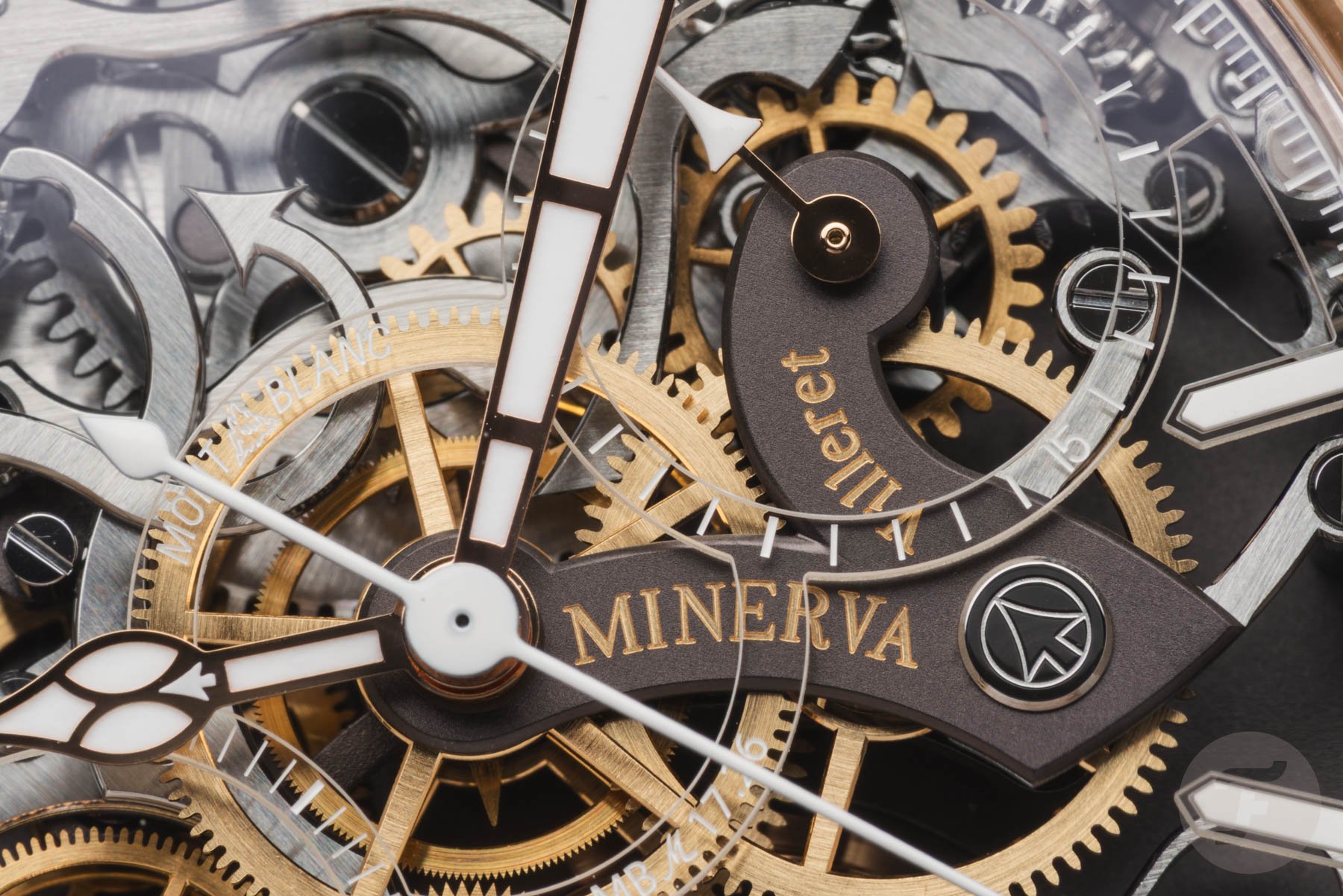
The “devil’s tail” and the V-shaped bridge of the modern caliber MB M17.26
The movements shared a high level of finishing. They stood out with their trademark V-shaped bridge and “devil’s tail,” the latter of which is, in fact, the arrow in the brand’s historical emblem that honors the Roman goddess of crafts (among other things, such as wisdom and war). The distinctive V shape of the bridge is inspired by the towering mountains outside the watchmaking atelier in Villeret.


Following the Richemont acquisition, the first watches produced by Minerva under the Montblanc name debuted as the Villeret Collection. These highly complicated, top-tier timepieces retained Minerva’s historical design language. They also shared one defining trait — an extraordinary level of manual finishing.


To this day, many of the tools and machines used a century ago are still in operation, resulting in a degree of hands-on craftsmanship that is exceptionally rare in modern watchmaking.

Regulation of a balance wheel with an in-house hairspring
Another distinctive strength of Minerva is its ability to manufacture hairsprings, an expertise possessed by only a handful of watchmaking brands. Since the hairspring is central to a movement’s accuracy, most of the industry relies heavily on a few specialist companies producing them. Minerva’s production volume is minimal; thus, the manufacture reserves its hairsprings exclusively for movements made in Villeret.
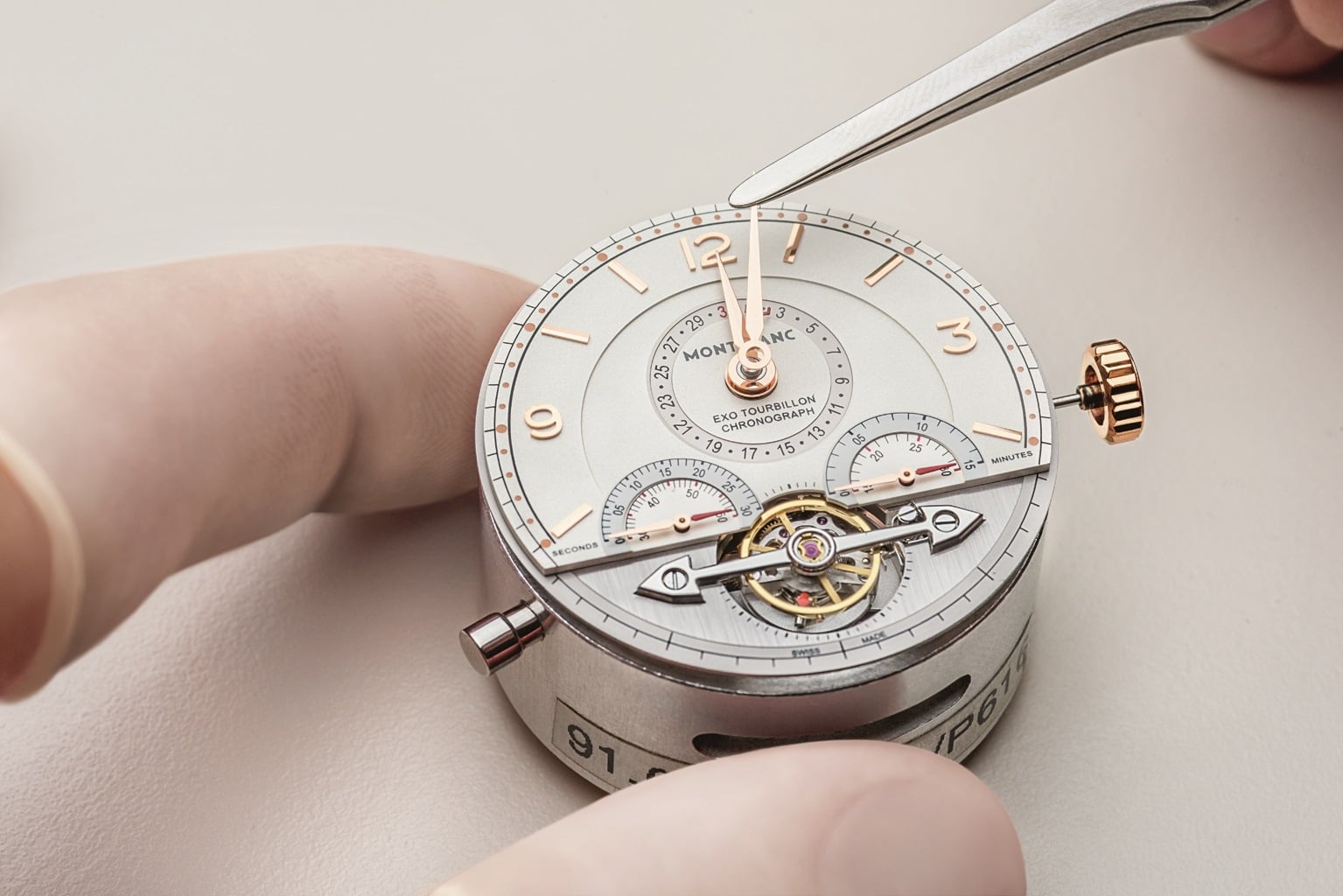
Assembly of the 2010 Montblanc Villeret Exo Tourbillon Chronograph
Special from the start
From the moment Montblanc had the opportunity to use Minerva’s expertise, surprising and remarkable watches started to appear. Take the 2010 Exo Tourbillon Chronograph, for instance, which was part of the Villeret collection. The Exo Tourbillon differs from a traditional tourbillon in one key respect: the balance is outside the tourbillon cage rather than within it. Freed from the constraints of a surrounding cage, the balance can be larger while the cage itself becomes smaller. A larger balance improves precision, while a smaller, lighter cage reduces the energy required to drive the tourbillon. It also looks spectacular.
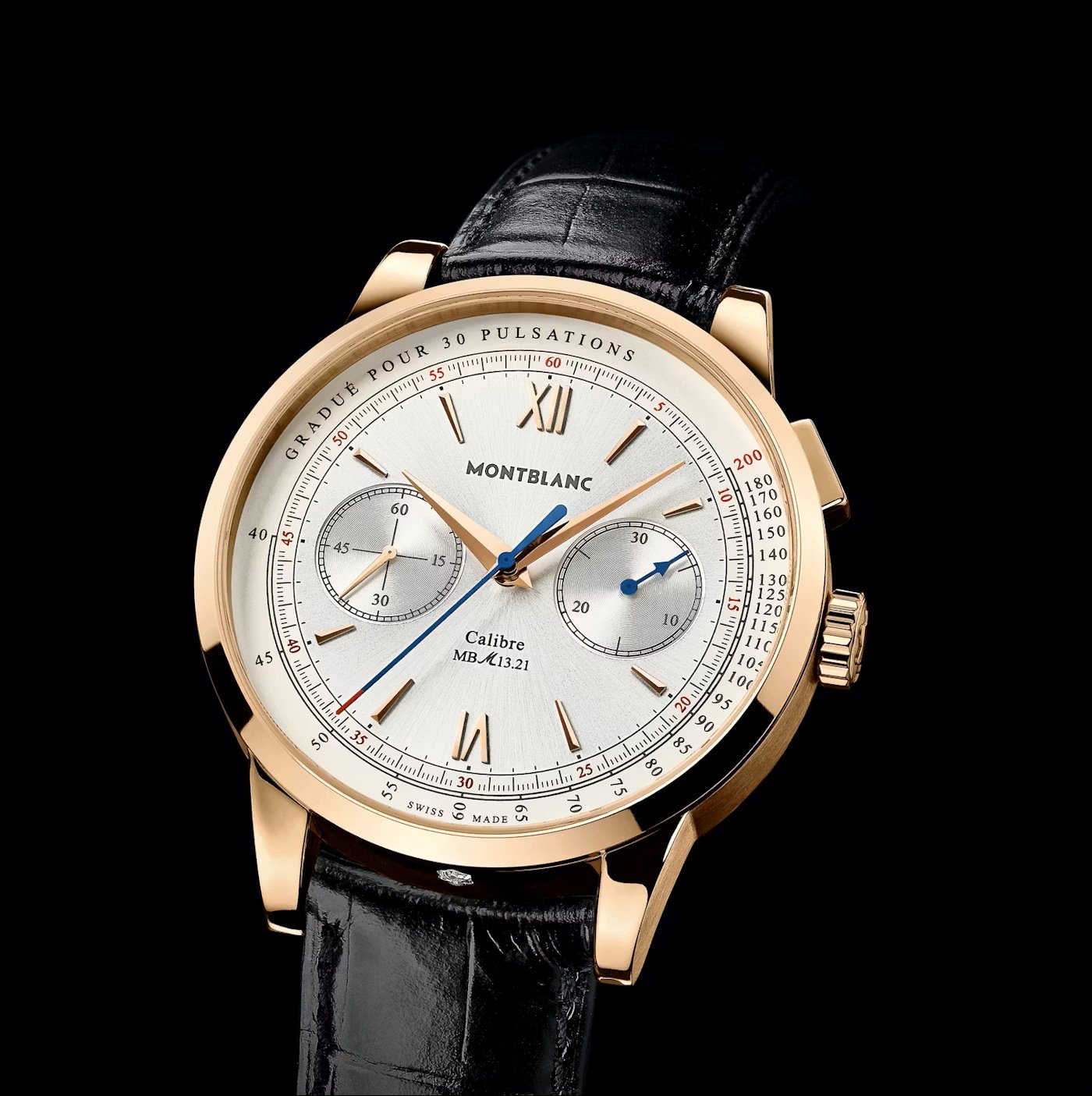
Montblanc Meisterstück Heritage Pulsograph from 2014
The first watch to blend Minerva’s craftsmanship with a distinctly Montblanc aesthetic was the 2014 Meisterstück Heritage Pulsograph. It featured a contemporary case, a classically styled dial, and the modern Minerva 13.21 movement.
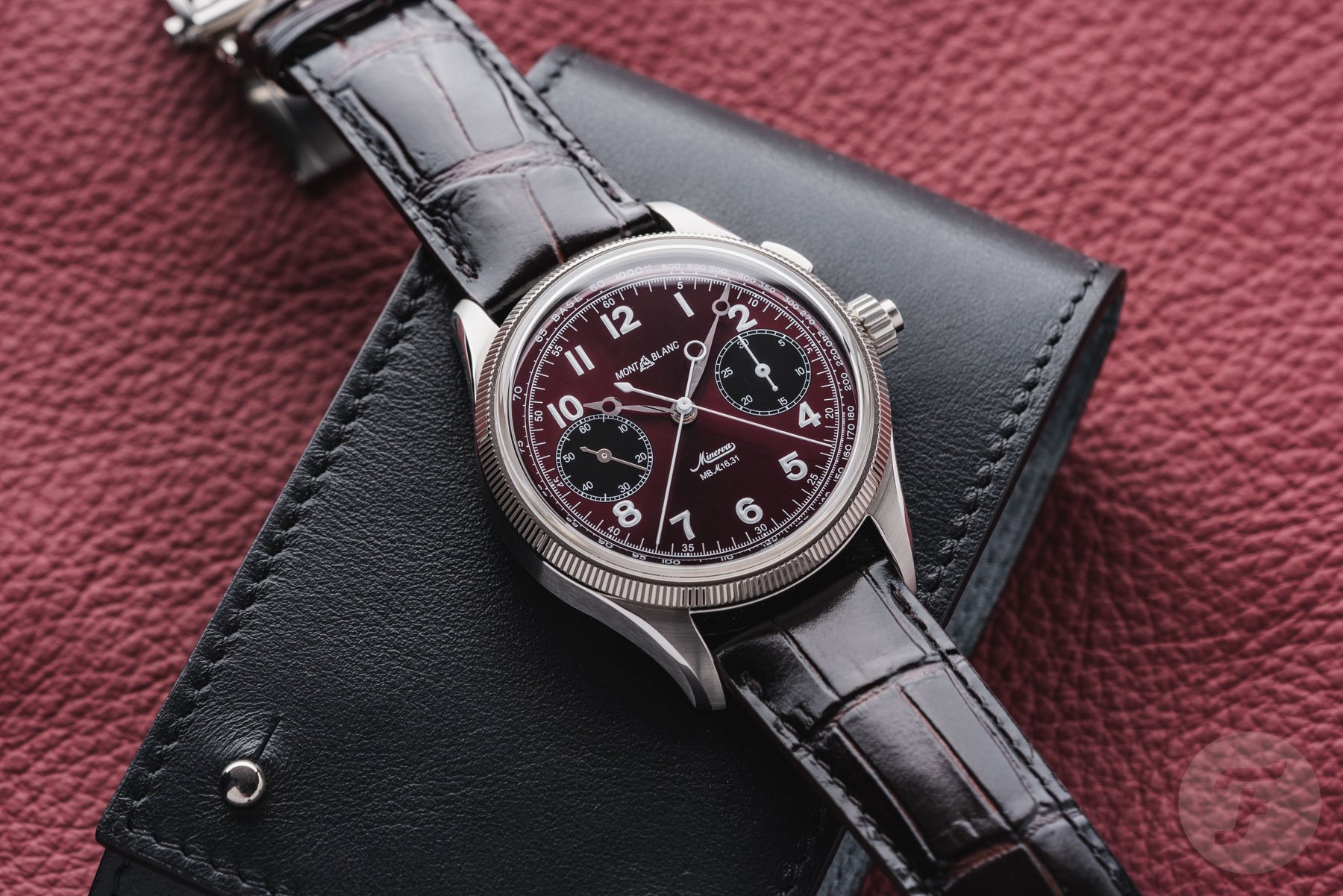
The 2025 Montblanc 1858 Split Second Chronograph Limited Edition in steel
Caliber MB M16.31: A split-second chronograph movement that doesn’t age
In 2019, Montblanc introduced the first edition of a traditional split-second chronograph powered by the newly developed MB M16.31. As with all modern Minerva movements, the MB M16.31 is meticulously decorated by hand to a standard rarely matched in serial production. The inaugural version featured a black dial paired with a bronze case, and Montblanc has released several additional case-and-dial combinations since then.


The newest iteration debuted earlier this year. The Montblanc 1858 Split Second Chronograph Limited Edition in Burgundy is a steel version featuring a white gold fluted bezel and a smoky burgundy dial, limited to 100 pieces. This 44 × 15.2mm watch is impressive and charismatic in equal measure.


The movement is also impressive. A look through the case back’s sapphire crystal reveals Geneva stripes, perlage on the base plate, and bridges in rhodium-plated German silver. Furthermore, there is inner anglage to enjoy, plus polished bevels, black polishing, circular graining, and a host of other old-school techniques applied by hand.
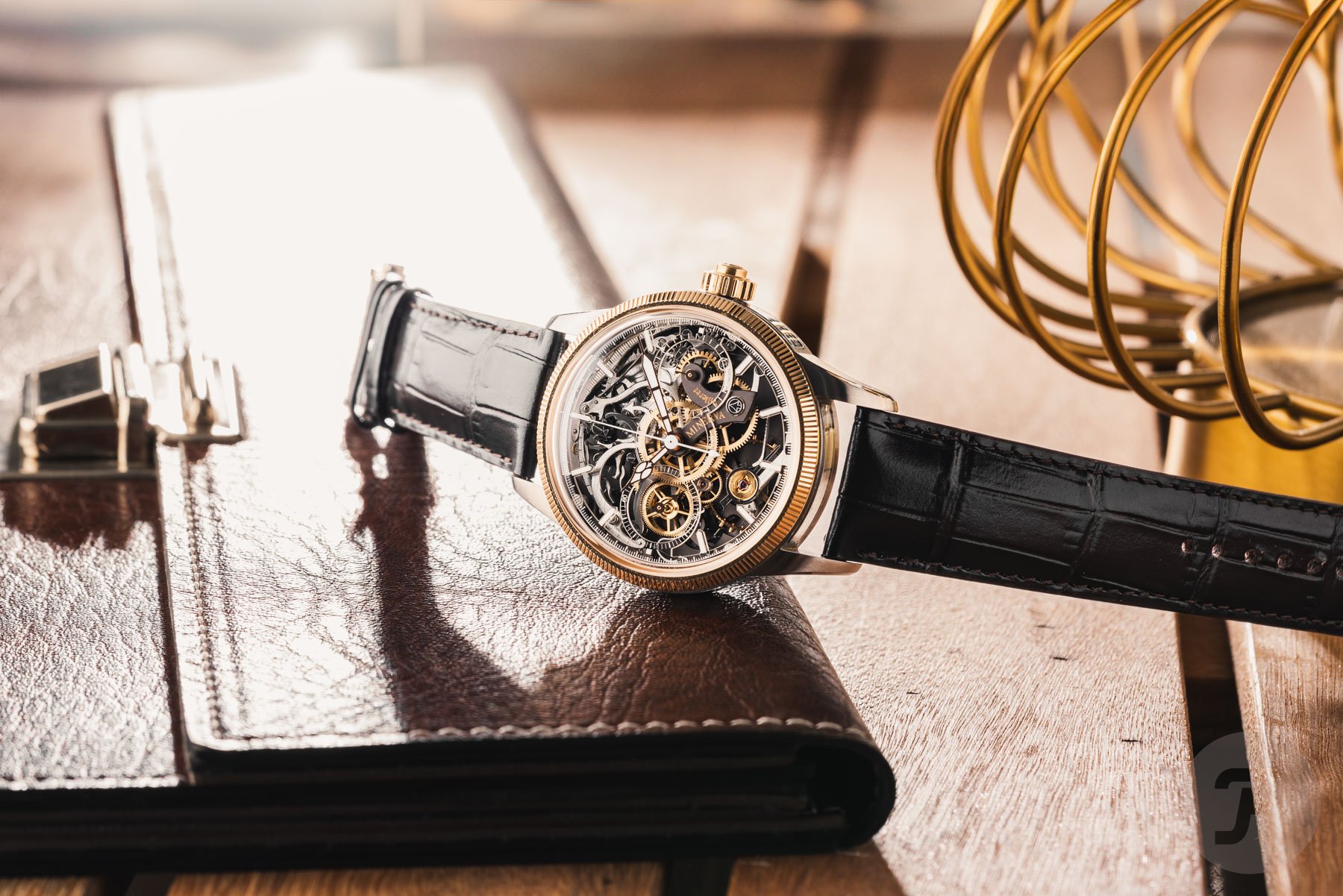
1858 Unveiled Minerva Chronograph Limited Edition in steel and yellow gold
Full disclosure
Earlier in 2025, Montblanc released the 1858 Unveiled Minerva Chronograph Limited Edition in steel and yellow gold. The concept of the watch turns everything on its head. The back has become the front and vice versa. Why? Because the beauty of a Minerva caliber is worthy of being the face of a watch, and you don’t really want to hide the caliber’s most recognizable feature: the arrow.


The MB M17.26 caliber inside the watch has a history reaching back to the 1930s. This movement stems from the classic Minerva 16.29, which is, in turn, based on the original Minerva 17-ligne caliber 17-29 from nearly a century ago. And when you go even further back to 1908, you will find Minerva’s first chronograph movement, the caliber 19-9.


Not only is the positioning of the movement quite something, but so are the movement’s colors. Brown-coated German silver bridges and plates, combined with the traditional untreated German silver finish, create a look that’s a bit vintage yet adds a lavish touch to the classic appearance of the finely fluted yellow gold bezel.
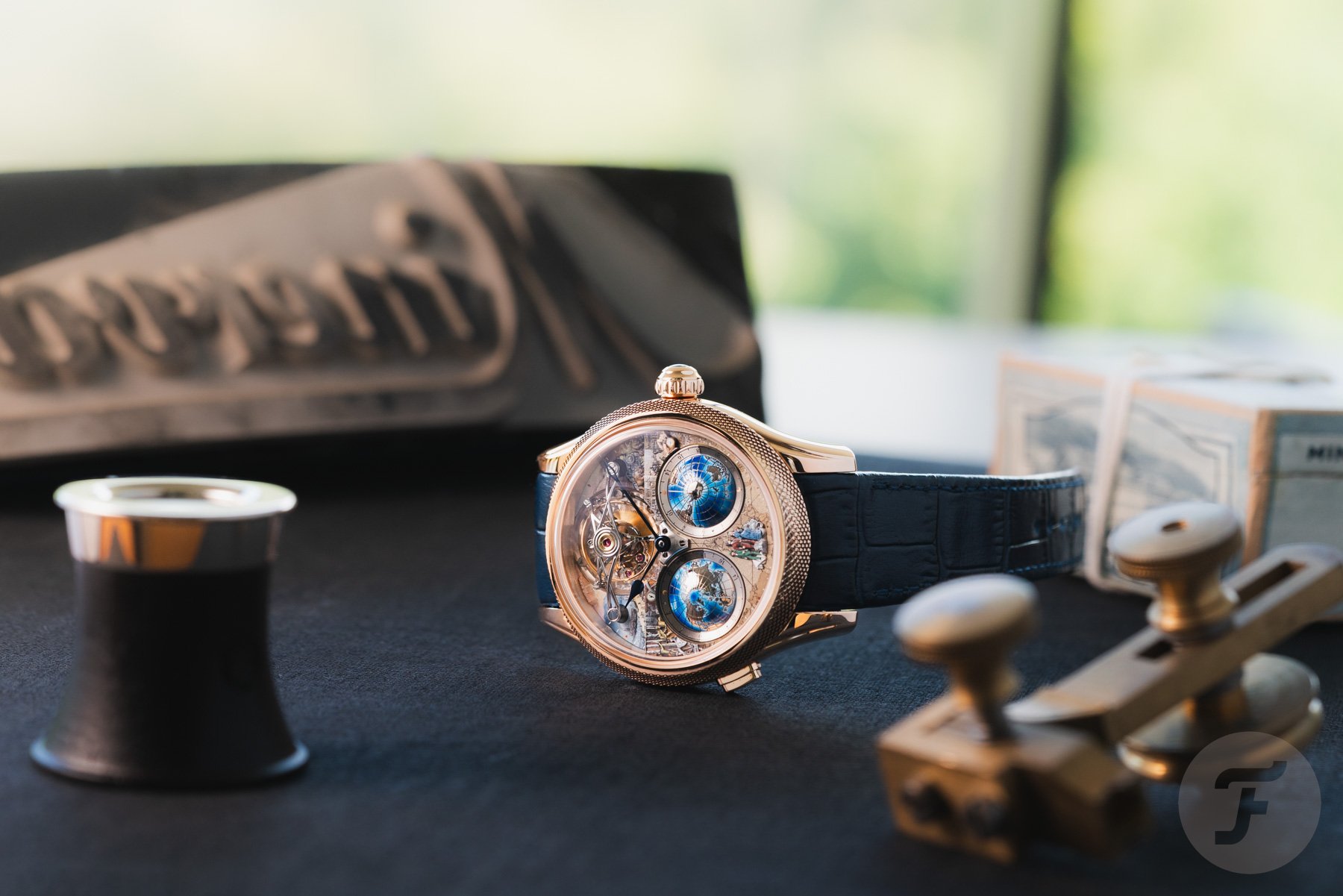
1858 Cylindrical Tourbillon Geosphere Around the World In 80 Days Limited Edition – Chapter Three
Minerva is more than chronographs
Minerva has an excellent reputation in chronographs, but in the present, and quite possibly the future, it will also go down in history as the creator of exclusive tourbillons. Only this year, two extraordinary timepieces debuted — the 1858 Cylindrical Tourbillon Geosphere Around the World In 80 Days Limited Edition – Chapter Three and the Star Legacy Suspended Exo Tourbillon Château de Versailles. By the way, with the 1858 collection, Montblanc honors the year of Minerva’s birth.


The limited edition of three pieces is the final edition of the trilogy of Haute Horlogerie creations inspired by Jules Verne’s novel Around the World in 80 Days. The final chapter of this timepiece trilogy portrays the final leg of Phileas Fogg’s and his loyal French valet Jean Passepartout’s legendary adventure. The watch features a hand-crafted, very exuberant storyboard, and the movement is also quite something. It features a cylindrical tourbillon, a showcase of horological artistry and finesse. The tourbillon has a three-dimensional, doubly curved bridge with a convex profile that visually echoes the dial’s twin globes. And beneath this sculptural bridge, the large tourbillon cage completes a full rotation every 60 seconds.


Crafting and polishing each movement bridge of the caliber MB M68.4 requires more than seven days of meticulous, hands-on work by a master watchmaker, resulting in a flawless finish. Notably, each watch is built from start to finish by a single watchmaker. Also, the entire assembly process is performed twice to ensure absolute mechanical and aesthetic perfection.

Star Legacy Suspended Exo Tourbillon Château de Versailles
Return of the Exo Tourbillon
The Star Legacy Suspended Exo Tourbillon Château de Versailles also comes to life in the hands of a single watchmaker and undergoes the same double-assembly process. The opulent watch takes inspiration from The Yew Tree Ball (Le Bal des Ifs), a masquerade ball held in 1745 by King Louis XV of France after the wedding of his son, the Dauphin Louis, to Infanta Maria Teresa Rafaela of Spain. The ball took place in the gilded Hall of Mirrors (Galerie des Glaces) at the Palace of Versailles. Some 1,500 elaborately costumed guests attended it — it reduces the Met Gala to an ordinary children’s party.


Montblanc and Minerva produced eight examples of this watch, each depicting the venue and showcasing a wealth of horological mastery. Caliber MB M16.68 is a 218-part manually wound movement. One highlight is the patented one-minute Suspended Exo Tourbillon with the balance wheel positioned above and outside the tourbillon cage. It’s not a new movement — its Exo Tourbillon origins go back to 2010, remember? — but it continues to impress.

Montblanc Geosphere Annual Calendar Limited Edition in lime gold
A new course for Minerva
Apart from highly exclusive, extremely extravagant, and ultra-limited pieces, Montblanc also presented a Minerva-made watch that is within the reach of a wider audience. The 1858 Geosphere Annual Calendar Limited Edition shows the Minerva name on the movement and the dial. The collection features two intricately designed models, in either lime gold or steel, highlighting fine finishing and handcrafted details. Their 42mm cases feature a blend of polished and brushed surfaces. Fluted steel or lime gold bezels recall historic Minerva models from 1927.


Both models feature silvery-white dials with a central sunray-finished section and an outer blasted surface. The steel piece has blued indexes and luminous hour and minute hands, while the lime gold version contains gold-plated details. Again, note the use of the Montblanc and Minerva names on the dial. For a complex timepiece, the Geosphere Annual Calendar presents a wealth of information clearly and concisely. The outer edge of the dial rotates and contains the names of the months. A red triangle at the top, another nod to Minerva’s history, points to the month. July has been replaced by the word “Minerva” because the brand name was registered on July 30, 1887.
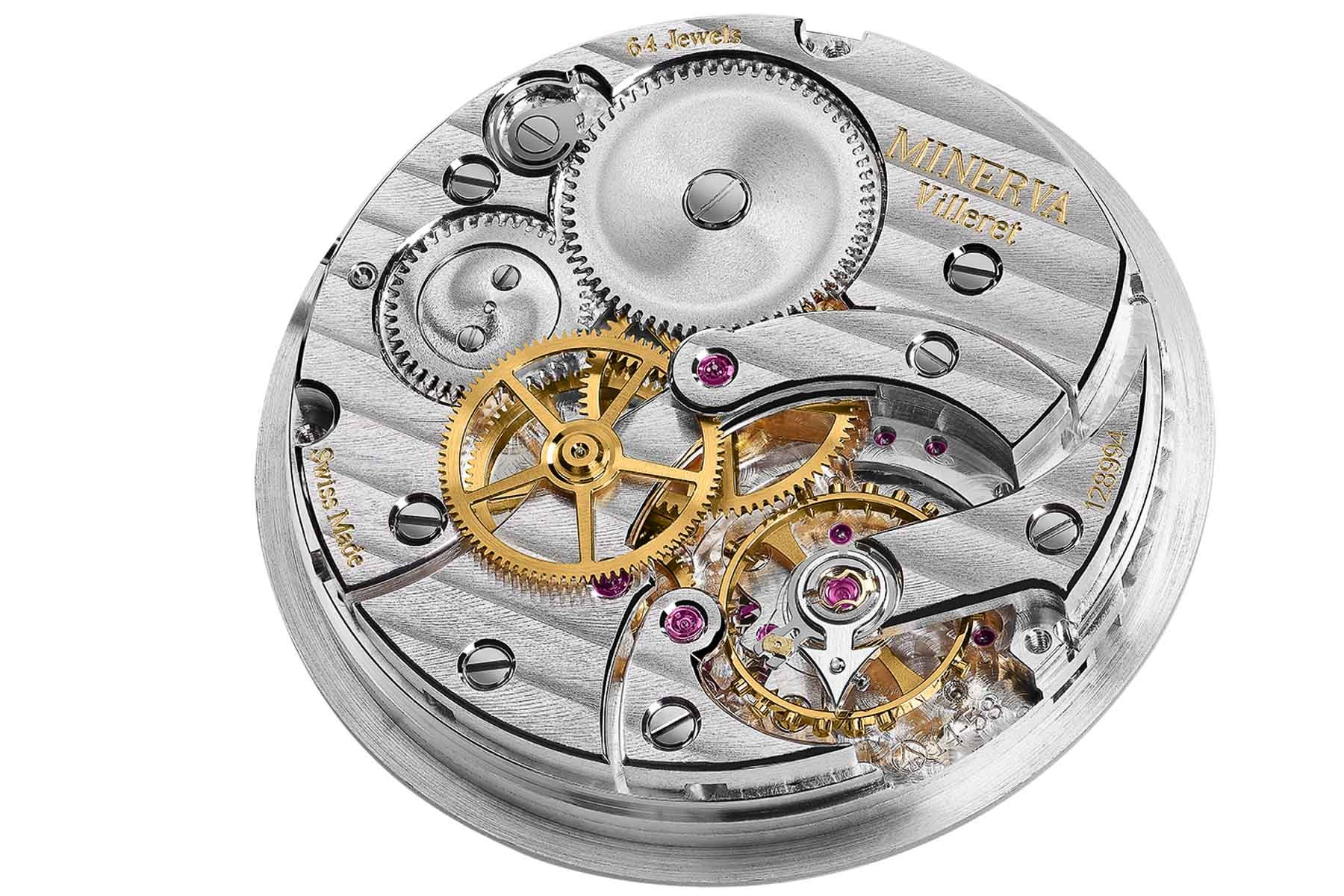
Caliber MB M14.58
Minerva in the Montblanc era — The coming years
In addition to debuting a new watch, Montblanc created a new caliber for the 1858 Geosphere Annual Calendar. The Minerva-signed, 336-part MB M14.58 is a manual-winding movement. It beats with a frequency of 18,000 vibrations per hour and has approximately 65 hours of power reserve. The watch is a next-generation Minerva, but although reaching for a new audience, it does not disregard the manufacture’s past. In other words, the movement features rhodium-plated German silver plates and bridges with Côtes de Genève and snailed finishes. Yellow gold plating was used on the gear train, and the bridges and plates show anglage.


It seems that under Laurent Lecamp, Montblanc’s global managing director of timepieces, writing instruments, and accessories, Minerva is coming into full bloom. There are the famous chronographs that keep Minerva’s heritage alive. But there’s also room for tourbillons, innovations, and artistry to shine. With the introduction of an annual calendar, it seems highly likely that the Minerva name will also appear on upcoming timepieces featuring other, probably surprising complications displayed originally. Surely, 2026 will tell if the expansion of Minerva under the wings of Montblanc continues. I believe that it will.

The 2020 Montblanc 1858 Split Second Chronograph Limited Edition 100 in titanium with a blue enamel dial
This is a preferred-position post. Learn more.