Long-Term Review: Omega Speedmaster Professional 310.30.42.50.01.001

The current Omega Speedmaster Professional Moonwatch 310.30.42.50.01.001 debuted on January 8th, 2021. The Moonwatch received a ton of updates, making many Speedmaster enthusiasts very happy. Those who weren’t hardcore fans, though, mainly found the big price increase from just south of €5,000 to €6,100 surprising.
Updates to the modern Moonwatch
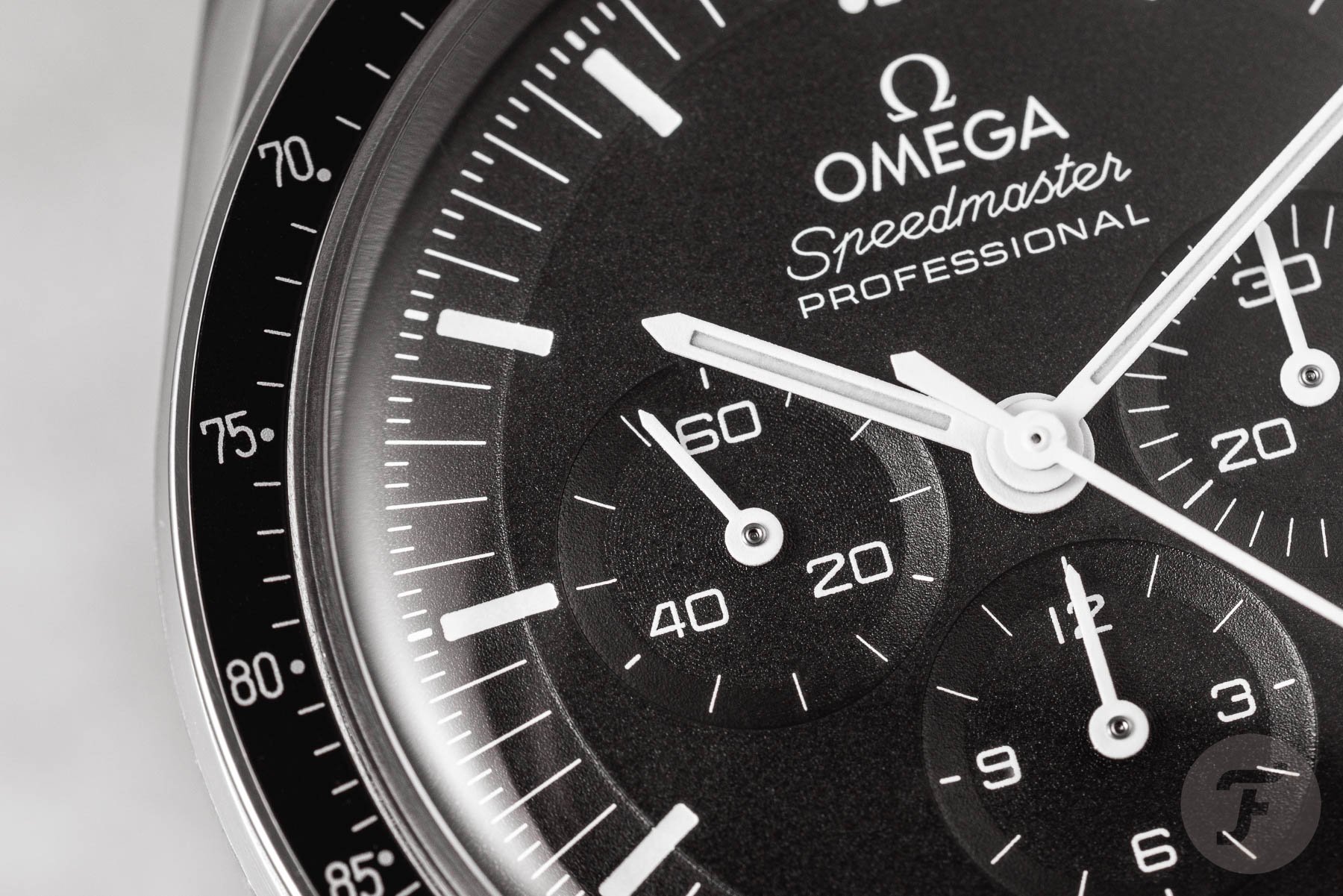
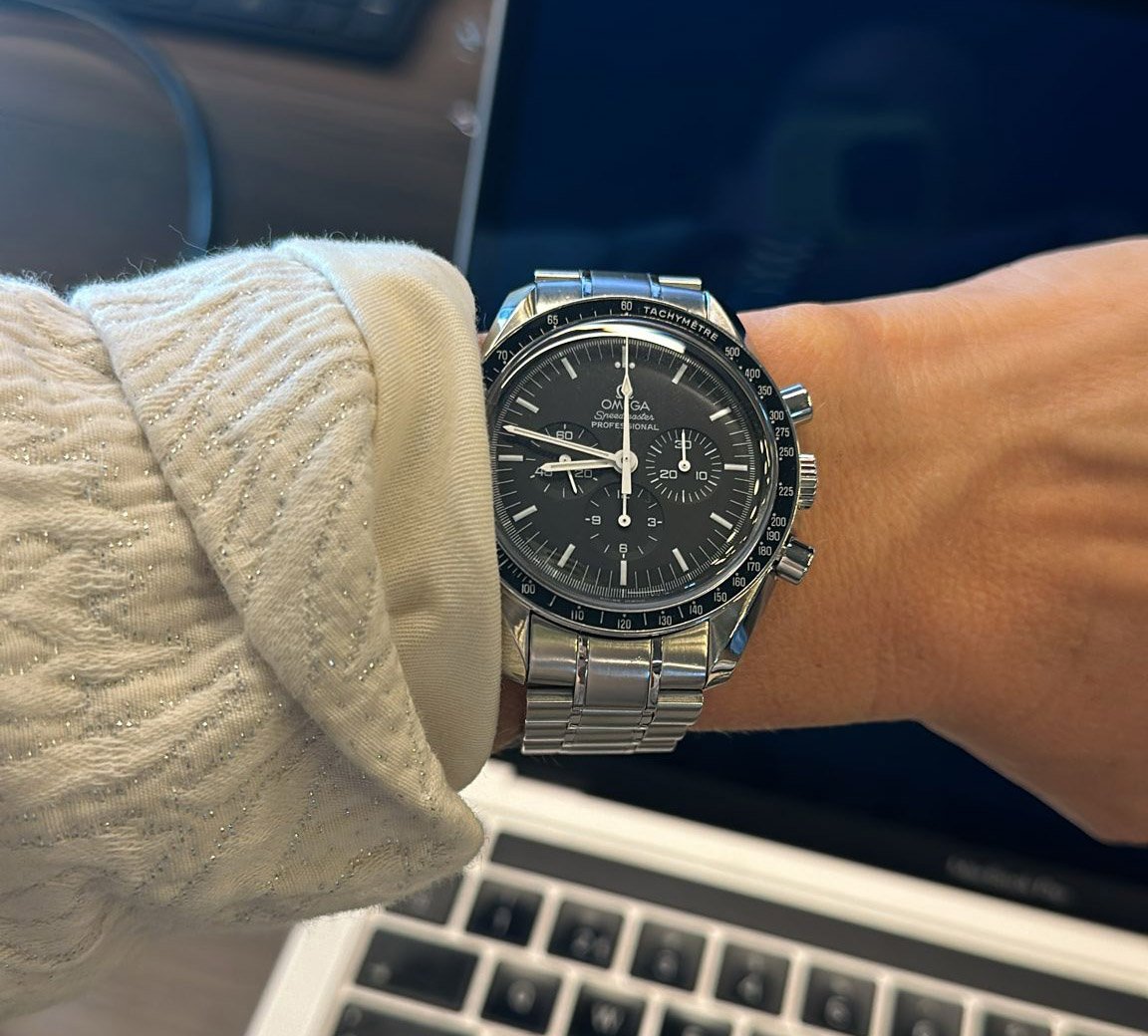
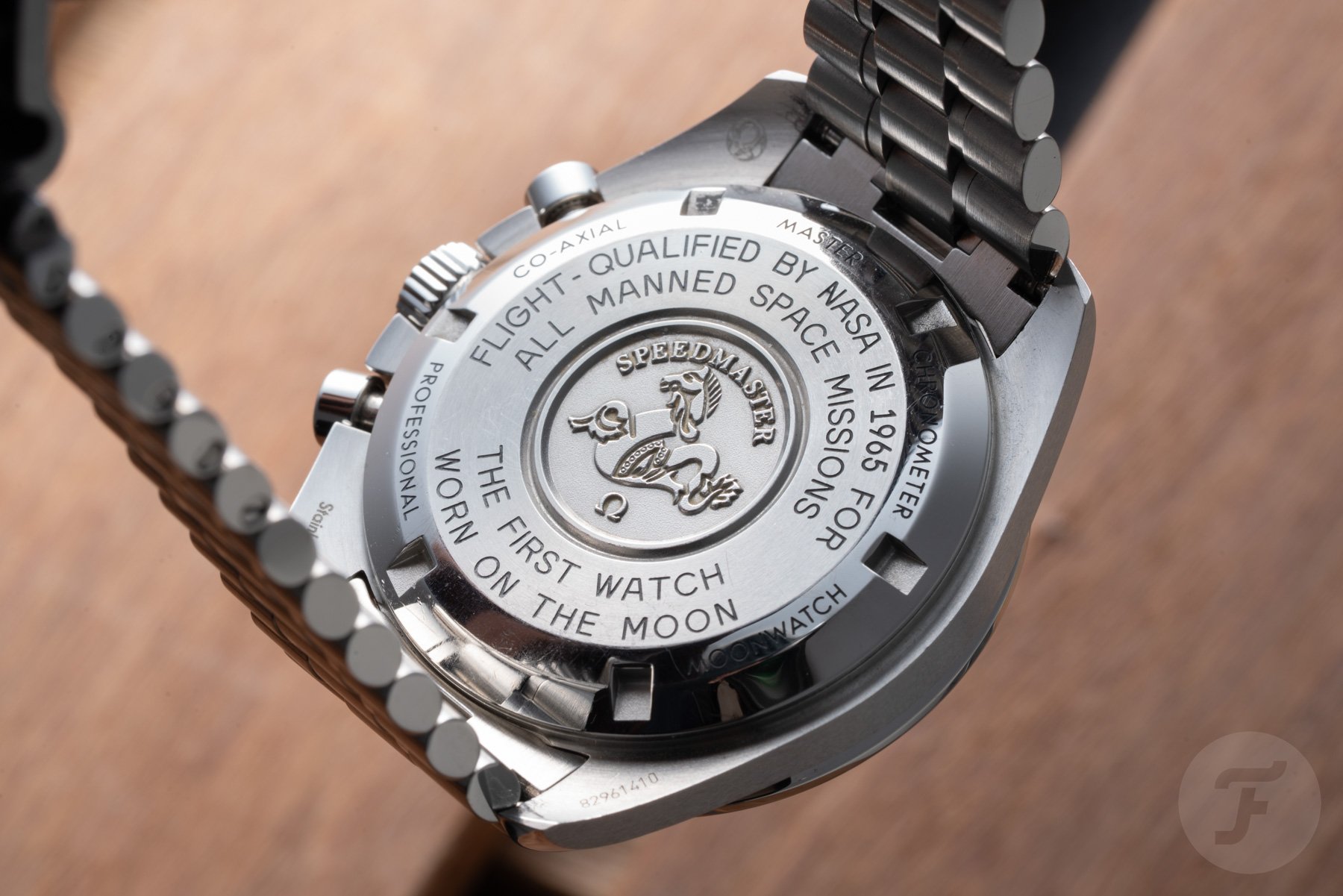
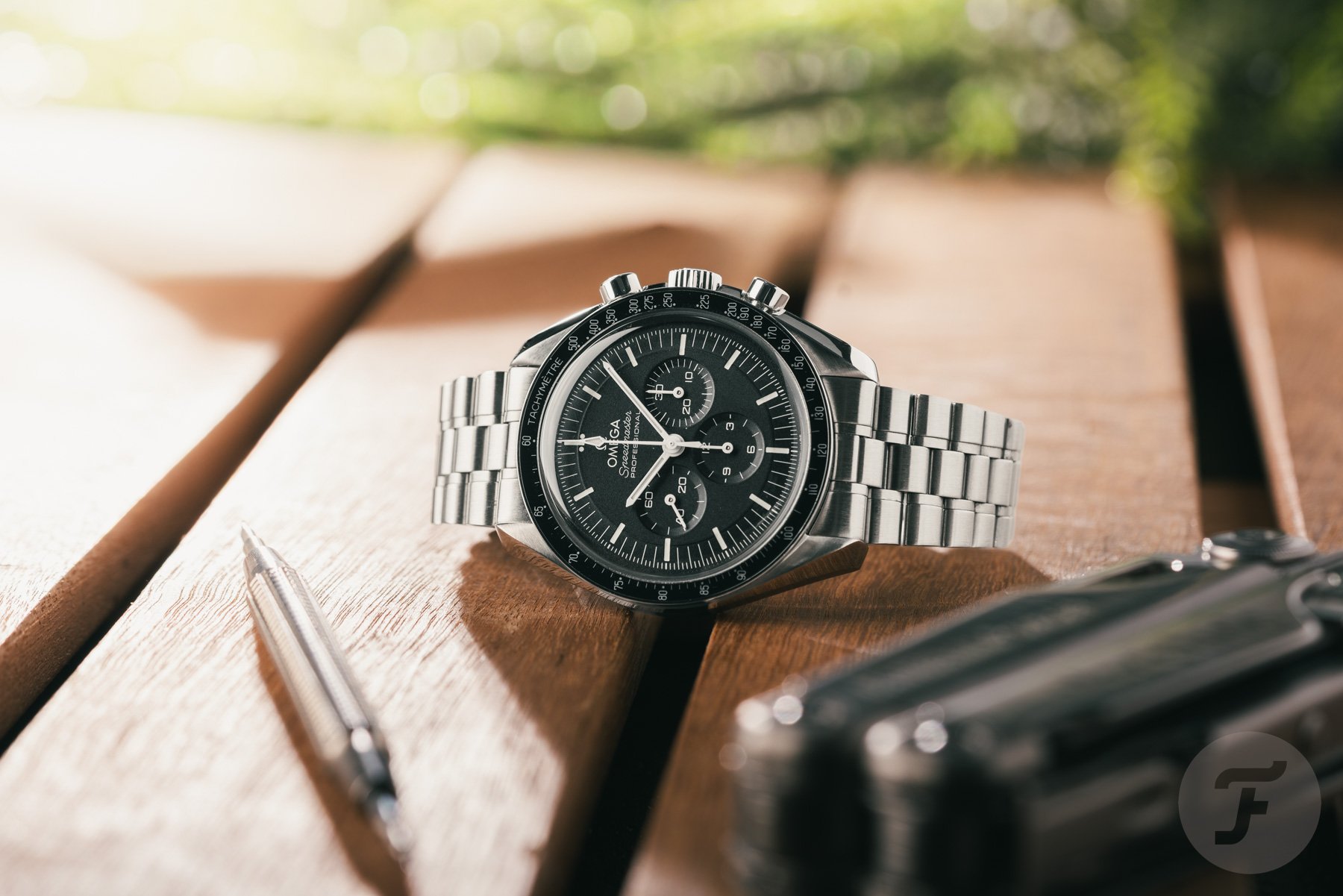
You can read a full comparison between the former model and the current Moonwatch here. In a nutshell, Omega made changes to the case, dial, hands, and bezel. Importantly, the watch also received a long-awaited new bracelet. Basically, everything changed, but the design remained the same. As I own one of the previous models, I waited a few months before buying the new Moonwatch. I simply had to figure out whether I would like the version with the sapphire crystal, dial with an applied logo, and bracelet with polished small links or the one with the Hesalite (acrylic) crystal, dial with a printed logo, and an all-brushed bracelet. And, not unimportantly, the sapphire-equipped version has a display back that shows off the modern Master Chronometer-certified 3861 movement.
The Hesalite will show scratches
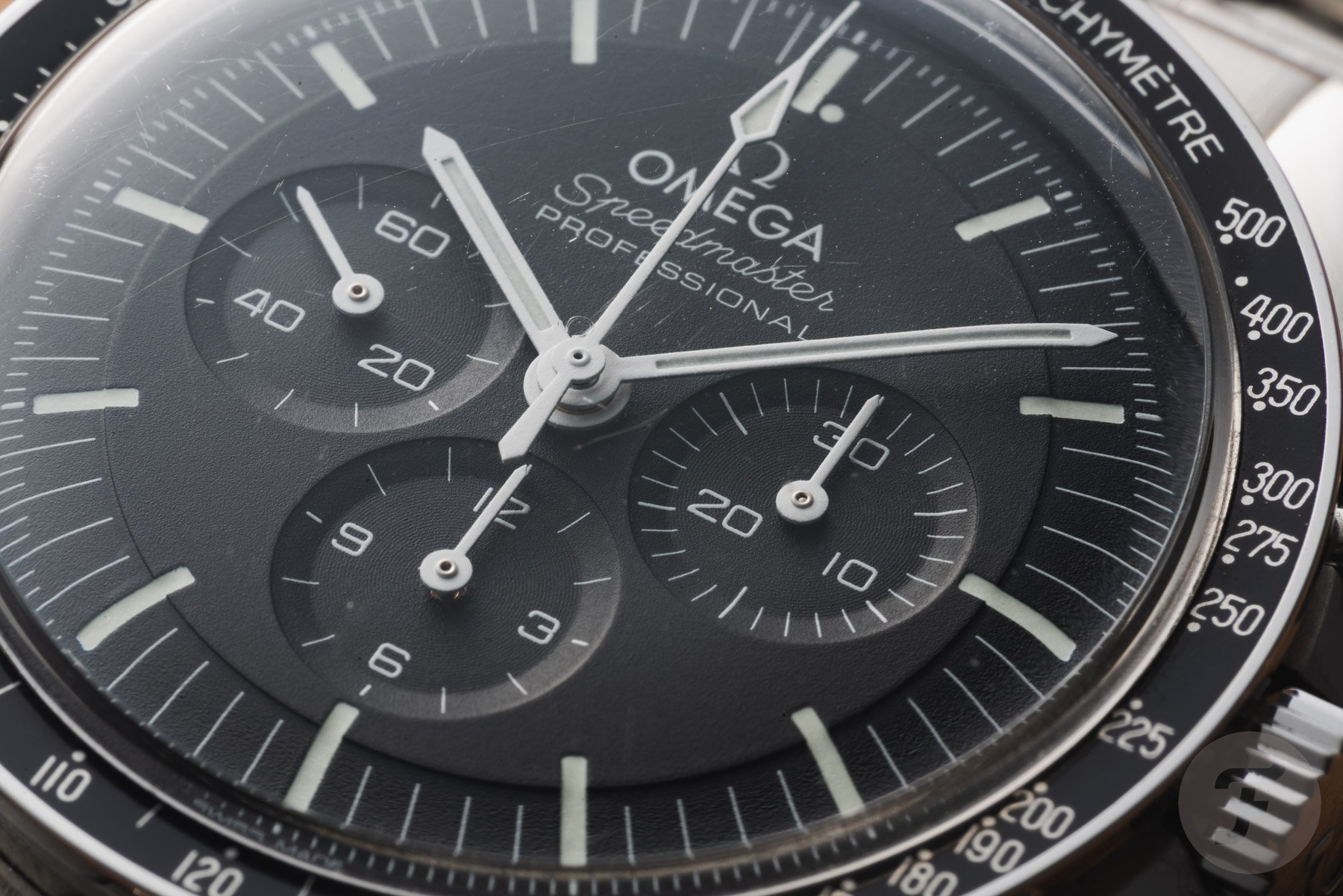
The Hesalite crystal
I decided to go for the “standard” Speedmaster Professional with the Hesalite crystal. The 3861 movement was already on display in my Moonshine Gold Speedmaster. I also have a soft spot for references that are closest to the original Speedmaster (Professional). That said, I would have picked the sapphire model if I didn’t already have the Moonshine Gold version. Omega informed me that the current Speedmaster Professional Moonwatch with the sapphire crystal is selling better than the Hesalite version. It’s the first time this has happened with the Moonwatch. Previously, the Hesalite model was always the most popular variant.
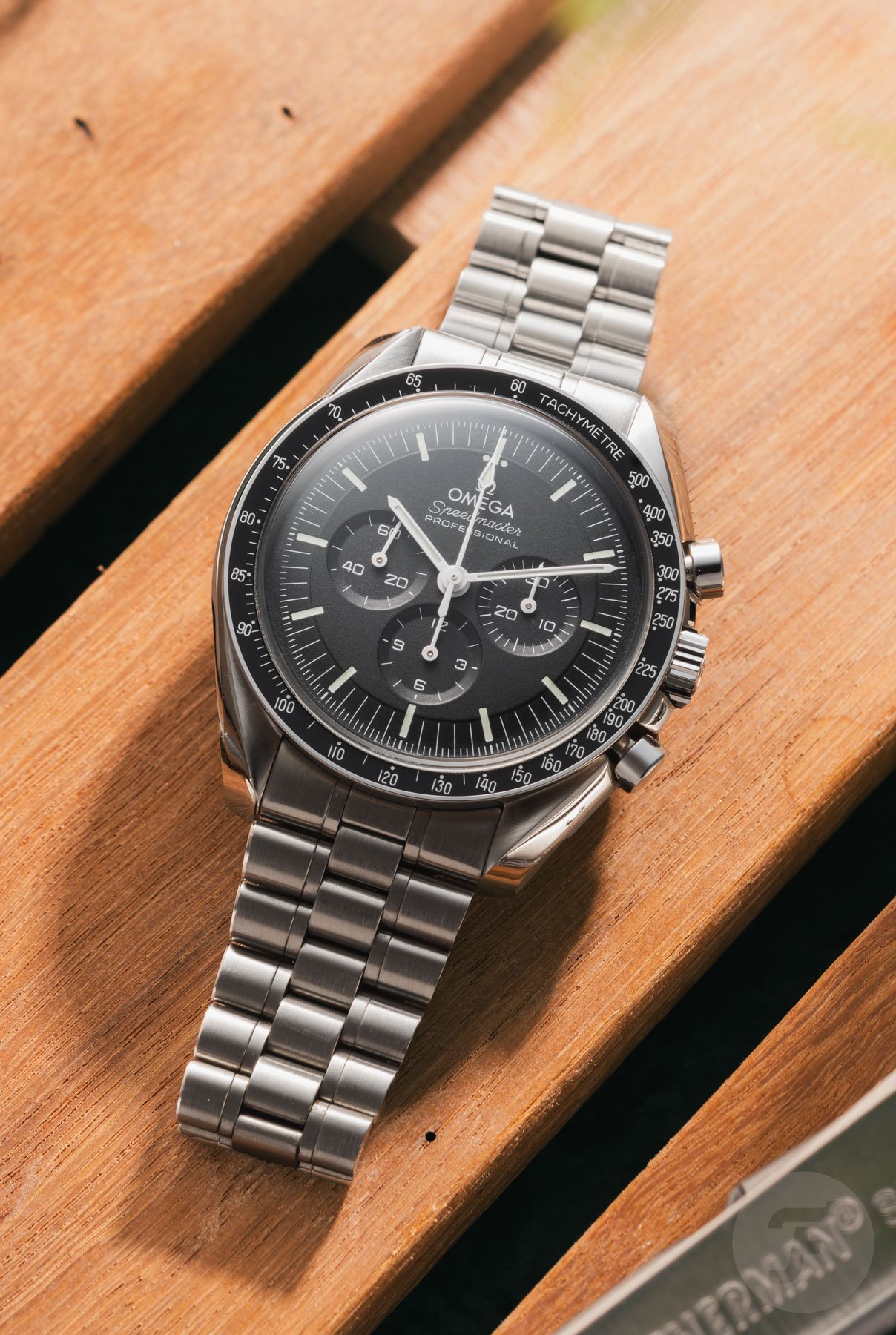
Five years with the Speedmaster Professional 310.30.42.50.01.001
Since I don’t want to repeat the info from our previously published articles, let’s get on with my long-term review. It’s fair to note that this watch has not been my daily watch over the last five years. In the distant past, the steel Speedmaster Professional 145.012 and the more modern 3570.50 were part of my daily rotation schedule, but this one hasn’t been. My Speedmaster Professional Moonshine Gold and Speedmaster Calibre 321 have a bit more mileage on them. That said, I have worn the Speedmaster Professional 310.30.42.50.01.001 on many occasions, and it is always within reach. As it suits nearly any occasion or dress code, it’s an easy pick.
The watch has its scuffs and scratches, but none of them are truly bothersome. The Hesalite crystal could use a light polish, but it’s not in such bad shape that it needs one.
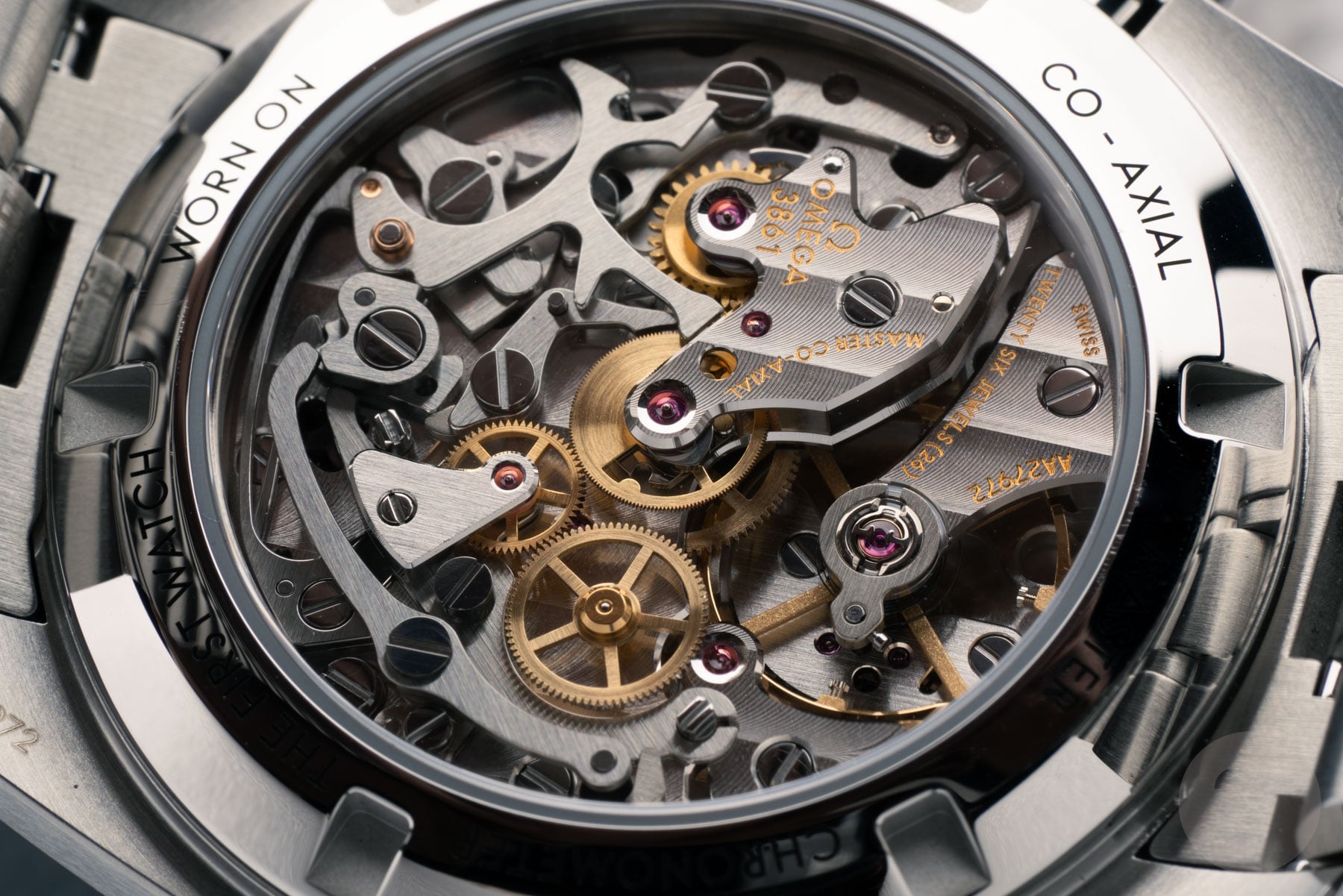
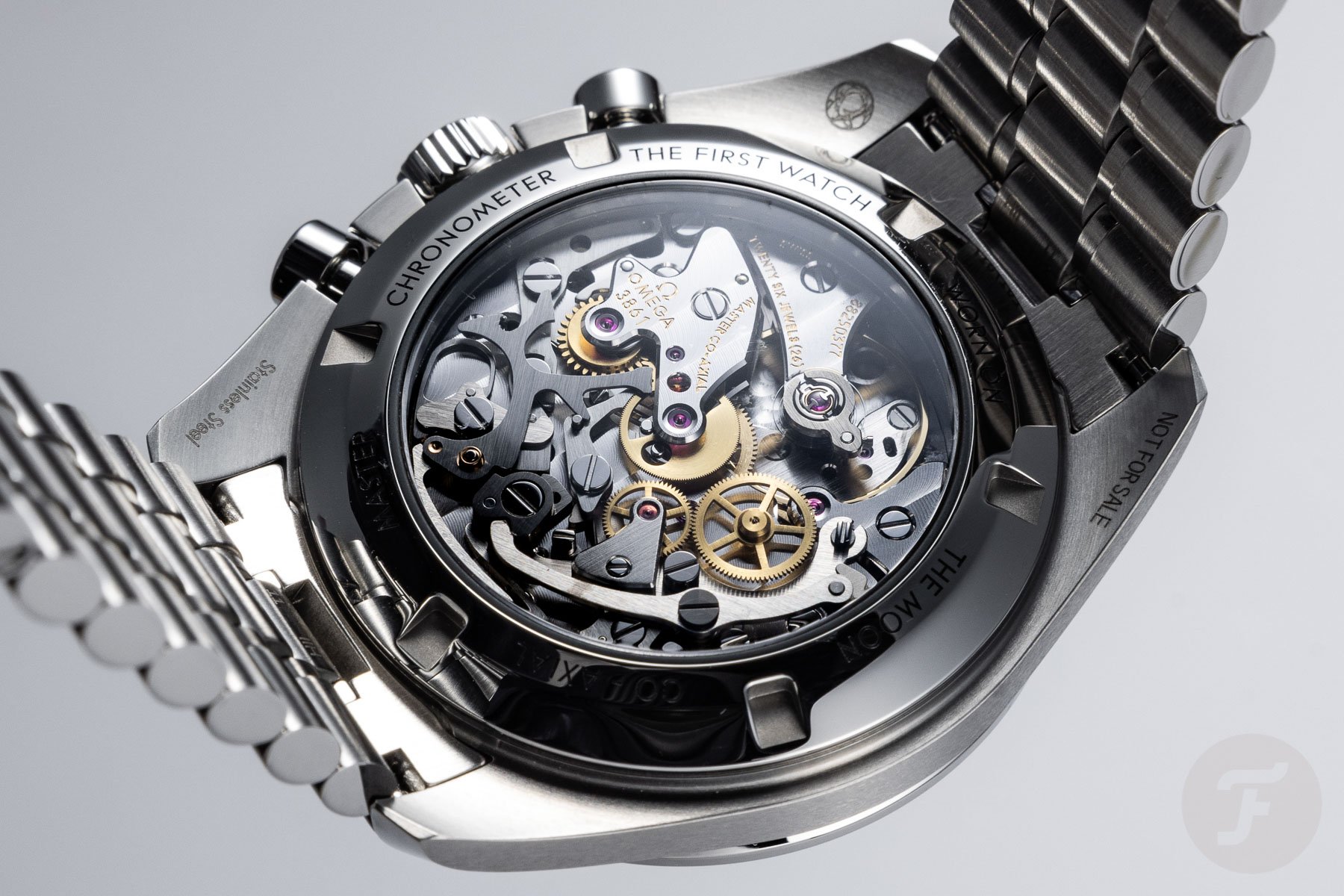
Caliber 3861 (not from this watch)
Chronometric performance
After five years of ownership, let me start with a few words on accuracy. Whereas its 1861-powered predecessor had an accuracy standard of -1/+10 seconds per day according to Omega back then, this Master Chronometer-certified movement should perform between 0 and +5 seconds per day on average. I recently put my Speedy Pro 310.30.42.50.01.001 on our timegrapher in the Fratello office, and it showed a rate of +4 seconds per day with the dial up (horizontal) and +2 seconds per day with the crown down (vertical). I didn’t measure in any other position, as I think these are the most common positions for my watch to be in.

The METAS Master Chronometer certificate for my Speedmaster Professional
Amplitude
The amplitude, which is always a good indicator of whether the watch needs service, ranged from 335 to 340 degrees, depending on the position of the watch. It’s all within the official Master Chronometer specifications, and the amplitude seems fine to me. My rule of thumb is that when the amplitude drops 270 degrees in a modern watch, it’s time to keep an eye on it. I also set the lift angle to 36 degrees when monitoring the accuracy. Update: At first, I stated 50 degrees, but this is not correct for this Co-Axial movement. The read-out on the amplitude is therefore also incorrect.
The lift angle’s value can be set in most timegrapher devices. It is the number of degrees of the arc the balance wheel has to turn while making contact with the pallet fork. You need to look up the number for the movement that’s inside the watch you want to measure, but you will find charts online that have this information. You can forget all about these details, but just know that using the correct lift angle is necessary to get a proper read-out.
I am not overly critical of my watches’ accuracy, as I rotate quite a bit. However, I do feel that if a brand claims to have very precise movements, the watches need to live up to that claim.
Step dial and printing
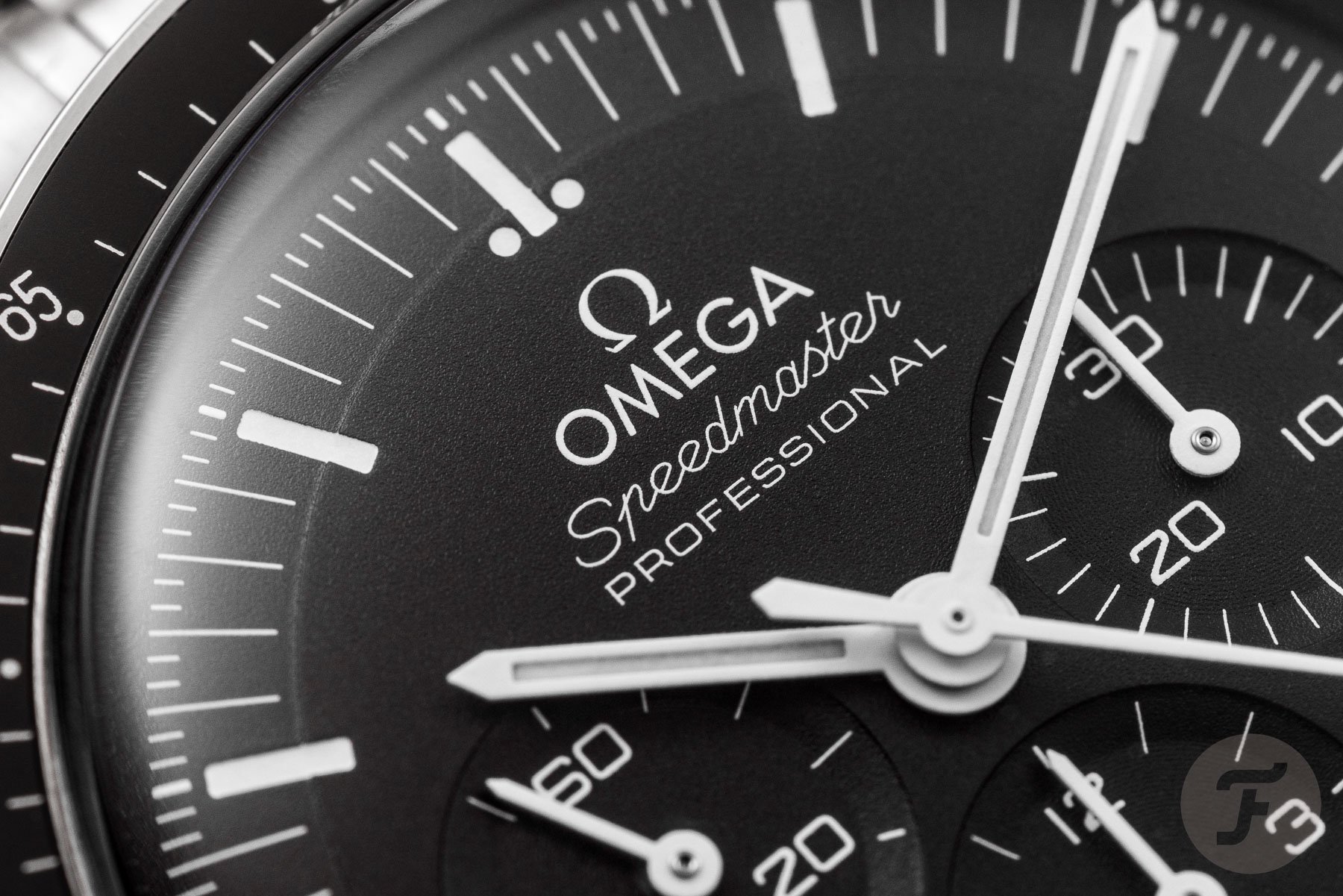
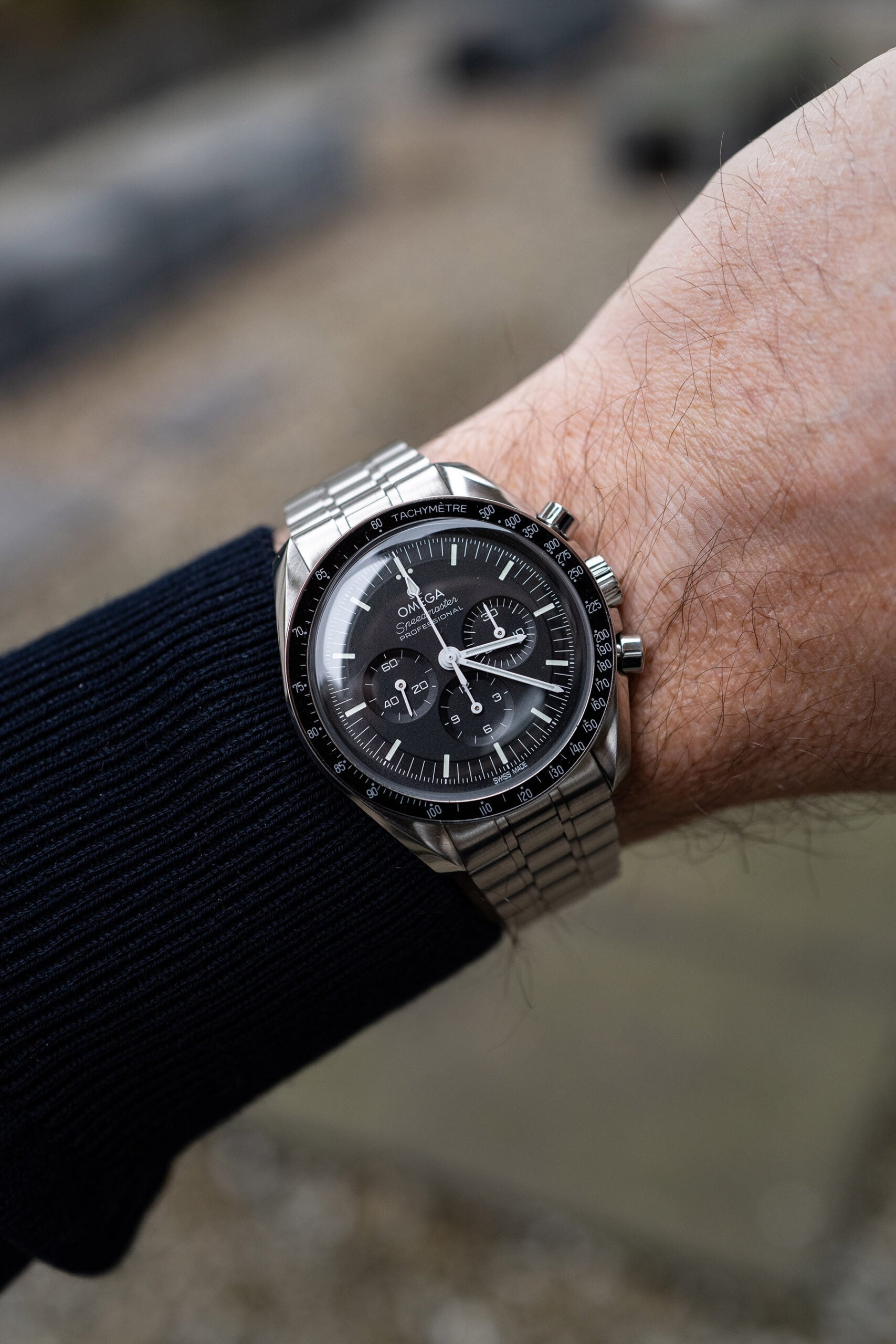
One of my concerns when the new references came out in 2021 was the dial printing. This changed slightly from the previous generations. Now, the “Speedmaster” and “PROFESSIONAL” wording are the same width on the dial rather than having the triangular shape they did in the past (the logo, “OMEGA,” “Speedmaster,” and “PROFESSIONAL” text went from narrow to wide). I wasn’t too sure this would bother me in the long run. After five years, I can tell you that it doesn’t, but I do feel the printing of the previous generations is more subtle. The current model’s step dial does add a bit of a vintage vibe, just like the drop counterweight on the chronograph’s seconds hand.
Concentric circles
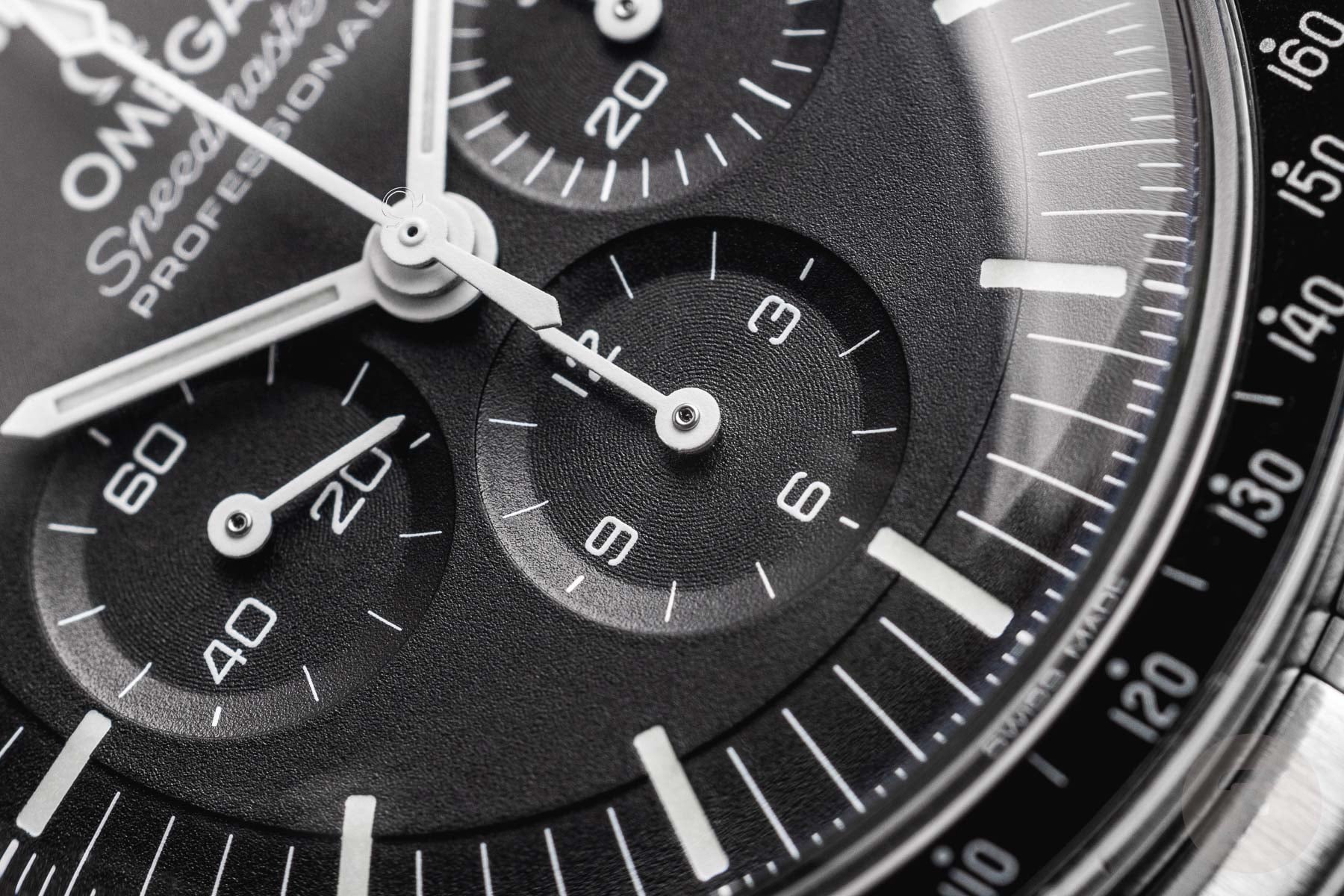
As you may have noticed, several dial variations exist for the current Moonwatch. I am not talking about the colors (black, white, reverse panda, gold, etc.) but about the finishing of the recessed sub-dials. You might find one with concentric circles in the sub-dials, but there are also versions without. Sometimes, you need to use a loupe to identify them. However, it’s also perfectly legit if they are not on there. Omega has been using different dial suppliers, and, weirdly enough, they supply dials based on the same specification with different finishing types. Some have concentric circles, and others don’t. My dial does, but they’re only visible (to me) when using a loupe. That’s one difference with the Speedmaster Calibre 321, which has concentric circles visible to the naked eye without having to squint.
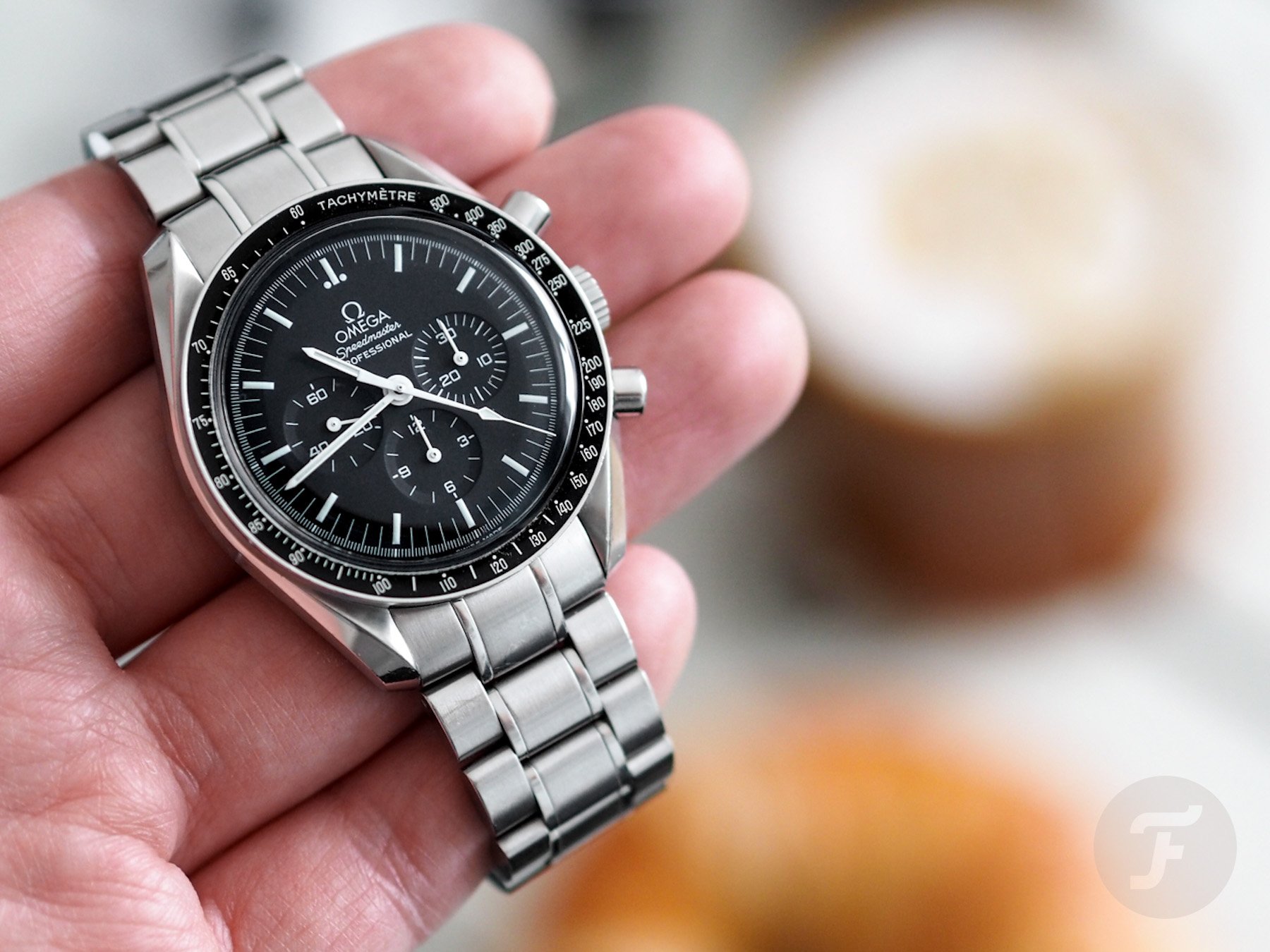
Note the shape of the text on the Speedmaster 3570.50
In any case, the dial of the modern Speedmaster Professional has more depth than its modern predecessors, so that’s a big advantage. Additionally, the drop counterweight of the chronograph’s seconds hand is nicer than the flat end. These factors are more important to me than the wide printing of the “Speedmaster” wording on the dial.
The Nixon bracelet
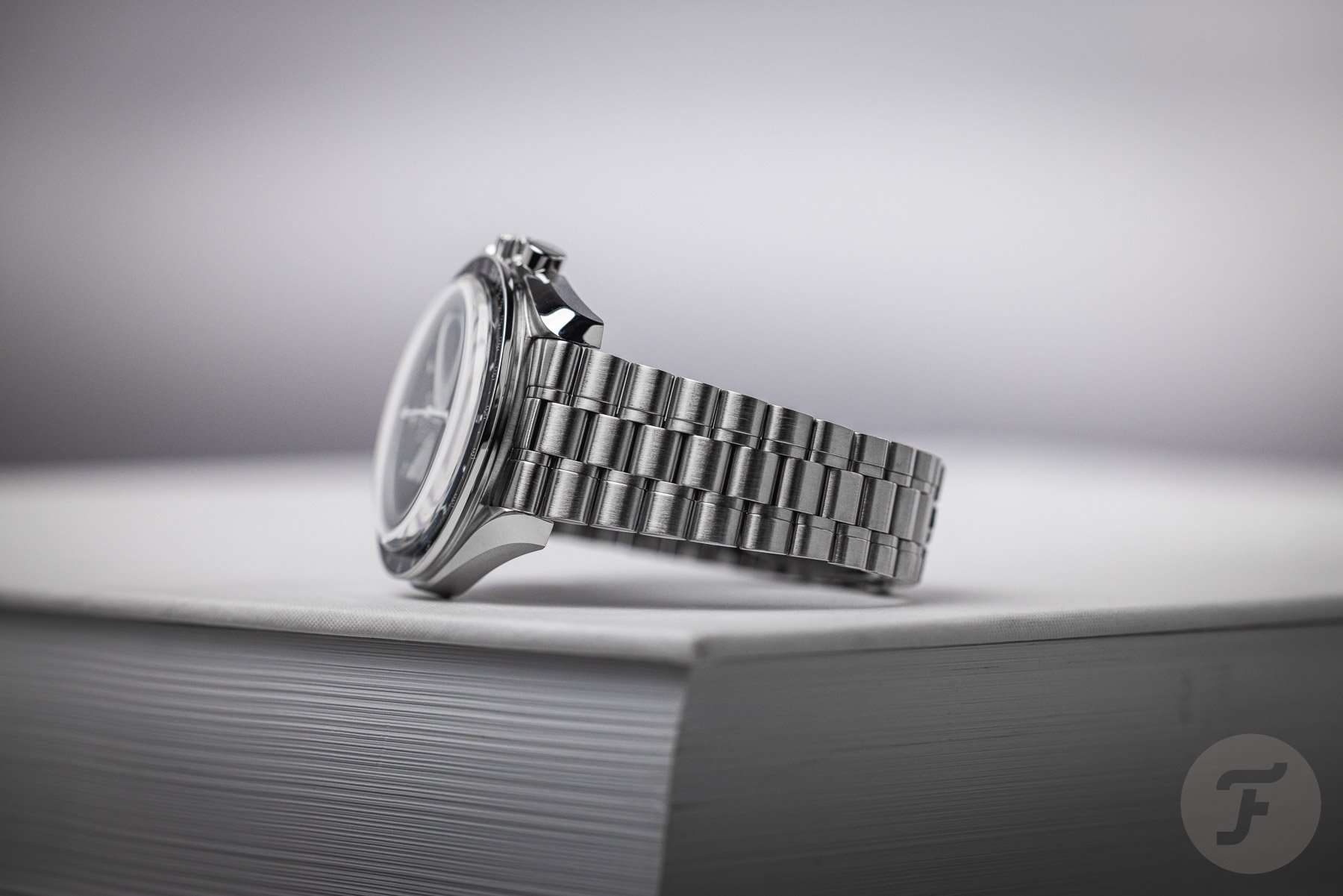
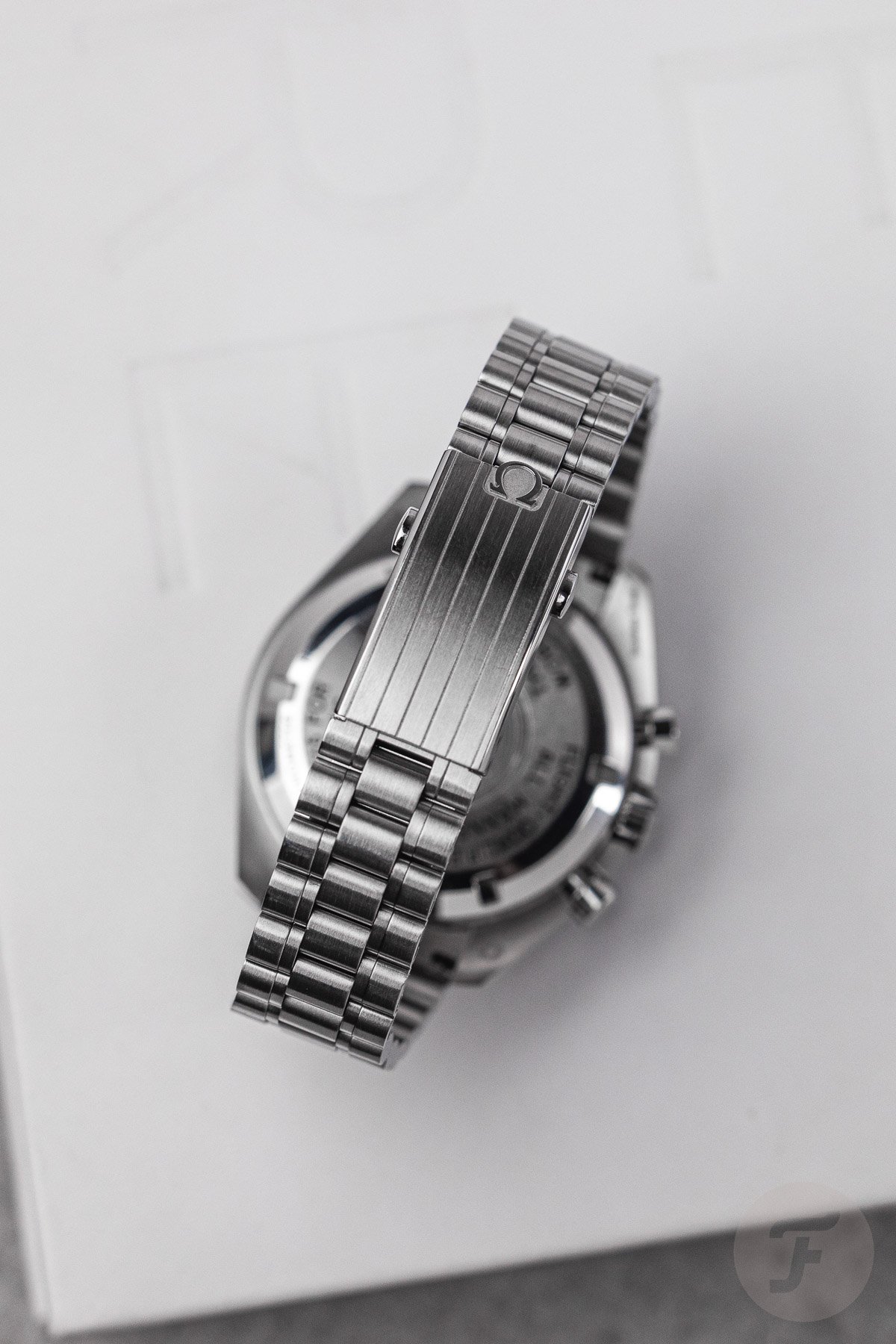
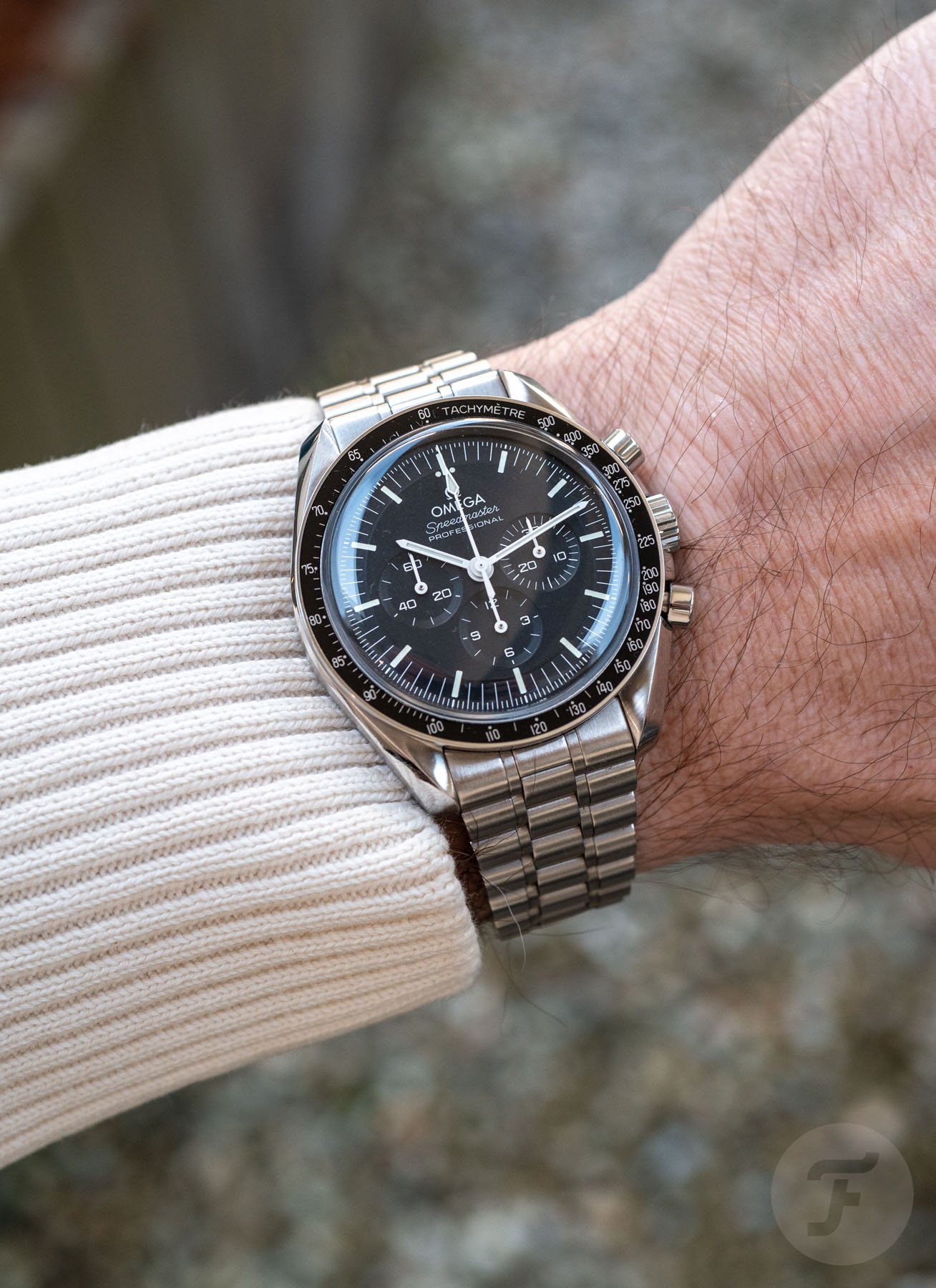
A very obvious update (and upgrade) is the stainless steel bracelet. It’s the same as the one introduced in 2019 on the Speedmaster Professional Moonshine Apollo 11 edition, but the links are a millimeter wider (15mm) at the clasp. It’s an incredibly comfortable bracelet and a significant step up from the previous Omega bracelet used from the mid-1990s until 2020. At first, the new 2021 Speedmaster “Nixon” bracelet (referring to the gold Speedmaster presented to US President Nixon in 1969, which also featured this bracelet style) came without a micro-adjustable clasp.
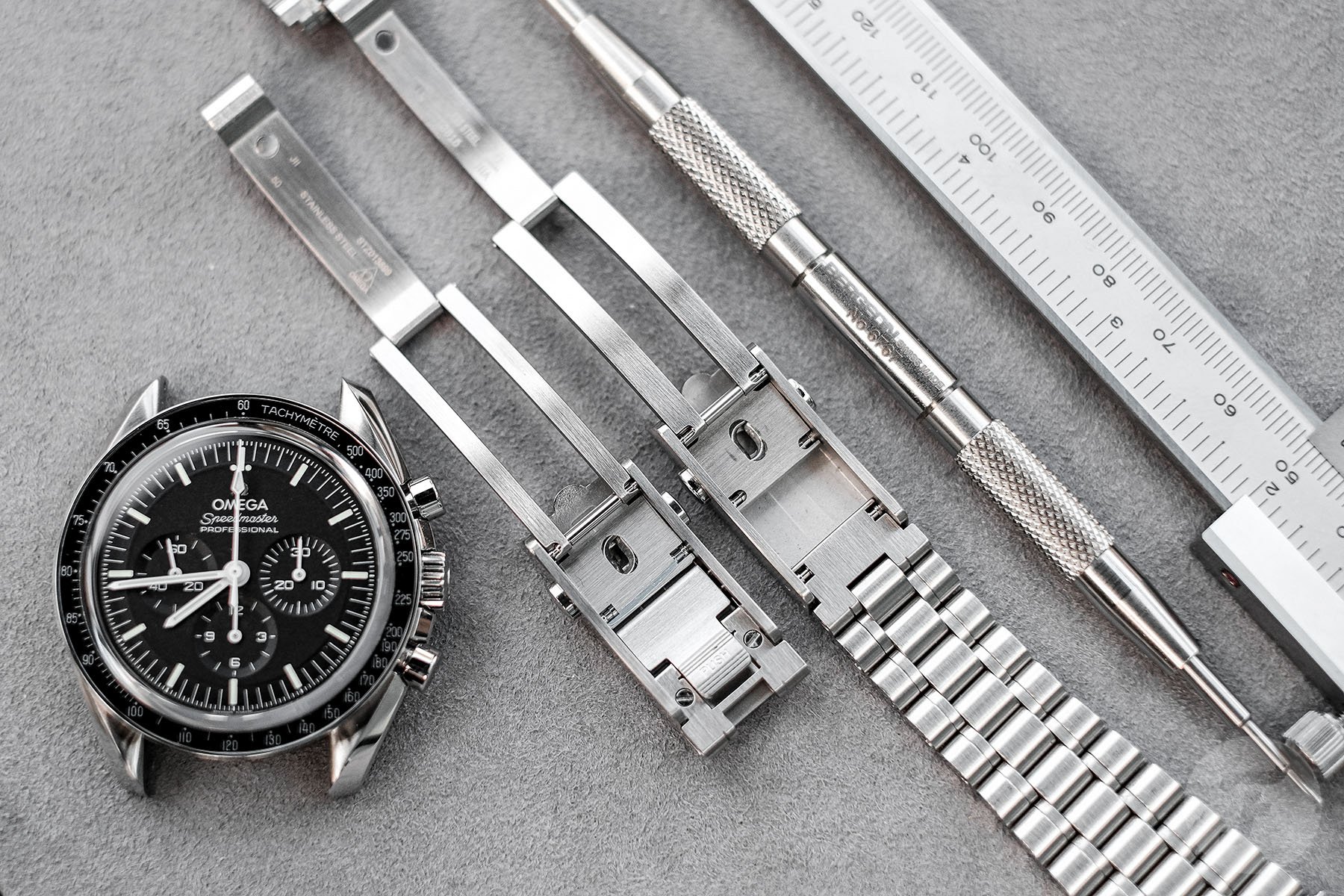
About a year later, Omega began equipping the Speedmaster Professional 310.30.42.50.01.001 and the sapphire reference 310.30.42.50.01.002 with a bracelet featuring a micro-adjustment mechanism. Mine doesn’t have one, and I typically don’t need it, as we don’t have the (extreme) weather conditions that call for one here in the Netherlands. At some point, Omega offered a “kit” that could turn this bracelet into a new one by replacing the clasp and one of the connecting links. My colleague Ben wrote about it here.
Although I never disliked the previous bracelet that much, it was simply outdated. The end links made it a bit uncomfortable for (very) small wrists.
The former Speedmaster bracelet on a small (lady’s) wrist
And design-wise, I do feel the new bracelet is more elegant with its 20–15mm taper. I also truly enjoy looking at the engraved lines on the current Speedmaster Professional’s clasp.
Water resistance
One of the updates that came with the Master Chronometer certification is the guaranteed 50m water resistance rating. Where the previous generations were rated to 30 or 50 meters, it wasn’t recommended to get in the water with them (and still don’t do so with the Calibre 321 model). By complying with the Master Chronometer standards, every current Speedmaster Professional has been tested in the water, and a substantial margin (+10%) has been used during testing. Just stay away from using the pushers when you’re in the water.
I am not much of a swimmer, and when I do swim, I either wear a proper diving watch or none at all. I don’t want to worry about damaging a watch in a swimming pool (I never swim in the sea or ocean for different reasons). However, you can swim with the Speedmaster Professional; just be aware that you shouldn’t use the crown or pushers. I also think it would make customers much more at ease if Omega could find a way to crank it up to 100 meters.
Sharpness of the case and bracelet
I recall several people on forums and on YouTube complaining about the sharpness of the exterior parts. I didn’t agree back then, and I don’t agree today. Sure, there are some sharp edges on the bracelet and 105.012-style case, but if these were overly rounded or polished, it would also change the design too much. The sharp parts, like the bottom of the case band, don’t touch my skin directly, and I can only feel their sharpness when taking the watch off, particularly when I move my fingers around those parts.
That said, the edges on my Rolex Day-Date and other models feel just as sharp. I found the bracelet on my Audemars Piguet Royal Oak 15202ST to be sharper than this Speedmaster’s. On the wrist, or when taking the watch off or putting it back on, there’s no issue whatsoever. But what applies to me isn’t necessarily true for everyone else. Just give the Moonwatch a try before you buy it and see if you encounter any sharp edges while wearing it.
Speedmaster pricing
I felt the previous Speedmaster Professional was too cheap for what it was. In fact, it was almost the most affordable watch in the Omega catalog. The current model’s price, however, seems more in line with other comparable watches. That said, since 2021, we’ve seen quite a few price increases among watch brands, including Omega. The current retail price for the Hesalite Speedmaster Professional Moonwatch ref. 310.30.42.50.01.001 on a stainless steel bracelet is €7,700. The sapphire version costs €8,900 (the white-dial model is €100 more), and the new Speedmaster Professional “Reverse Panda” went just over €10k.
In the past five years, no issues have occurred with my Speedmaster Professional 310.30.42.50.01.001. As written above, the timekeeping is perfect, and no other technical issues have arisen. There’s just been the typical wear on the crystal and other exterior parts. With my Speedmaster Professional 3570.50, I encountered an issue with the crown winding (incredibly stiff), which required replacement. Omega also had to demagnetize my more recent Speedmaster Calibre 321 because it deviated a bit too much per day. Thanks to the METAS certification, which ensures antimagnetism up to 15,000 gauss, you won’t have to worry about that.
But as you could see in the first paragraph of this article, today’s price is a big step up from the initial price in 2021. Would I have bought mine today for €7,700? Without a doubt, it’s still one of my favorite watches under €10k. However, it would surely make me regret not having purchased one earlier. You can also look for one on the secondary market; just make sure you find one in the condition you want. To me, the Speedmaster Professional 310.30.42.50.01.001 is still the one I’d go for (first), as it’s the classic. But if scratches on your Hesalite crystal bother you or you want to have a closer look at the movement at any time, the sapphire versions are great as well.
For more information, visit the official Omega website.