Inside The Mind Of David Lowinger: Five Wild Concepts From A German Independent Watchmaker

There are watchmakers, and then there are people like David Lowinger, who seem to operate in a world of their own. I honestly cannot remember exactly when we started speaking. It was some time, a good few years ago, after I stumbled across his work on Instagram and reached out. What began as a casual exchange turned into one of those ongoing conversations that surface every couple of months, usually sparked by something new he has been sketching or prototyping on his bench. Lowinger is not loud about what he does. He posts only a fraction of his work online. Much of his creativity lives in the background, tucked away in folders, trays, and CAD files that most people never see.
This year, I finally asked him to lift the curtain a little. I knew he had concepts he had never shown publicly, and I wanted to give them a proper showcase. What he sent back was far more ambitious than I expected. Each project is designed component by component, right down to the individual wheels, springs, and screws. These are not visual mood boards or digital flights of fancy. They are fully worked-out and functioning ideas that could be built if someone chose to fund them.
Today, I am sharing five of those unseen designs that capture the breadth of Lowinger’s imagination, from classical watchmaking to creations that flirt with science fiction. Buckle up, Fratelli; we’re in for a ride.
ExoRotor
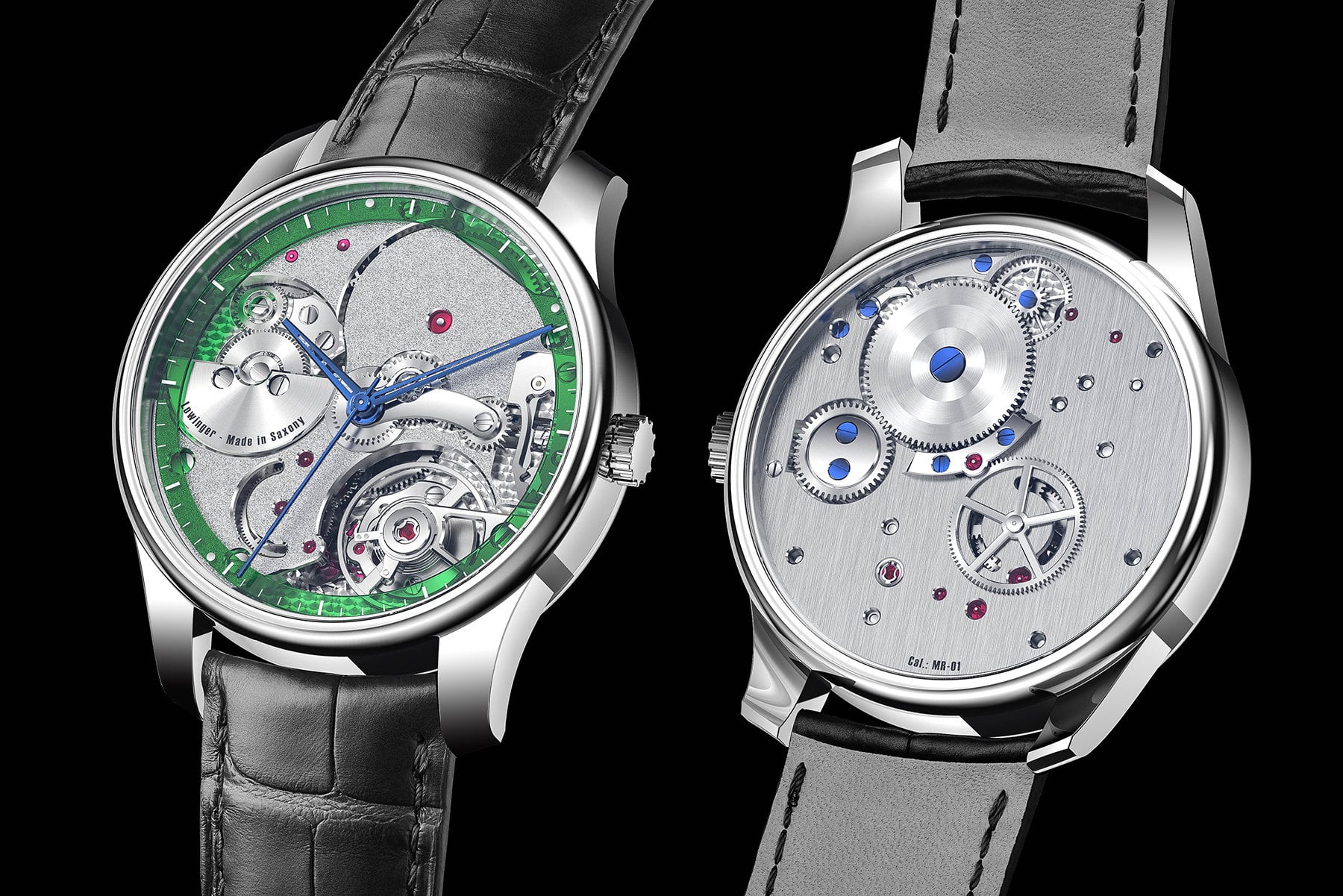
The ExoRotor is the most “traditional” of the five concepts, although even calling it traditional feels like a stretch once you start studying the details. It uses a micro-rotor movement with a central seconds display and around 150 components. The case has a 43mm diameter and an 11mm thickness, so it wears with a calm, elegant profile while giving the dial side plenty of room. Though 43mm watches are certainly not considered small these days, there is a lot to show off here, so the real estate feels justified. Lowinger kept the case stripped back, almost neutral in its presence. That restraint pulls your eye straight to the real star of the show.


Instead of a dial, you get a green sapphire minute ring around the periphery. Everything else is movement architecture. The dial-side balance sits around 5 o’clock, and next to it, you get a view of the keyless works and the micro-rotor. Even some of the jewels are placed in a way that feels intentional, catching the light and adding slow flashes of color. The view from the back is far simpler, which is a choice I appreciate. With so much happening at the front, the rear becomes a palate cleanser, showing only the barrel, the winding mechanism, and a few supporting elements. The ExoRotor is the most classical model here, but it’s still unmistakably Lowinger.
Helix2
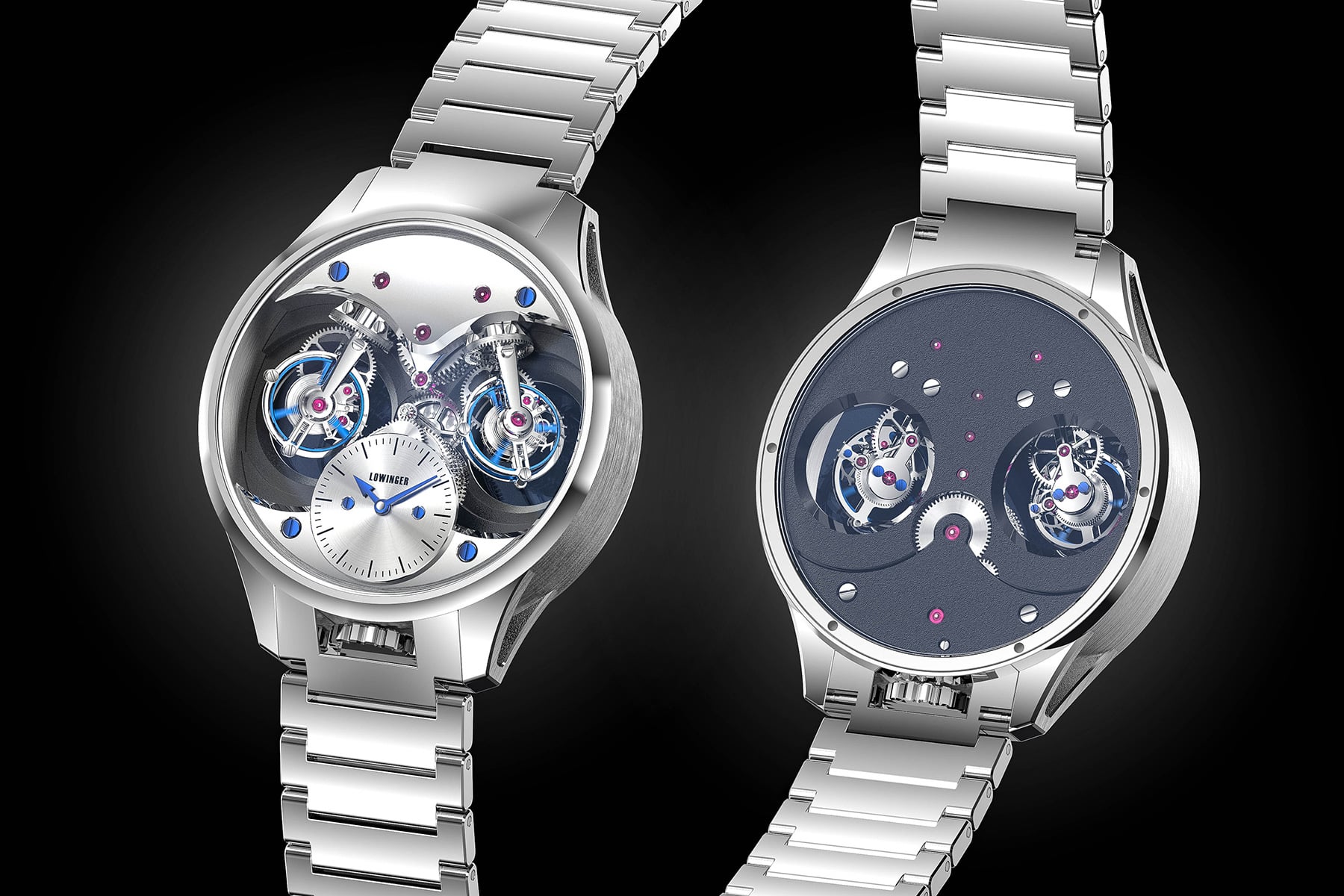
The Helix2 is where things start to escalate. A single double-axis tourbillon is already ambitious. Lowinger decided to use two. The movement contains around 220 components and houses a pair of rotating mechanisms that orbit, spin, and counter-rotate in ways that would make even seasoned watchmakers sweat. Lowinger has never hidden his love for tourbillons, and the Helix2 feels like a shrine to that fascination.


The 43mm case retains a familiar silhouette, although the open-worked lugs give it a slightly futuristic stance. With a 17mm total thickness, it will carry some presence on the wrist, but that measurement is, of course, due to the twin tourbillons. The crown placement at 6 o’clock is unusual but surprisingly natural once you imagine it on the wrist. It keeps the whole design visually balanced and vertically symmetrical. A stainless steel bracelet completes the look, and this was the first time I saw him experiment with integrated metal. The result is a hybrid between a traditional round watch and something more sculptural.
In person, or even in render form, the twin double-axis tourbillons steal the entire stage. They are hypnotic. They also make it clear how far Lowinger is willing to push things when he leans fully into mechanical theater.
Apex Vertical
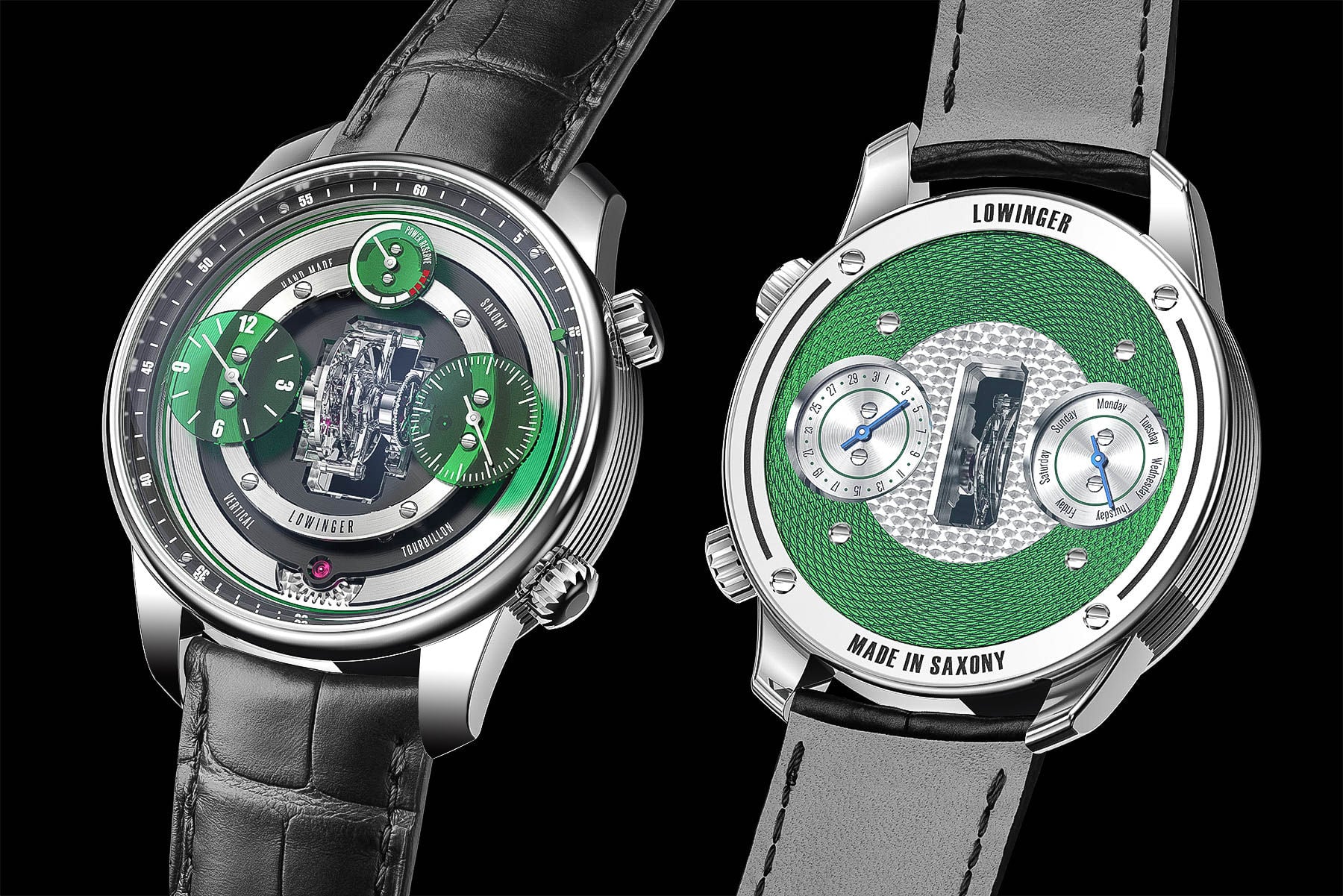
The Apex Vertical is where Lowinger’s design vocabulary becomes unmistakable. This piece features a centrally mounted vertical one-minute tourbillon, an uncommon sight in watchmaking. The movement contains roughly 260 components and supports a surprising number of functions — hours, minutes, seconds, a power reserve indicator, day, and date. The 41mm case feels compact for the amount of information it holds, and the 15mm thickness, which includes the highly domed crystal, gives it a sense of height without tipping into excess. The touches of green sapphire are a theme I have seen in several of Lowinger’s other concepts, almost akin to a signature.


The regulator-style layout is also classic Lowinger. Having seen many of his other private projects, I know it’s a structure that appeals to him from a watchmaking perspective. Hours sit on a sub-dial at 9 o’clock, while seconds are at 3 o’clock, and a green minute pointer orbits the outer track. The power reserve indicator sits cleanly at 12. Then, right in the center, the vertical tourbillon rises like a miniature tower. Vertical regulating organs are rare because they complicate everything, from shock behavior to case construction. Only a handful of brands have ever attempted one. Off the top of my head, I can think of F.P.Journe, Cyrus, and Korean watchmaker Eugene Kim, so seeing Lowinger tackle it head-on is telling.
Turn the watch over, and you get a beautifully decorated guilloché plate with two small recessed sub-dials for the day and date. It has the charm of a mechanical instrument mixed with a sense of invention that feels very modern. The Apex Vertical is probably the one that best captures Lowinger’s overall design identity.
Tarantula
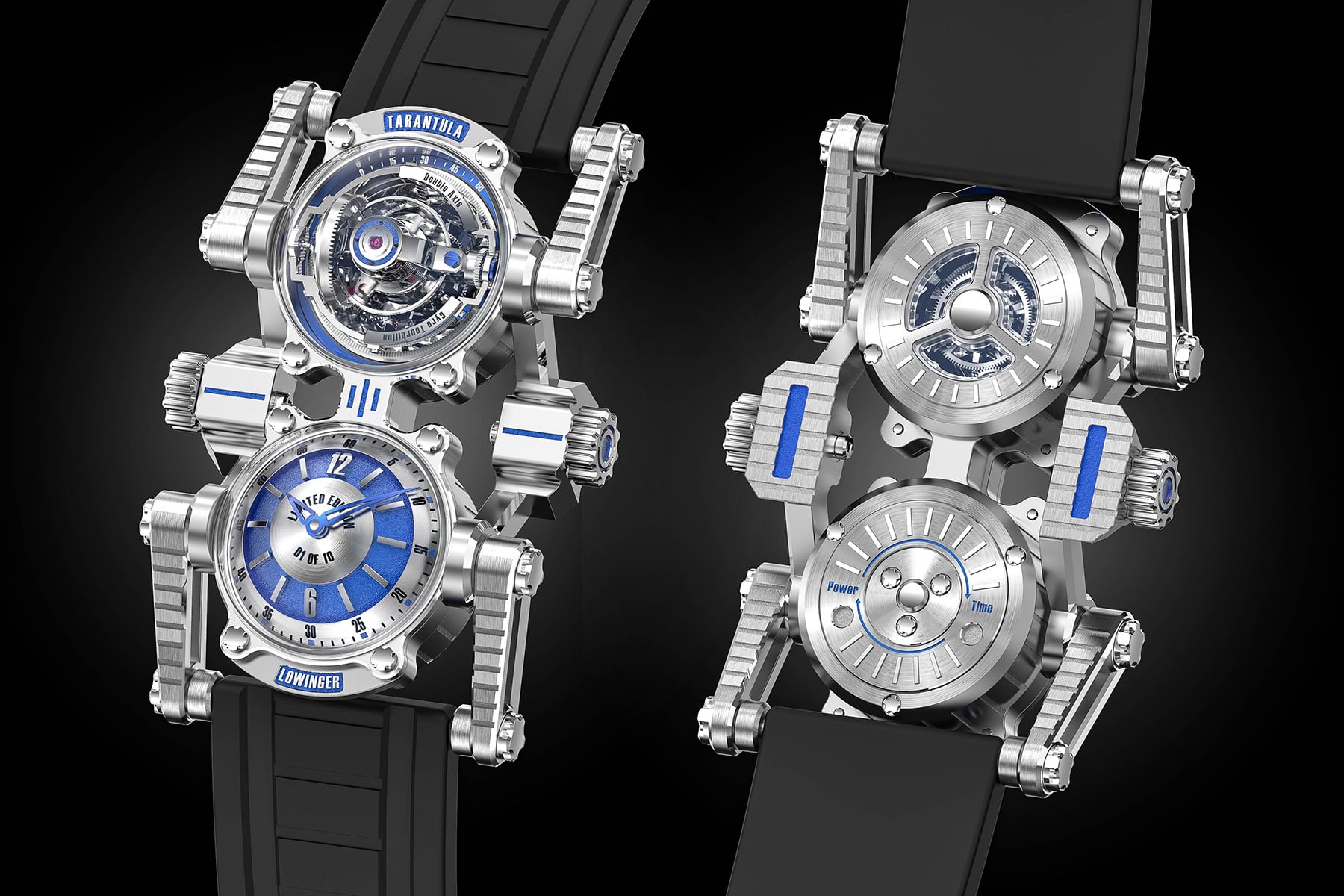
The Tarantula is the watch I told Lowinger we were absolutely including. Even he laughed when I said it because he knew exactly why. It is wild, expressive, and unlike anything else in this lineup. It features a double-axis gyrotourbillon with a helical hairspring, and the case footprint is much smaller than the images suggest. With a mere 47mm length, 36mm diameter, and 15.5mm profile at its thickest points, the Tarantula would be surprisingly wearable. The leg-like lugs also articulate, meaning this watch would hug the wrist perfectly.


The first thing that jumps out is the creature-like silhouette. The long central body houses the tourbillon up top, and the sub-dial for the time sits below it under a curved dome with hands that bend gently to match the surface. You get what appear to be two crowns at the sides, but neither is actually a crown. They are removable keys. One winds the mainspring, and the other sets the time from the back of the watch. This is a small detail, but it demonstrates Lowinger’s commitment to integrating practicality into the performance.
As a side note, this is the one I would love to see in the hands of Max Büsser. It feels like it was born for an MB&F collaboration. I am half hoping this article helps nudge that conversation into the world. Let’s make it happen, people.
Wastelander
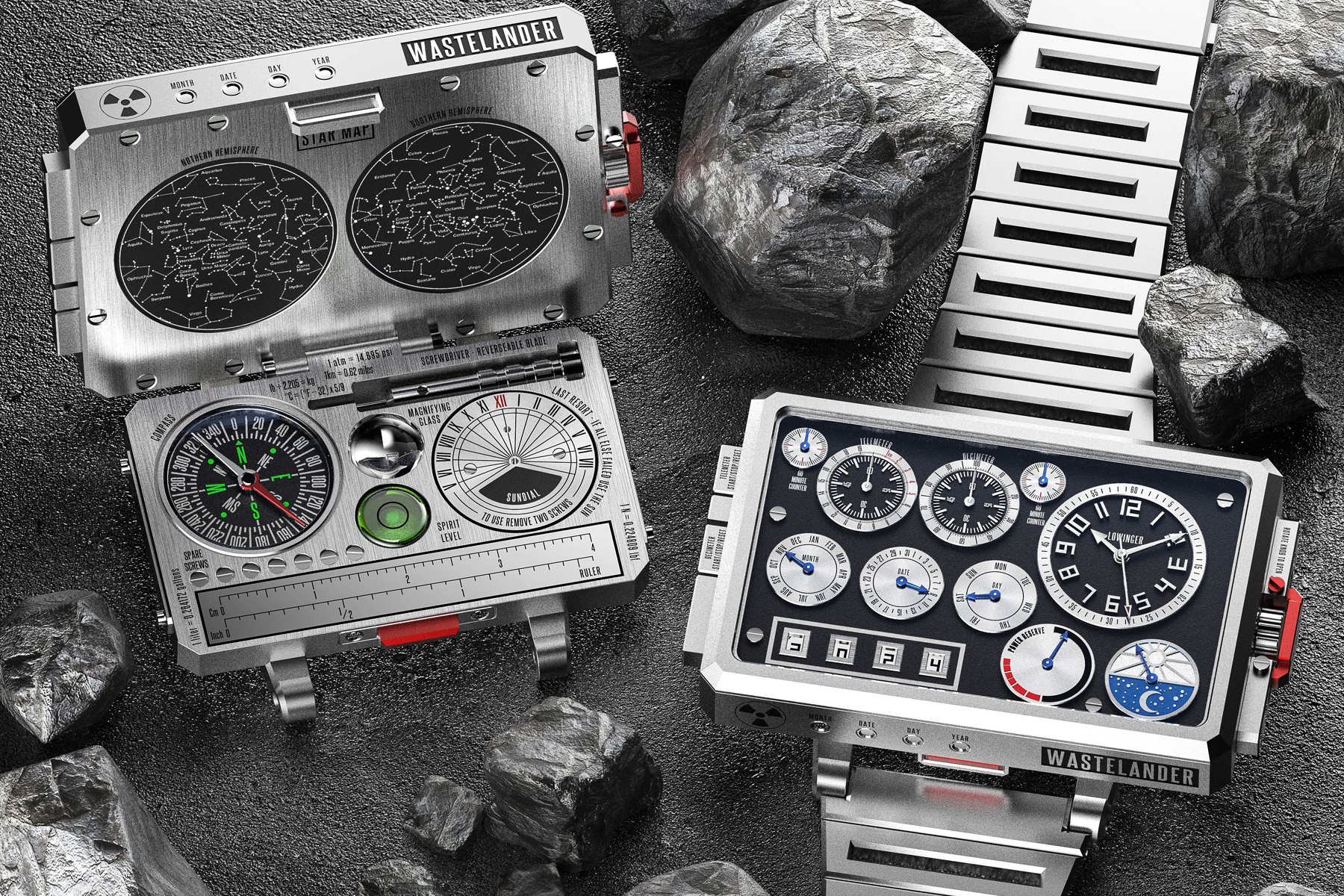
If the Tarantula sits on the line between watchmaking and mechanical sculpture, the Wastelander sprints past it. This is Lowinger at his most unrestrained. The movement is still evolving and very much a work in progress. Lowinger expects the final count to be around 500 components, with hours, minutes, seconds, day, date, month, year, a power reserve, a day/night indicator, and not one but two monopusher chronographs.


Then, it gets stranger. The Wastelander packs a star map, a compass, a spirit level, a magnifier, a ruler, a sundial, a screwdriver, and spare screws. With a 57mm diameter, 38mm length, and 16mm thickness, the Wastelander will sit more like a wrist-worn instrument than a conventional watch. Every time I look at it, I immediately think of the Pip-Boy from the Fallout games. I mentioned this to David, and he admitted the name was absolutely picked with that universe in mind. As someone who got into the series with Fallout 3, in which the protagonist is referred to as a Wastelander, the nostalgia hits hard.
It is absurd. It is brilliant. Indeed, it is exactly the sort of whimsical overkill that only works when the person behind it understands enough to make the absurdity functional. In a post-apocalyptic wasteland, this thing might genuinely keep you alive. The only thing missing is a kitchen sink.
Lowinger’s imagination deserves a wider audience
Spending time with David and seeing his work on screen reminds me how wide independent watchmaking really is. Some independents refine a single idea for years. Others chase mechanical purity. Lowinger approaches watchmaking like a laboratory. Every concept is complete. Every mechanism is engineered. There are no shortcuts. Even the craziest drawings exist because he has thought through each gear and bridge in the system.
I want more people to see what he is doing, partly because it deserves attention and partly because I want to know which of these watches resonates with readers. Hopefully, in the future, we can highlight even more of his work, but for now, you will have to savor these five pieces. Let me know which one caught your eye. To see more of Lowinger’s work, I highly recommend following him on Instagram.
…And if anyone knows Max Büsser, please send him the Tarantula. It needs to exist in the real world!