The Genus × Atelier Stauffacher × Tad Kozh “Les Flux Du Temps” — Enamel in Motion

In Breton, Tad Kozh means “grandfather,” but there is nothing old-fashioned about this brand. Named in tribute to co-founder Baudouin van Es’s grandfather, this Geneva-based nonprofit connects independent watchmakers with master craftspeople. The artisans receive a blank canvas and complete creative freedom. There is no micromanagement. Proceeds from these small, subscription-only editions also fund Tad Kozh’s talent competition. Winners receive workshop machinery to develop new skills and build a career around their passion, along with free technical and business mentoring.
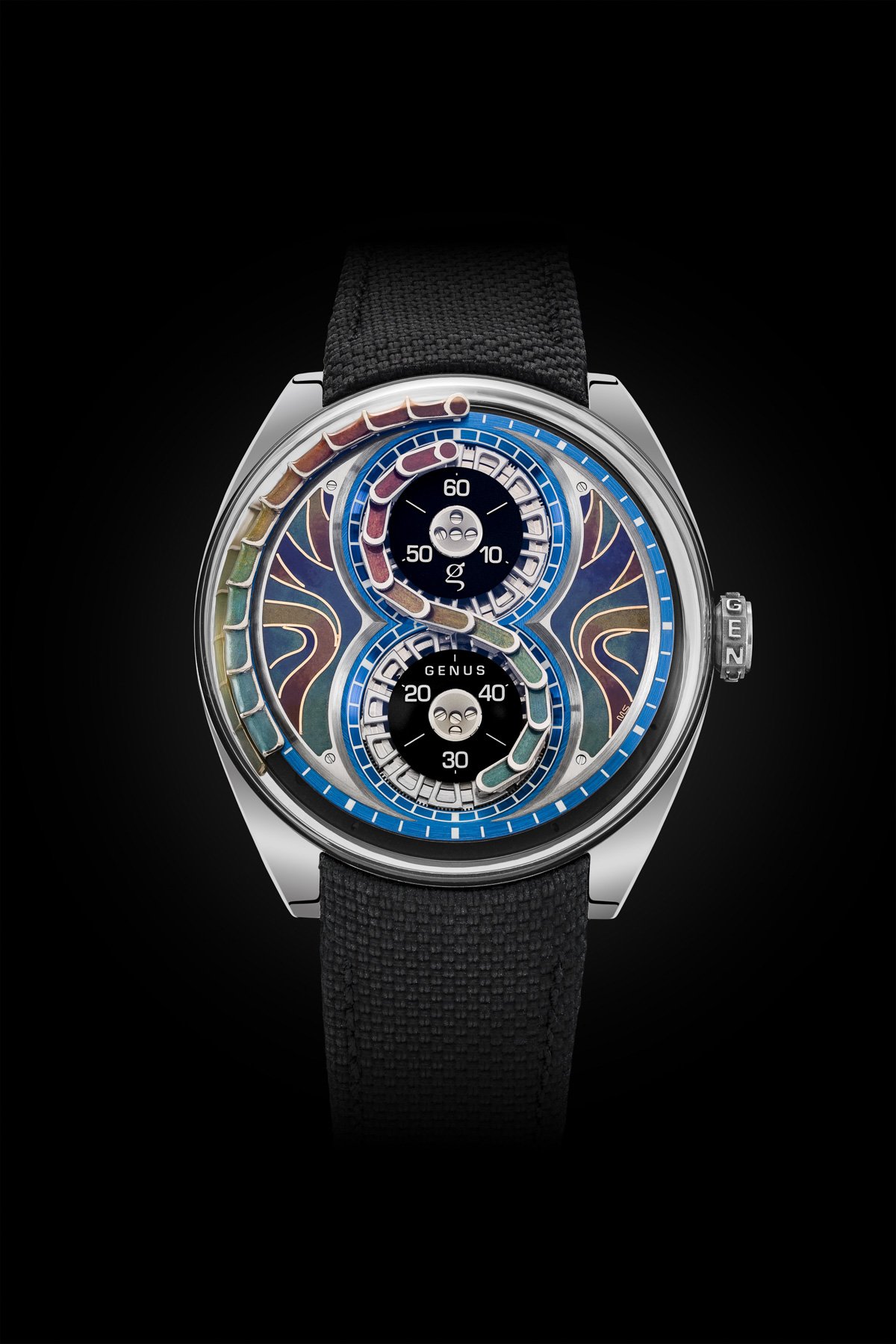
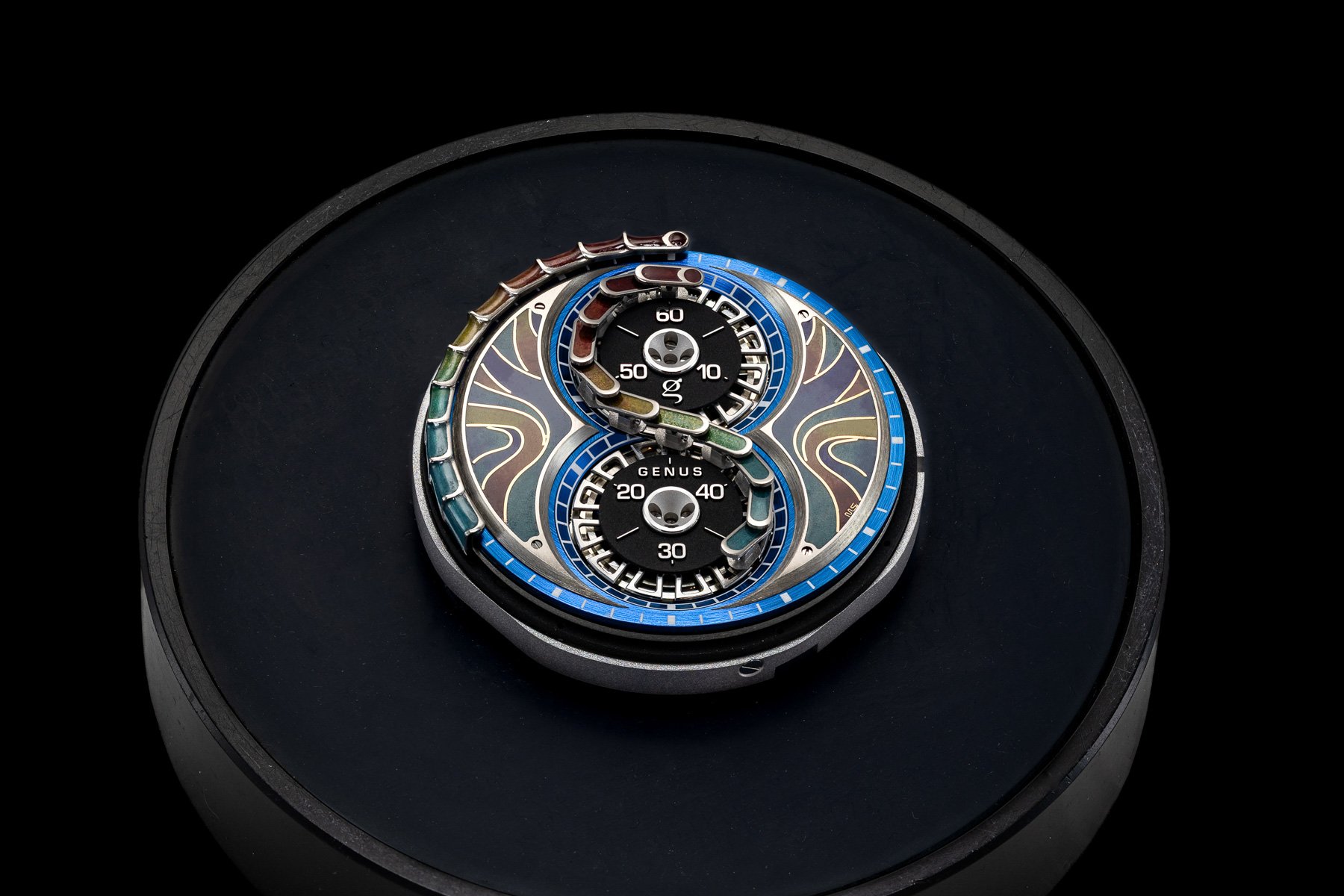
For its debut watch, unveiled at Geneva Watch Days 2026, Tad Kozh paired Lausanne-based enameller Matteo Stauffacher with Genus. Together, they reinterpreted the watchmaker’s GNS2 as the Genus × Atelier Stauffacher × Tad Kozh “Les Flux du Temps.” The GNS2 debuted as a sleeker, more minimalist evolution of the original GNS1. It retained Genus’s no-hands concept, using free-moving markers instead. These orbit the dial’s outer edge to indicate the hours. They also weave through a central figure-eight track to display the minutes. However, this collaboration marks the first time Genus has used grand feu enamel.
Fire, gold, and a hundred hours
For anyone learning enameling in Switzerland, training under master Anita Porchet is about as good as it gets. She is one of haute horlogerie’s most respected independent enamel artists. Matteo Stauffacher learned his craft under her guidance. Genus then gave him complete freedom to develop the dial design.

Matteo Stauffacher, enameler
“I had always dreamed of sitting down at a table with a watchmaker and saying, ‘Now, let’s try to create something we’ve never done before,’” Stauffacher said.
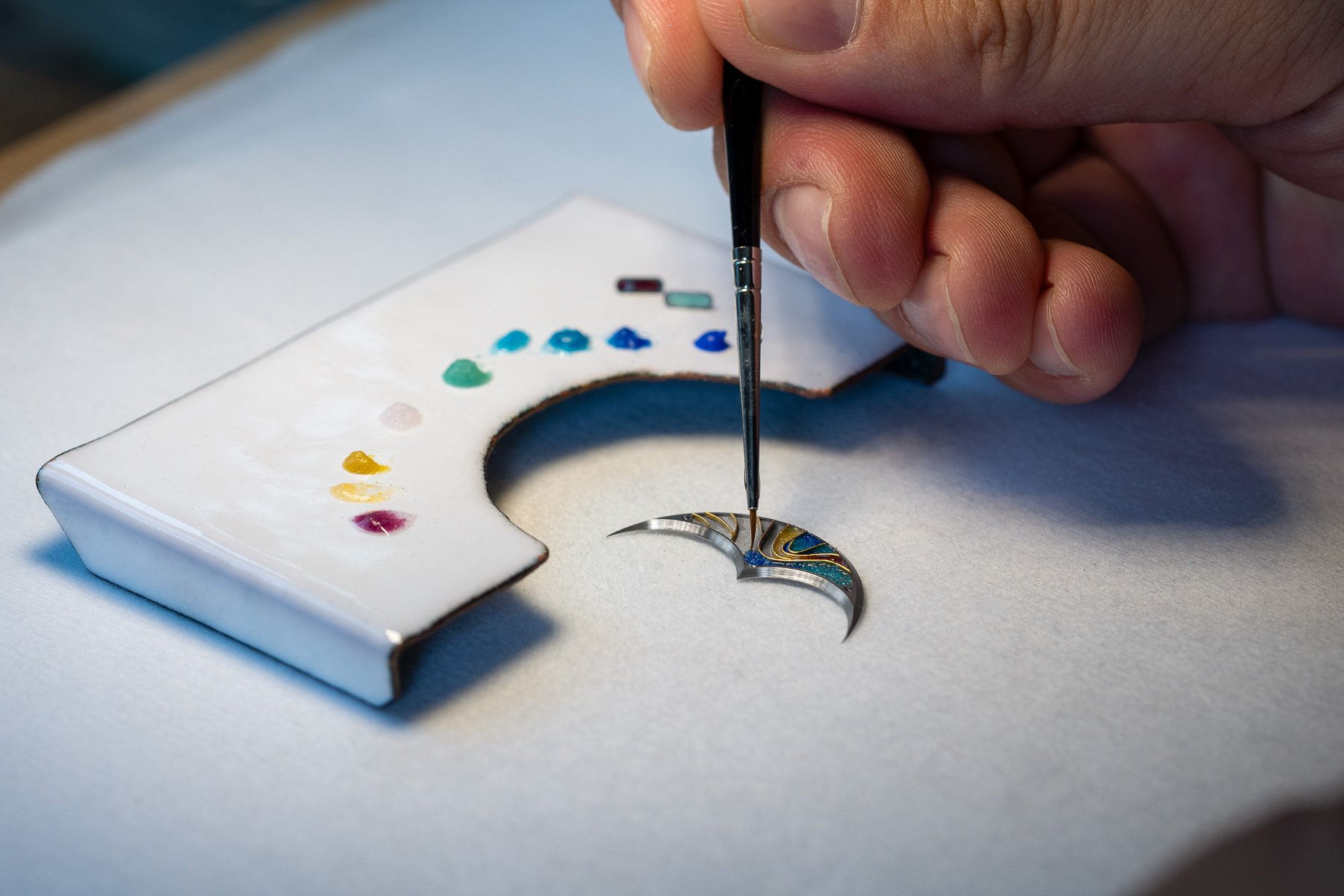
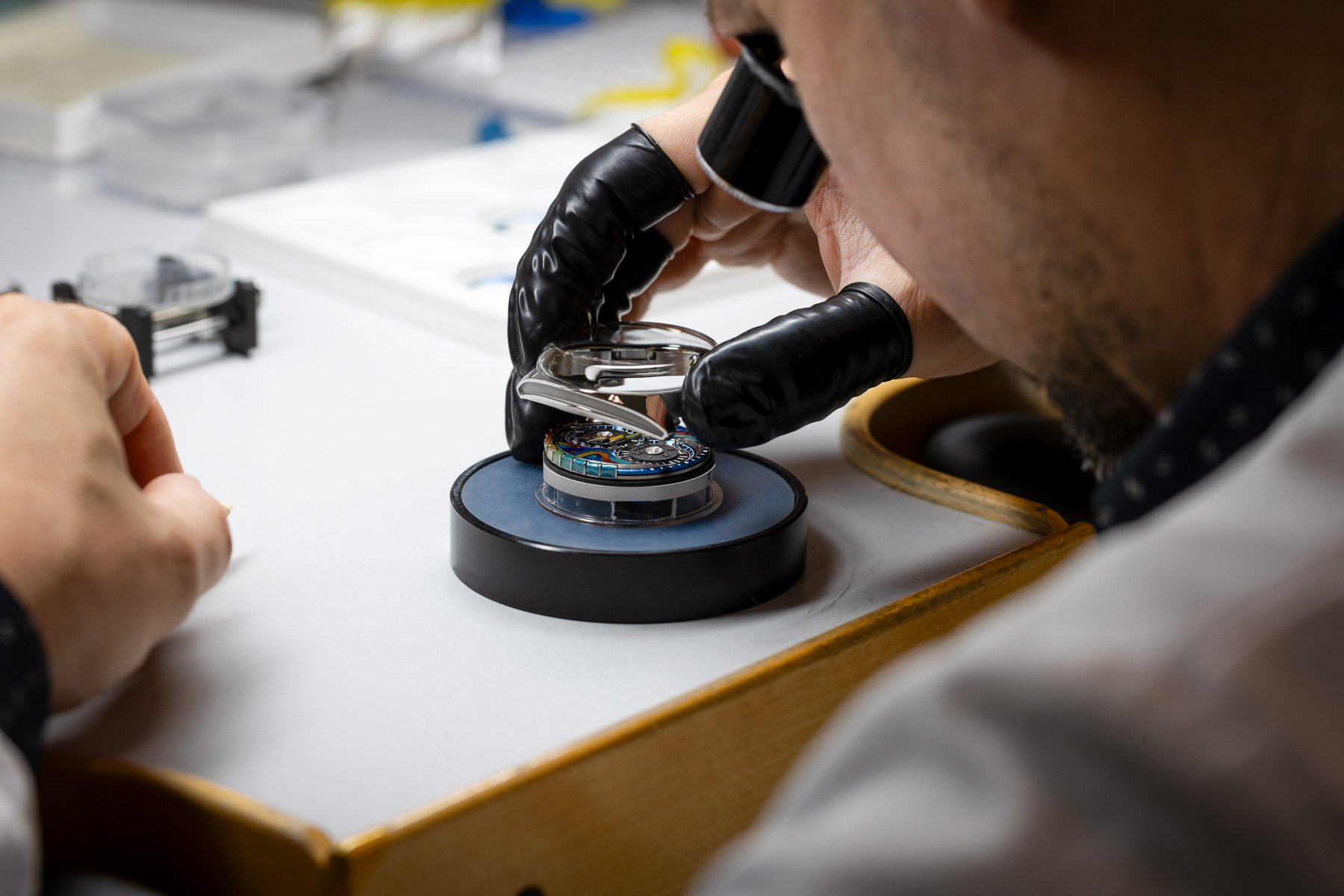
Grand feu enamel covers the dial of this collaboration. Each watch requires around 100 hours of enameling work. To achieve its distinctive appearance, 18K gold half-moons flank the five-part openworked display. Each features grand feu cloisonné enamel.
Stauffacher begins by bending a 12cm piece of 0.2mm-thick(!) 24K gold wire into waves. He then fixes it to the gold base. The wire forms the walls, or cloisons, that contain 10 shades of enamel powder. Each half-moon then enters the kiln 8–10 times at temperatures exceeding 800°C. Once the enamel has been fired, it must be manually polished to achieve a mirror-like finish. Even a minor mishap can crack or shatter the dial. That would erase hours of painstaking work in an instant.
How time moves without hands
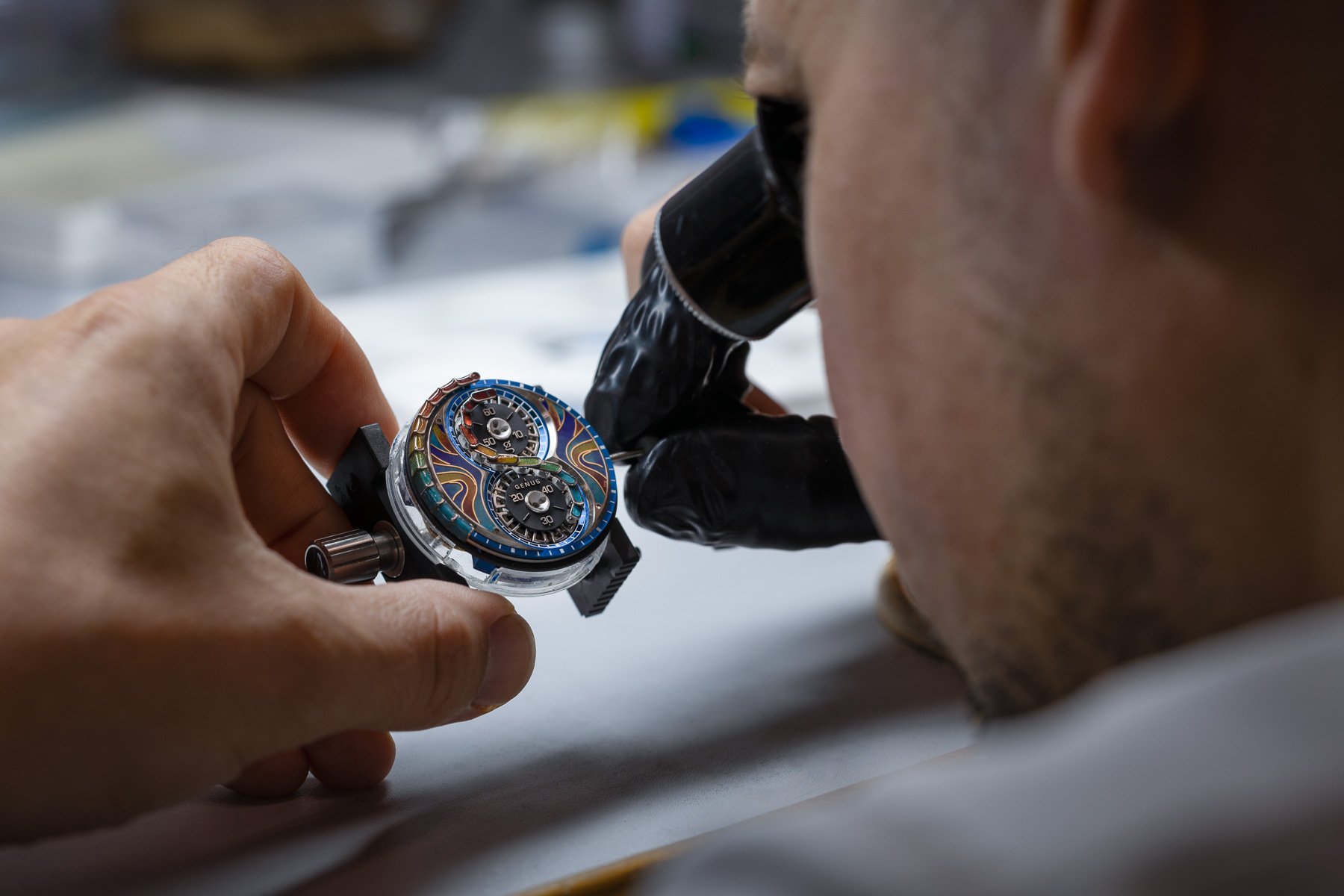
Genus was founded in 2019 in a suburb of Geneva. That same year, its no-hands GNS1.2 won the Mechanical Exception prize at the GPHG. The brand introduced the GNS2 in 2024, refining the original concept with a more balanced display. It consolidated the hours, tens of minutes, and exact minutes into two intuitive tracks. An outer ring indicates the hours, while a central figure-eight displays the minutes. For the “Les Flux du Temps,” Stauffacher applied grand feu champlevé enamel to the solid surfaces to achieve moving, jointed enameled pieces.
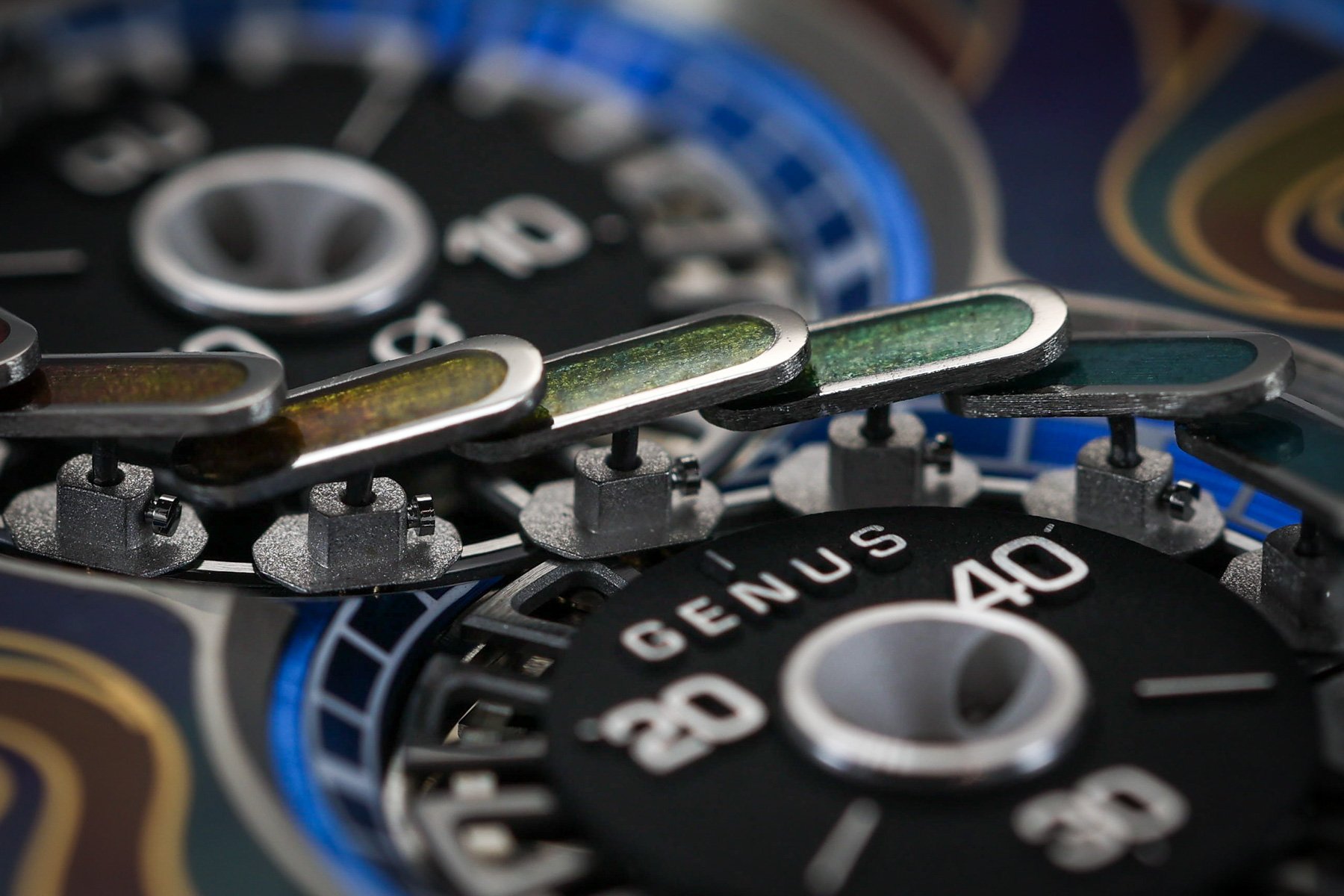
Despite the dial’s complexity, reading the time is relatively straightforward. A large, free-moving C-shaped element in 18K gold glides around the outer track, indicating the hours and quarters. At the center, 11 linked 18K gold elements trace a figure-eight between two counter-rotating wheels. Two small, round dials indicate the tens of minutes and exact minutes against the larger base dial. The enameled gold train winds between the rotating discs with surprising ease. Its fluid motion belies the complexity of its construction.
The case and movement
All this motion takes place inside a Grade 5 titanium case measuring 43mm across and 13.3mm thick. A highly domed, glass-box sapphire crystal with antireflective coating protects the dial, bringing the total profile to 18.8mm. Titanium helps offset the substantial dimensions, keeping the watch relatively light and manageable. Other details include a Grade 5 titanium crown with raised “GENUS” lettering. A screw-secured display case back and 30m water resistance complete the package.

Sébastien Billières, Genus co-founder and master watchmaker
Turn the watch over to see the in-house, hand-wound caliber 260Rh-2, designed and assembled by Sébastien Billières in Geneva. This 38 movement comprises 285 parts, including 26 jewels, and measures 38mm across and 7.7mm thick. It runs at 18,000 vibrations per hour and features a Swiss lever escapement, a free-sprung hairspring with a Breguet overcoil, and a variable-inertia balance wheel. It also offers a roughly 50-hour power reserve.
The Genus × Atelier Stauffacher × Tad Kozh “Les Flux du Temps” comes with a slightly padded rubber, calfskin, or exotic leather strap. Each features folded edges and topstitching, along with an engraved titanium pin buckle.
Five pieces and a subscription
Production of the Genus × Atelier Stauffacher × Tad Kozh “Les Flux du Temps” is limited to five pieces. Each is handmade, so no two will be exactly alike. The price is CHF 83,000 before taxes, and the watch is available exclusively by subscription. That is a substantial sum, but the craftsmanship behind the dial and mechanics is considerable.
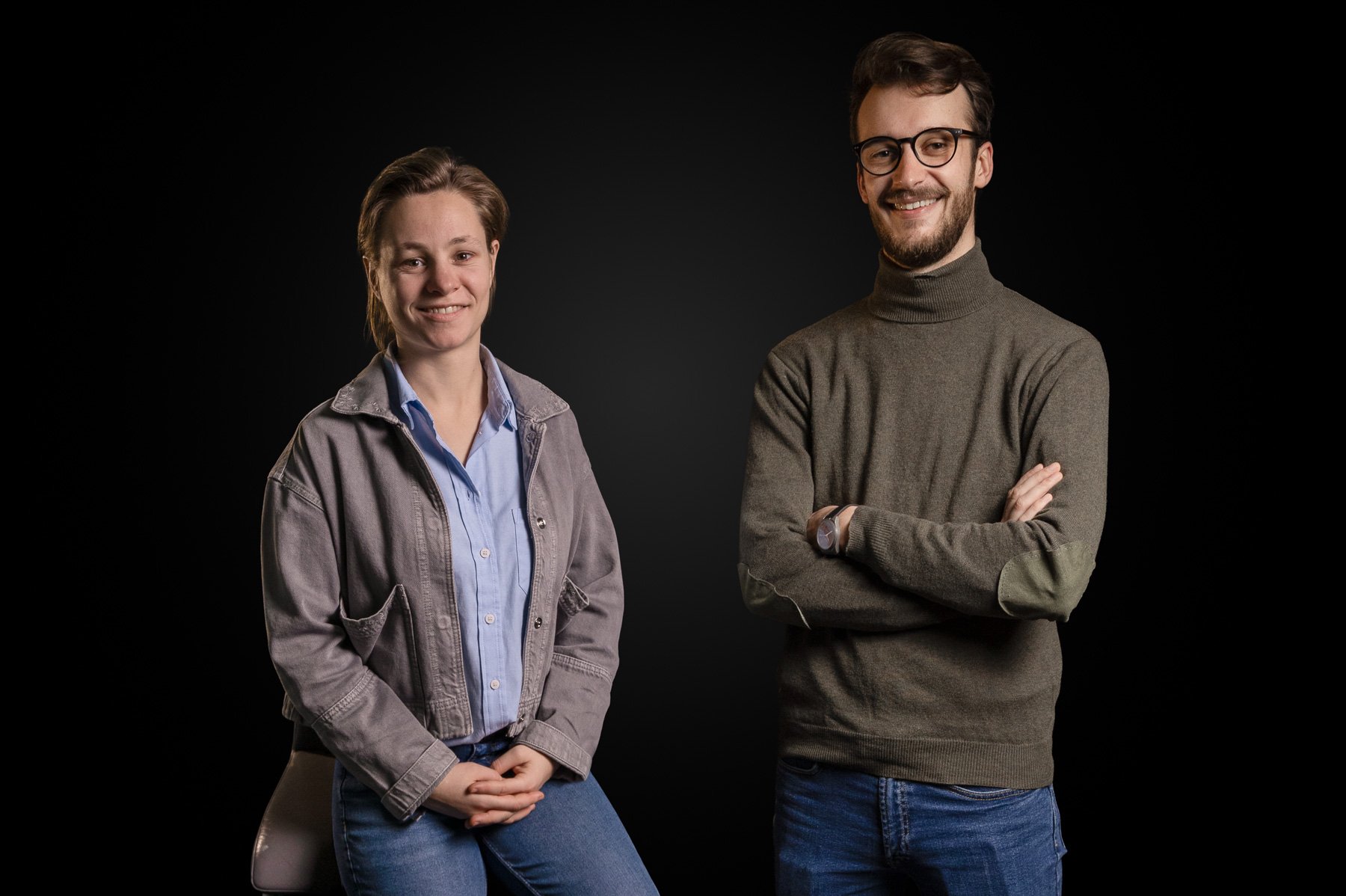
Alix and Baudouin van Es, founders of Tad Kozh
Proceeds will help fund the next generation of independent watchmakers. That gives this version of the GNS2 a purpose beyond its price tag. And if this is what happens when brands step back and let craftspeople lead, perhaps the rest of the industry should take note.