Hands-On: The CIGA Design Hunter Tourbillon In Blue

CIGA Design is a Shenzhen-based watch brand that has been producing watches since 2016. I’d say the turning point came in 2021, when the brand’s Blue Planet won the Challenge Watch Prize at the Grand Prix d’Horlogerie de Genève (GPHG). Since then, CIGA Design has built a solid model palette across its Aventur, Everest, Zodiac, and Edge collections and is steadily developing proprietary calibers. The CIGA Hunter Tourbillon belongs to the Edge series, alongside the original Edge, the Falcon, and the Vector.
In my earlier review of the Hunter Titanium Automatic, I mentioned that we hadn’t yet covered the Hunter Tourbillon, even though its reworked titanium case was the basis for that model. It’s time to change that. The Hunter Tourbillon is the most complicated watch in the reworked Hunter family, with a more refined skeleton architecture. At €2,199 / US$1,999, it’s also the most expensive. It comes in Carbon, Silver, and Blue colorways, and I was happy to spend over a week with the third one.
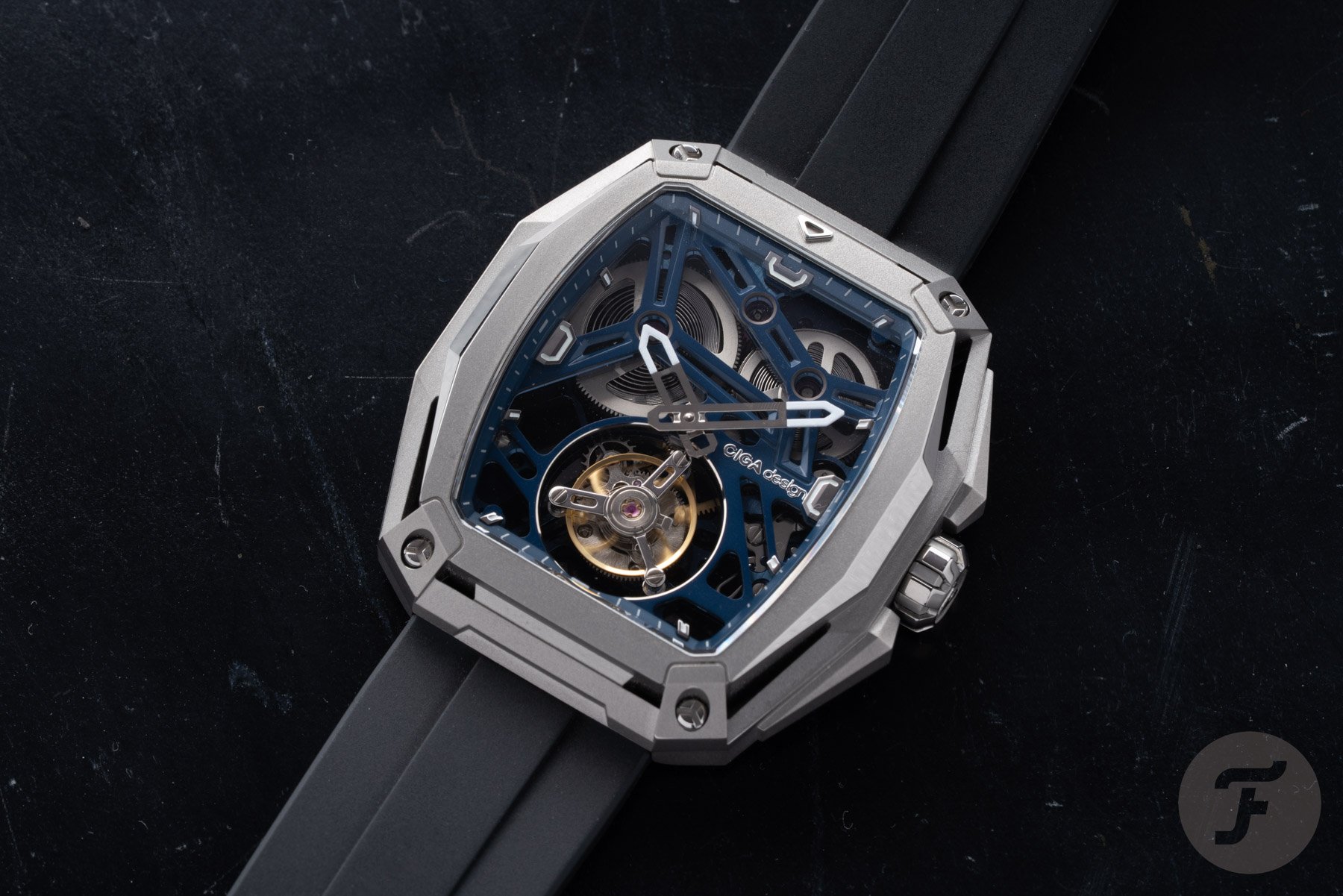
First impression of the CIGA Hunter Tourbillon
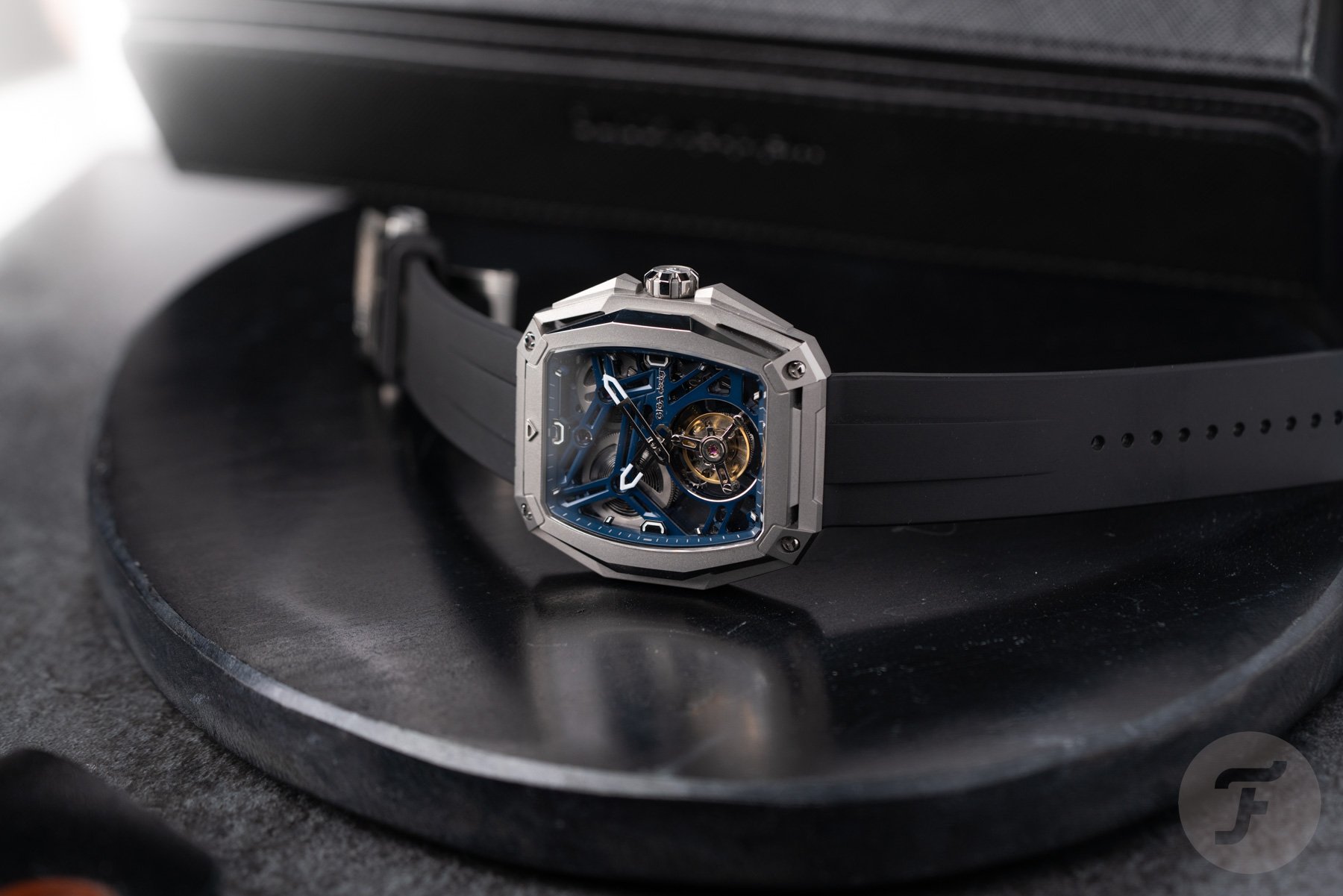
The Hunter Tourbillon’s Grade 5 titanium case measures 41.5 mm wide, 47.45 mm long, and 12.4 mm thick. It is lugless, so the case length is also the lug-to-lug distance. As with the automatic Hunter Titanium, the flanks have stepped cutouts, and Y-grooved bezel screws are exposed at the corners. In my opinion, this is a more resolved design than the first Hunter models, as the added openings make the case look lighter and more in line with the skeleton dial. The front of the case has a curved sapphire crystal, while the back features a flat one.

Fluororubber strap and titanium bracelet
The watch weighs 94.6 grams, including the fluororubber strap with its push-button butterfly clasp. The 22/20mm strap will fit small to ankle-sized wrists. Because of this, the strap is longer than I’d like for my roughly 18cm wrist, but it has enough holes to adjust it to the right size. I even had two holes left and 12 unused on the long end. In addition to the fluororubber strap, this Tourbillon version includes the same Grade 2 titanium H-link bracelet as the automatic Hunter Titanium.
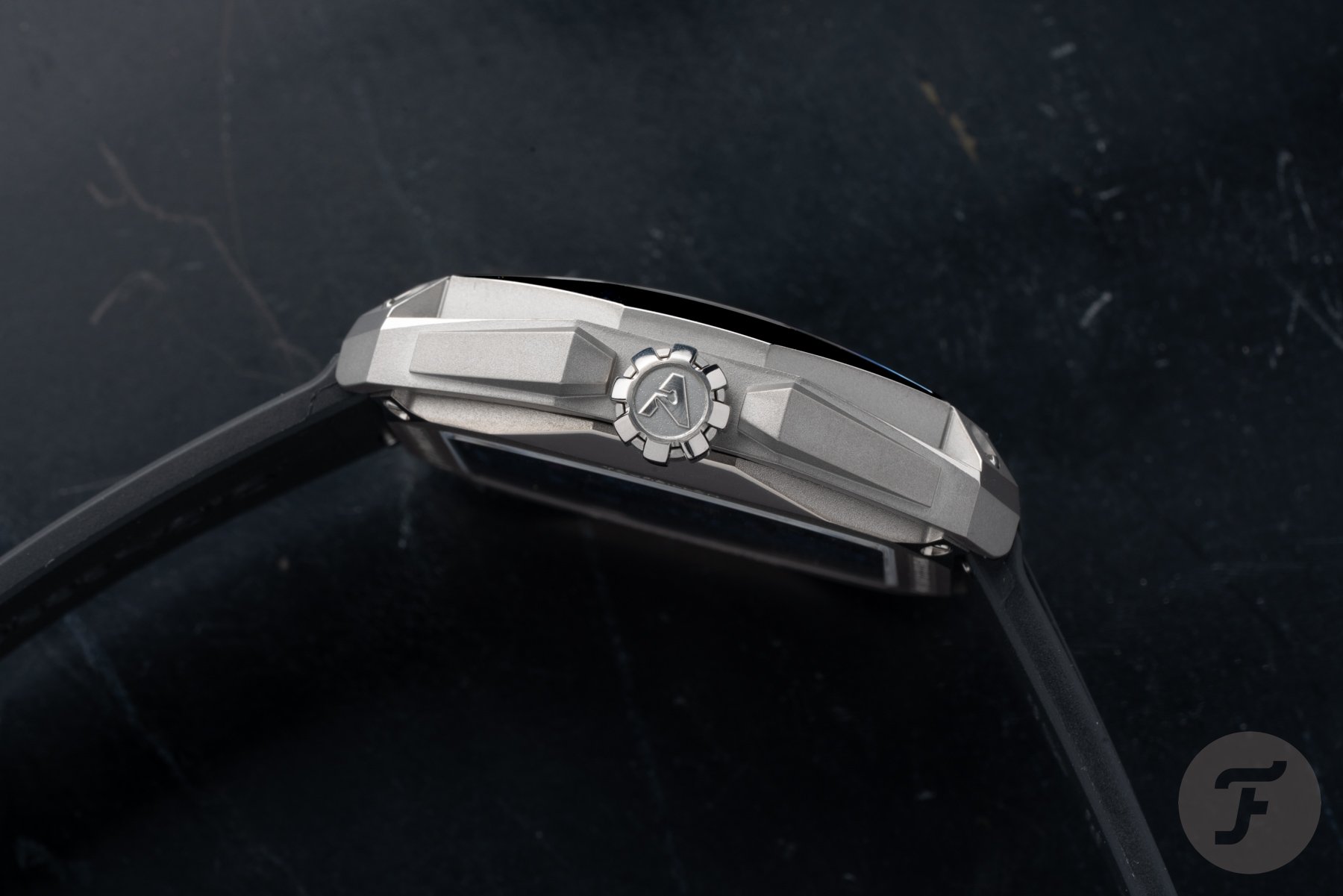
Generally, I’m not a big fan of rubber straps, but with the CIGA Hunter, I might prefer it to the titanium bracelet. As noted, the strap could have been much shorter for my wrist size, and it probably would have been nice if its color had been closer to the movement’s blue bridges. Nevertheless, it is very comfortable and places greater emphasis on the watch. Anyway, you don’t have to choose one option or the other, since the Hunter Tourbillon comes with both the fluororubber strap and the titanium bracelet.
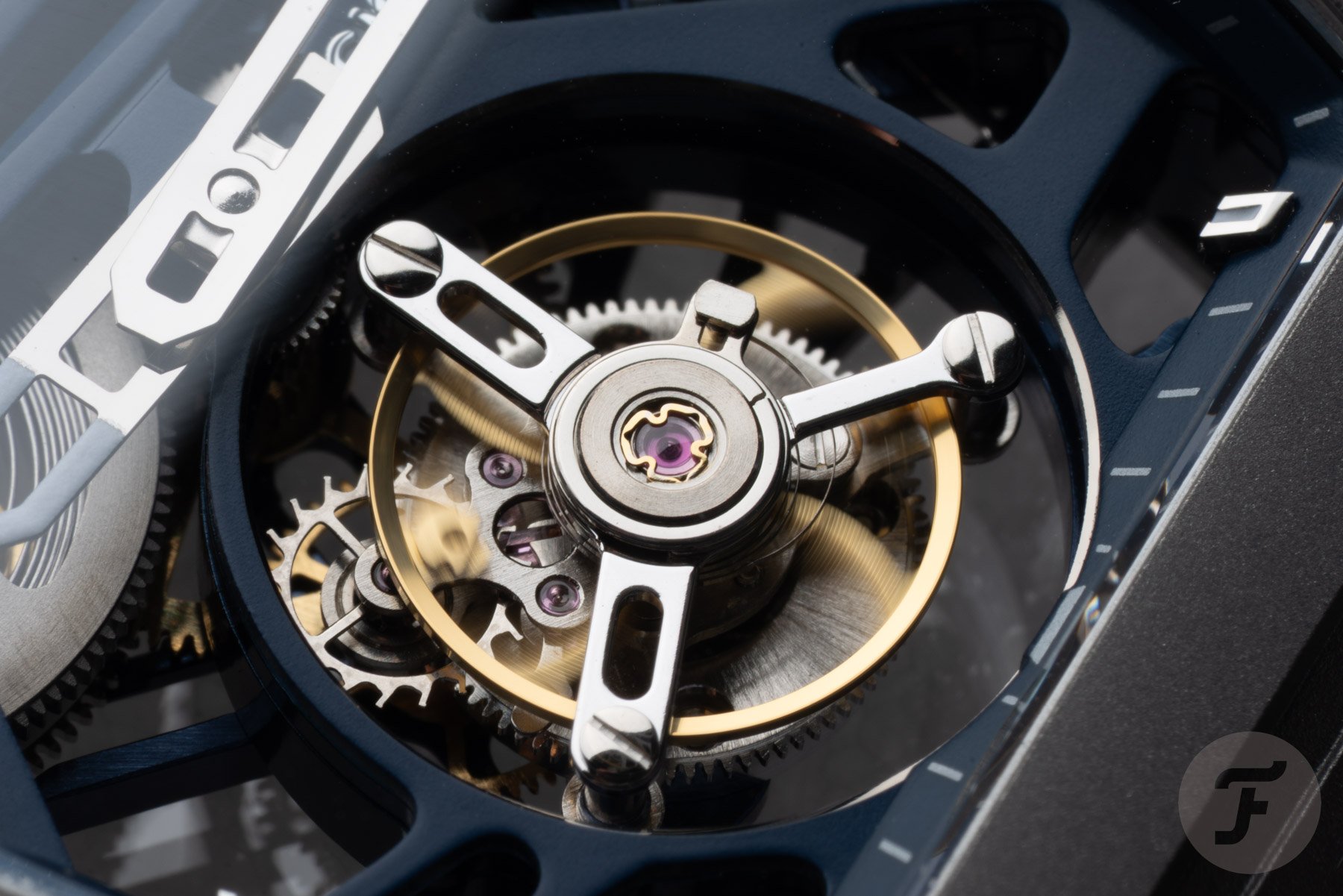
Enjoying the movement
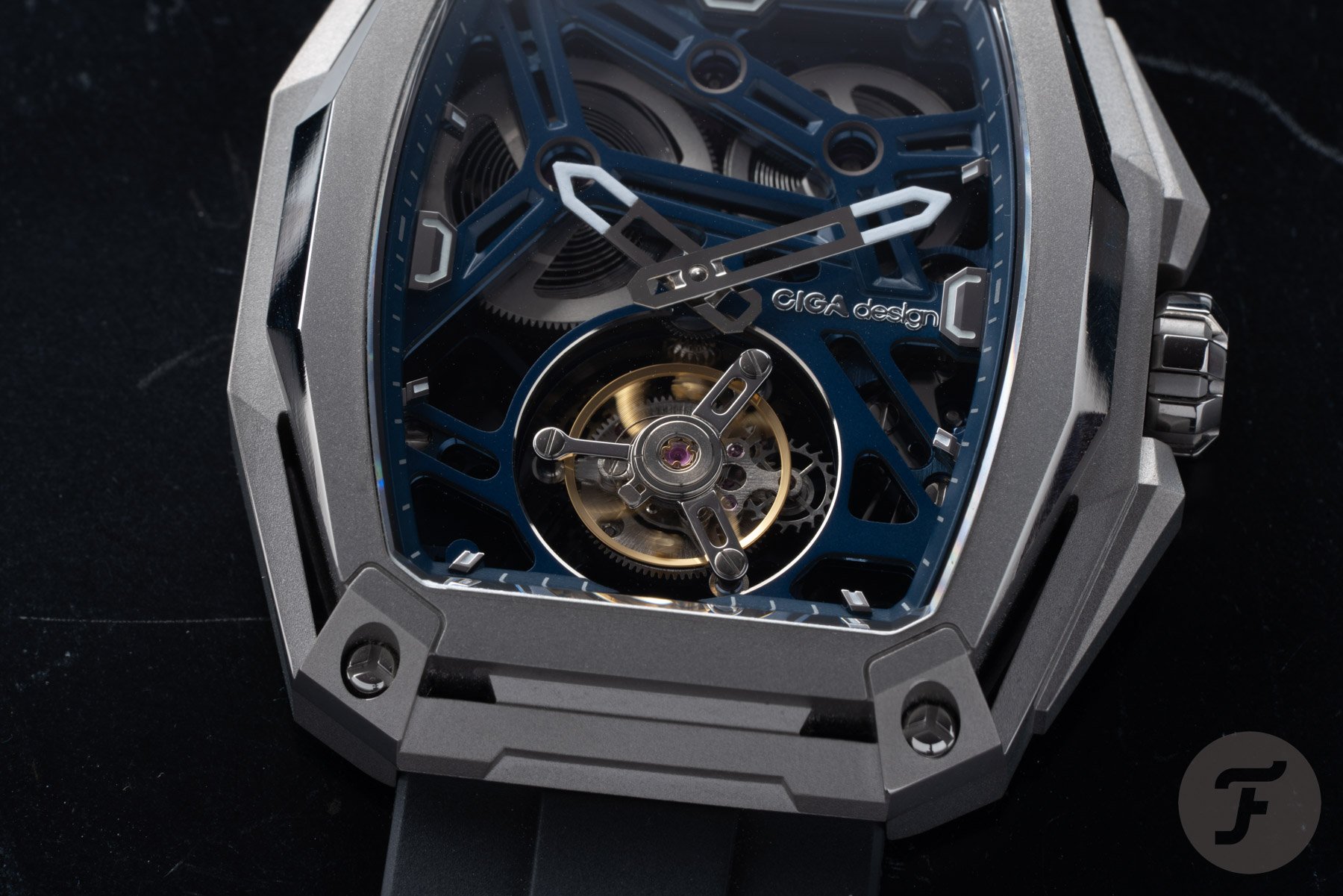
Inside the Hunter Tourbillon is the CD-011, a hand-wound 26-jewel skeleton movement developed by CIGA. It has twin barrels, resulting in a 72-hour power reserve, and a 28,800vph (4Hz) frequency. The tourbillon is of a so-called “flying” construction. The tourbillon cage looks like it’s floating, which is a more demanding construction than a bridged one. The mechanism sits at the 6 o’clock position, and its three-armed cage completes one rotation per minute. On the Blue version, the bridges have a semi-matte blue coating, and the chamfers and polished jewel-mounting holes stand out well against it. I think this is what sets the Blue version apart from the Carbon and Silver; it gives more depth than I expected from a picture.
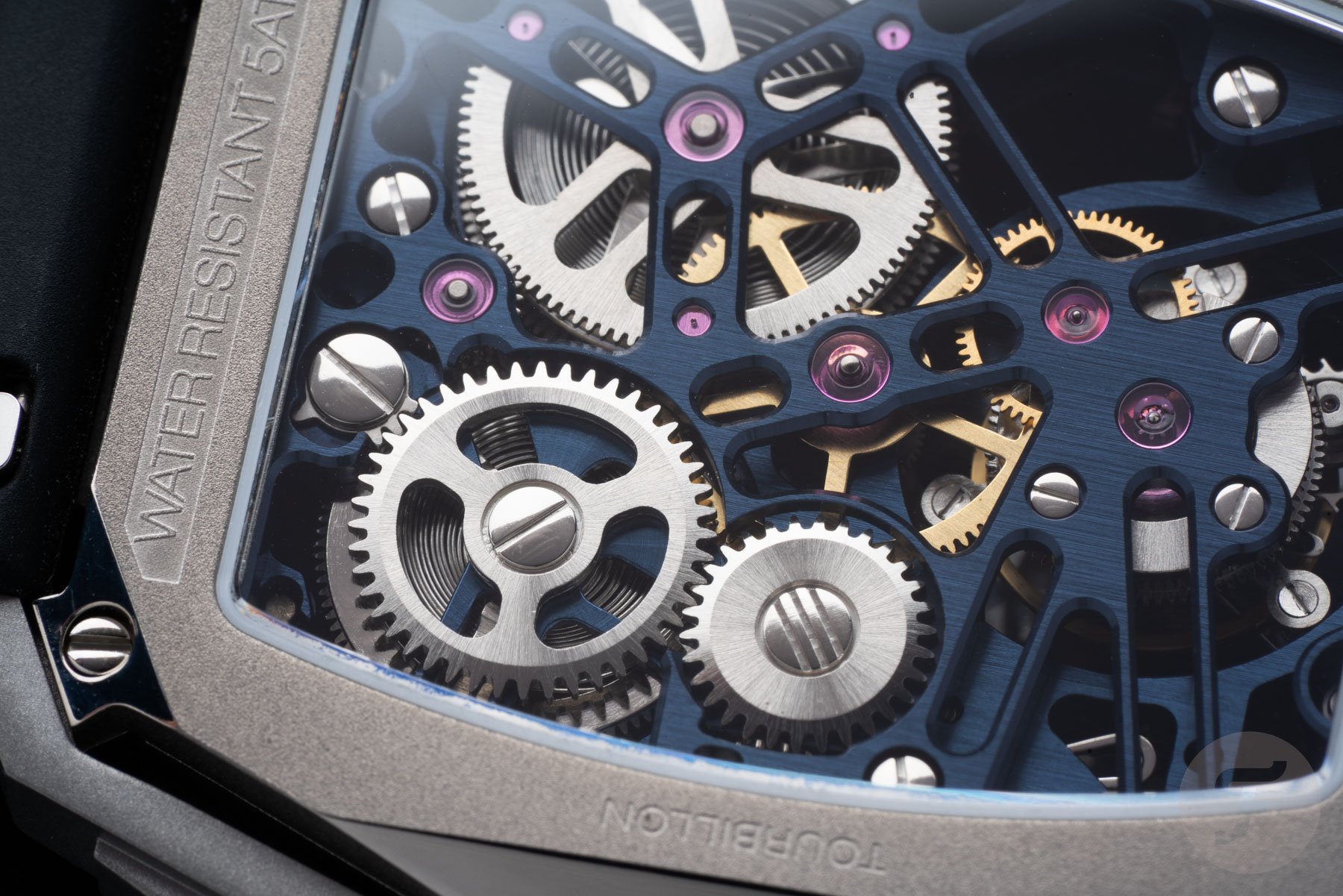
Compared to the automatic Hunter Titanium, the view of Tourbillon’s movement appears slightly more cluttered. Unsurprisingly, a hand-wound tourbillon with two mainspring barrels is much more complex. As a result, it loses a bit of its visual lightness, but it offers much more technology to admire. Winding the watch is a pleasant, soft, and hassle-free experience. However, after using the full 72-hour power reserve, the manual winding requires quite a few crown turns.
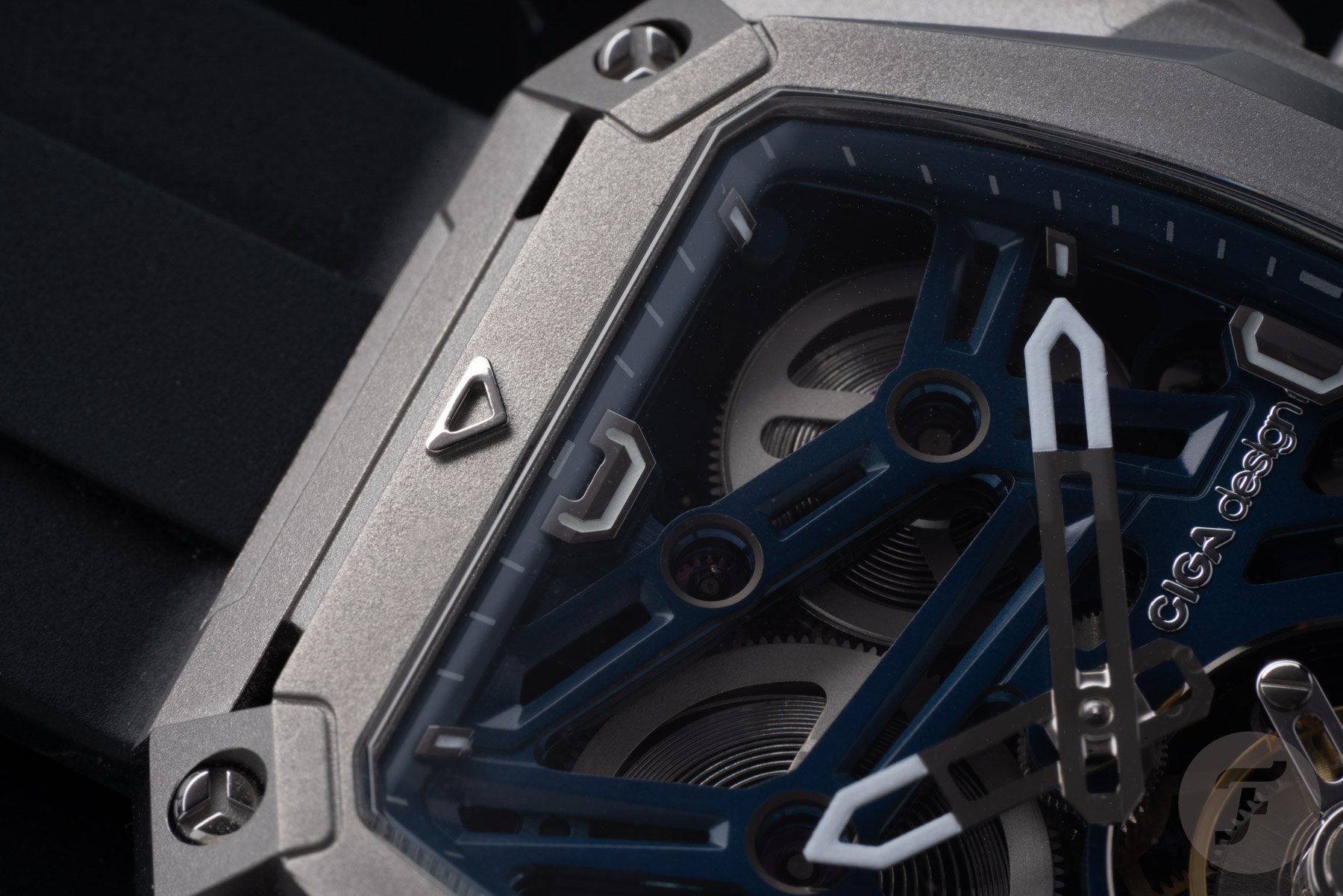
Legibility is fine for a full skeleton. The 11 indexes — the one at 6 o’clock is absent due to the tourbillon cage — are applied, and all carry Super-LumiNova. The hands are polished and feature Super-LumiNova at their tips, enhancing legibility in all lighting conditions. CIGA states an accuracy of -10/+20 seconds per day. My review watch ran just under 20 seconds fast per day. I don’t think accuracy is the main reason to buy a tourbillon, though, and here is why.
Why does a tourbillon exist?
The tourbillon was invented by Abraham-Louis Breguet, who received a French patent for it on June 26th, 1801. The word means “whirlwind.” The problem he wanted to solve was specific to pocket watches, which spent most of the day upright in a waistcoat pocket. In a fixed vertical position, gravity acts unequally on the balance wheel and hairspring, causing positional errors in the rate.
Breguet’s solution was to place the balance and escapement in a small rotating cage, which turns once per minute in the classic design. Because the cage keeps changing position, the errors don’t build up in one direction. They are spread over a full rotation and largely cancel each other out. So the tourbillon was originally a way to improve accuracy, not a decorative feature.
That purpose has faded considerably. A wristwatch’s position constantly changes as the wearer moves, so the original problem is much smaller. Furthermore, the cage’s extra mass and complexity can even undermine precision. Today, a tourbillon is mostly valued as a demonstration of watchmaking skill and for the pleasure of watching the cage turn. I think that is a fair reason to want one, as long as you are aware of it.
Pricing and availability
The Hunter Tourbillon retails for €2,199 / $1,999. For comparison, the automatic Hunter Titanium costs €999 / US$899, and the regular and Vintage non-titanium models cost €649 / US$599. So the hand-wound tourbillon movement adds about €1,200 to the price compared to the titanium automatic, which shares the same case, materials, and colors. For a tourbillon watch with an in-house caliber, that is good value for money, if you ask me. This does not mean the watch matches Swiss tourbillons from higher price segments in terms of finishing or movement construction, and CIGA doesn’t claim that either. In the end, it’s a very well-made and beautiful flying tourbillon nonetheless. The watch is available through CIGA Design’s official online store and the brand’s authorized dealers worldwide.

Conclusion
I find the Hunter Tourbillon as difficult to classify as its automatic titanium brother. Given its size and construction, it is not a dress watch. And given its design, it’s not a sports watch either. It’s a watch for a specific audience — people who like to look at the movement. If you mainly like the design, the automatic is the more sensible choice. If you want the exclusivity of a flying tourbillon, its moving cage, a hand-wound movement, and a longer power reserve, the Hunter Tourbillon is the one.
What is your take on the CIGA Hunter Tourbillon? At this price, would you consider it, or do you prefer the simpler automatic version? And how do you like the blue movement? Let’s discuss it in the comments below!
This is a partnership post. Learn more.