Hands-On With The All-New Blancpain Carrousel Incliné: A New Angle On Precision

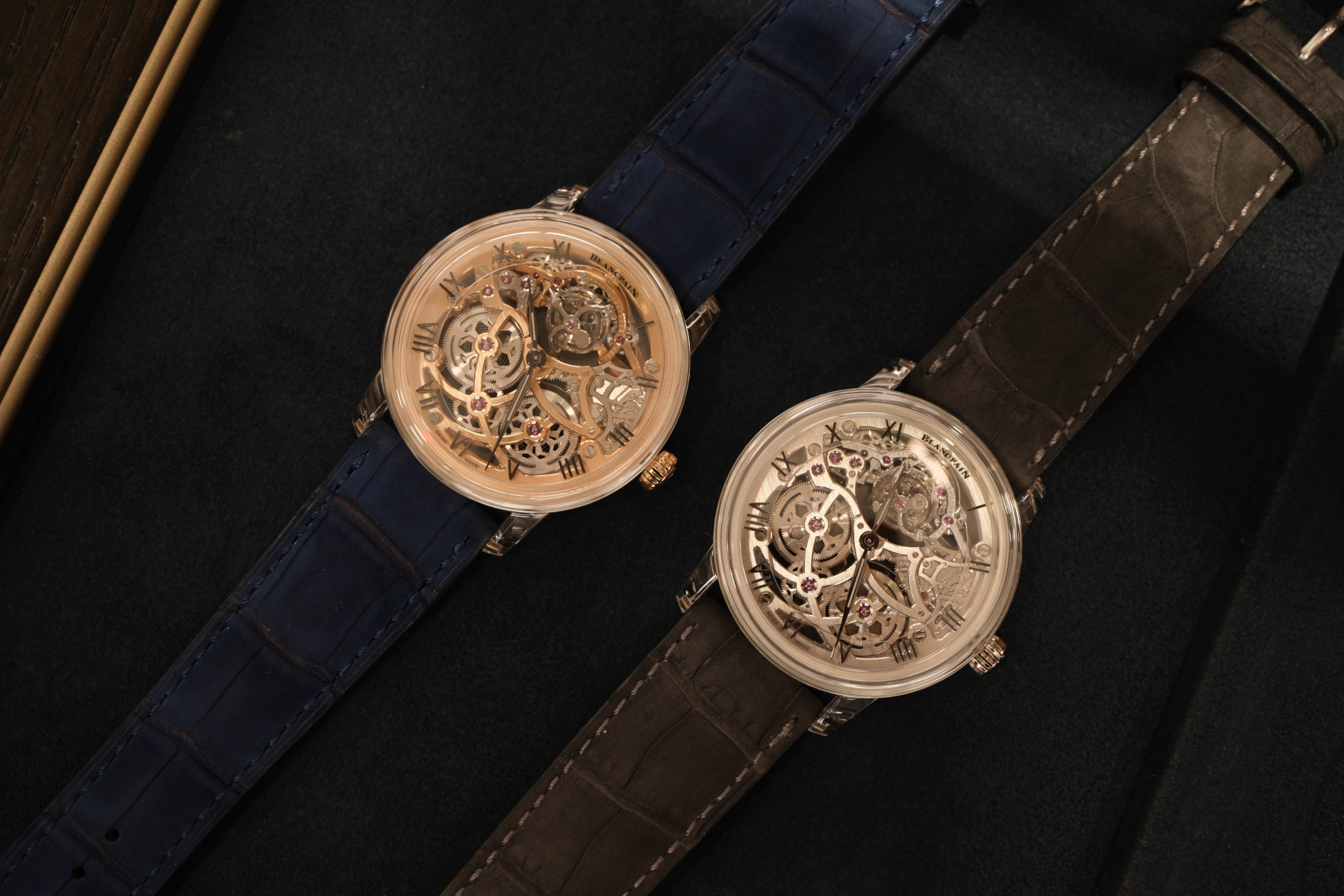
The new Blancpain Carrousel Incliné is a fascinating watch. It features a one-minute flying carrousel inclined at 30 degrees, an extensively skeletonized movement, and a sapphire case that lets you see almost all of it. On paper, it sounds well outside Blancpain’s usual wheelhouse. However, if the recent GPHG-winning Grande Double Sonnerie tells us anything, it’s that we should never underestimate what Blancpain can do.
I had the chance to spend some time with both versions during New York Watch Week in October. An early start in New York isn’t so bad when you have a good reason to get out of bed (other than jet lag). After a decent bagel and an average coffee, I set off on a brisk walk uptown with my Fratello colleague Balazs in tow. I told myself it was to burn off breakfast, but the reality was that no subway stop was conveniently close to the boutique. I arrived at the Blancpain boutique just before opening and was shown into the private viewing room, where the two watches were laid out on a table. The lighting was great for viewing them in person but less ideal for photography — typical boutique conditions, really.
A carrousel is not a tourbillon!
Joining us was Jeff Kingston, Blancpain’s unofficial official historian and co-editor of the brand’s magazine, Lettres du Brassus. We’d spoken before, but this was our first time meeting in person. I promptly made a strong first impression by mentioning the watch’s tourbillon. Jeff immediately corrected me: “It’s a carrousel.” It was a useful reminder and a good place to start.
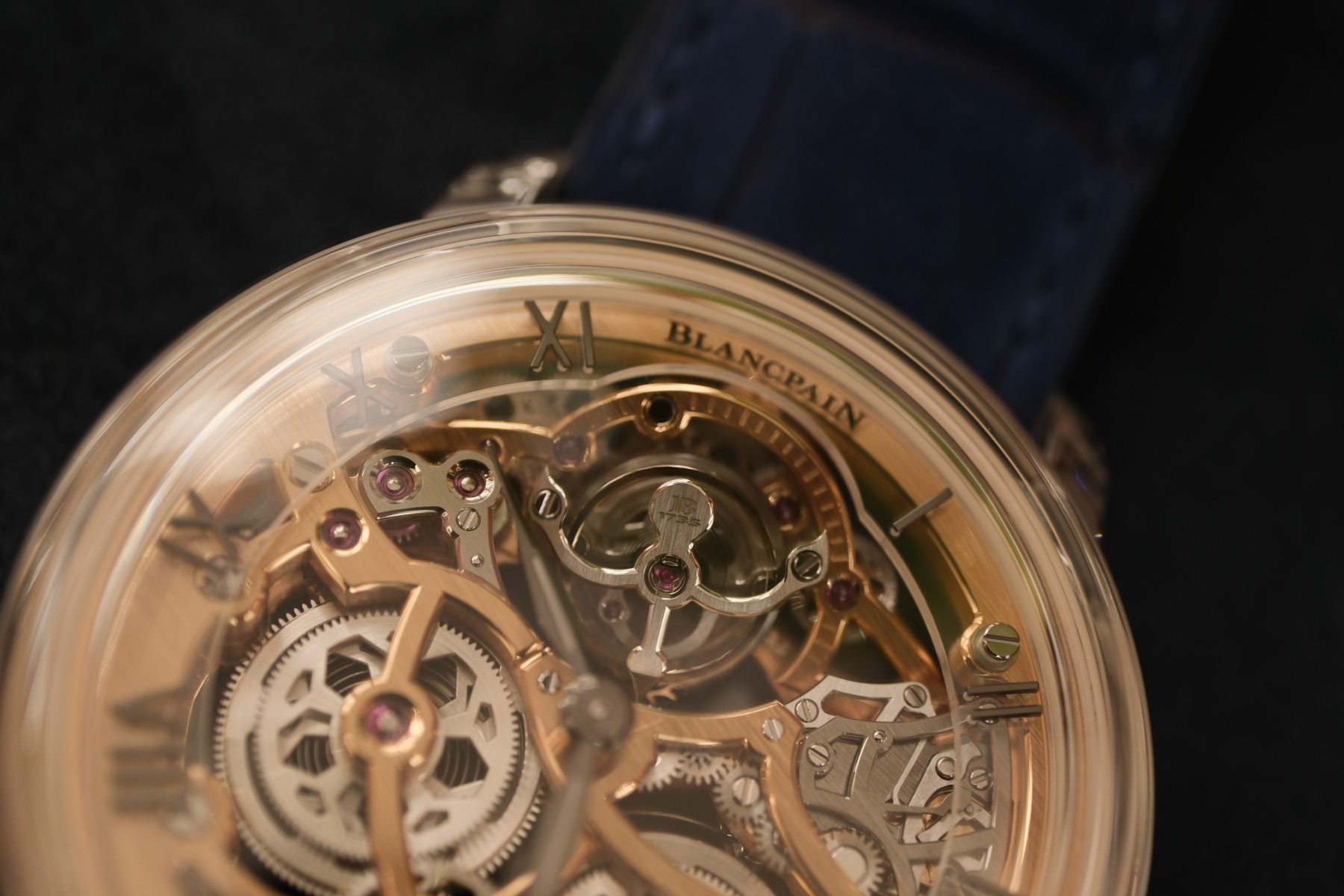
Both mechanisms rotate to average out gravity-induced positional errors, but they work differently. A traditional tourbillon uses a single gear train and a fixed wheel arrangement to power the escapement as the cage rotates. A carrousel has two separate trains: one drives the escapement, while the other rotates the cage. The difference is significant, even if the two mechanisms might look similar.
The carrousel dates to 1892, when Danish watchmaker Bahne Bonniksen developed it in Britain. It largely disappeared during the 20th century before Blancpain revived it for wristwatches in 2008. Since then, the brand has paired carrousels with minute repeaters and chronographs, and even combined a carrousel and tourbillon in a single movement. For the new Carrousel Incliné, Blancpain started from scratch. The manually wound caliber 222ISQ is an entirely new movement featuring a one-minute flying carrousel inclined at 30 degrees. Unsurprisingly, Blancpain didn’t choose that angle just because it looks impressive.
Why incline the carrousel by 30 degrees?
A conventional carrousel rotates parallel to the mainplate, helping to average out positional errors when the watch is vertical. However, when the watch lies flat, the regulator remains horizontal. Tilting it means its orientation continues to change relative to gravity, even when the watch is resting flat.
Blancpain spent four years developing the movement, testing inclinations from 0 to 35 degrees in five-degree increments. The research measured amplitude, rate, and positional variation in six positions. Improvements became significant between 15 and 20 degrees, but 30 degrees offered the best balance of accuracy, movement thickness, and proportions. Each watch therefore comes with an individual chronometry certificate documenting its performance in all six positions throughout the full 100-hour power reserve. Blancpain specifies an average daily rate tolerance of 0 to +2 seconds.
Getting power to the inclined assembly presented another challenge. Rather than accommodating the full 30-degree change at a single gear engagement, Blancpain divides it into two steps of 22 and eight degrees. This lets the carrousel’s separate drive trains operate on the inclined plane without one abrupt change in direction.
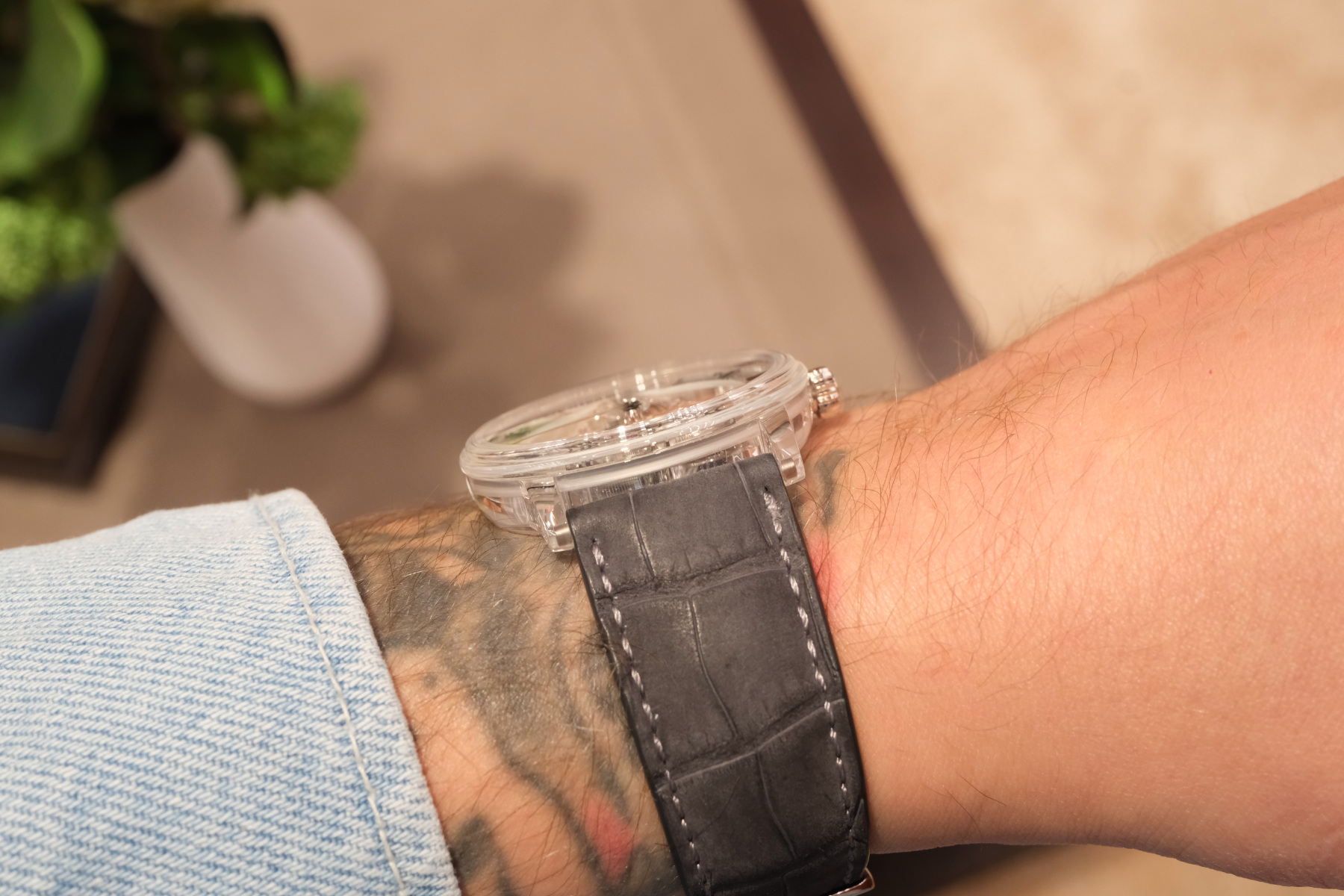
Surprisingly slim on the wrist
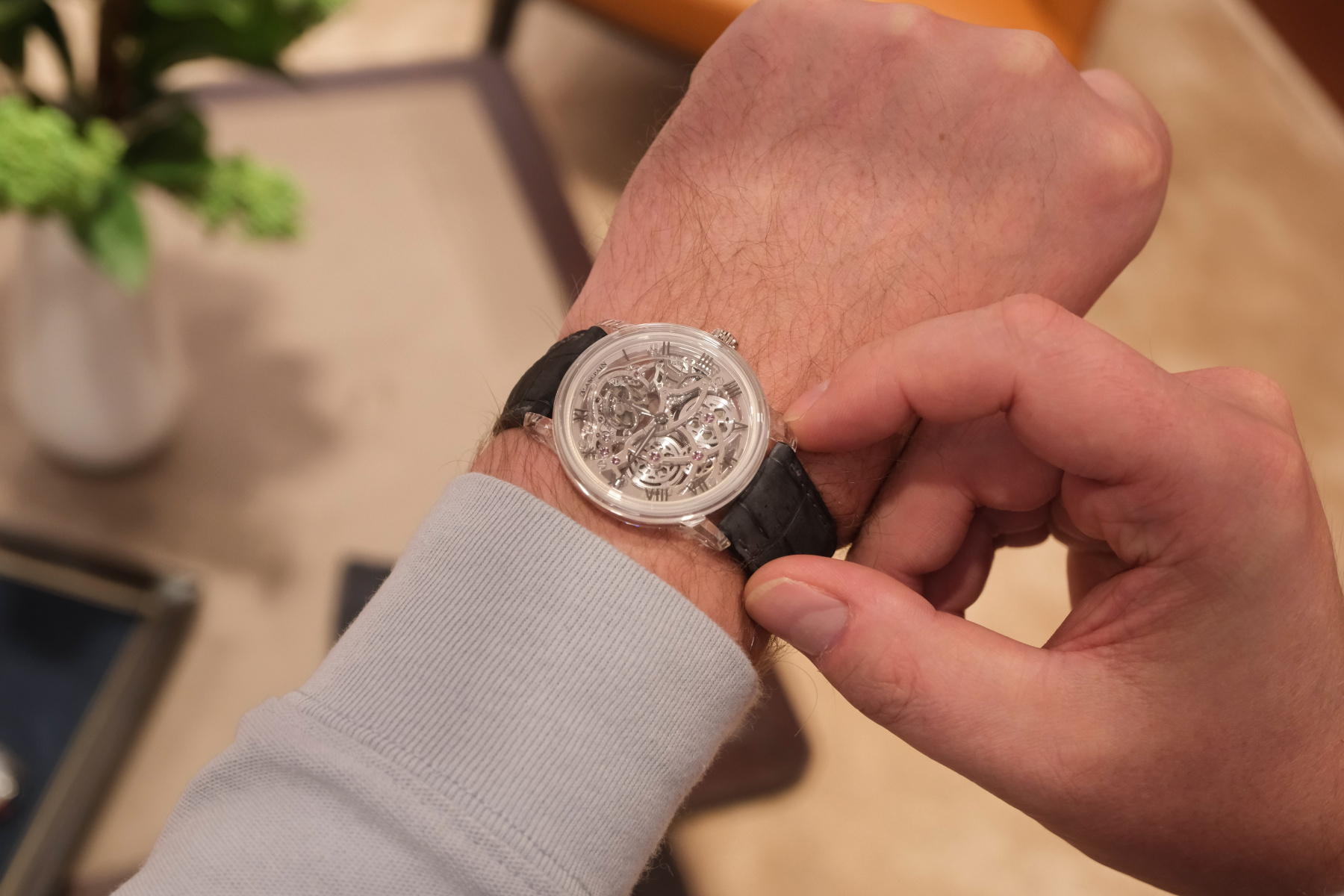
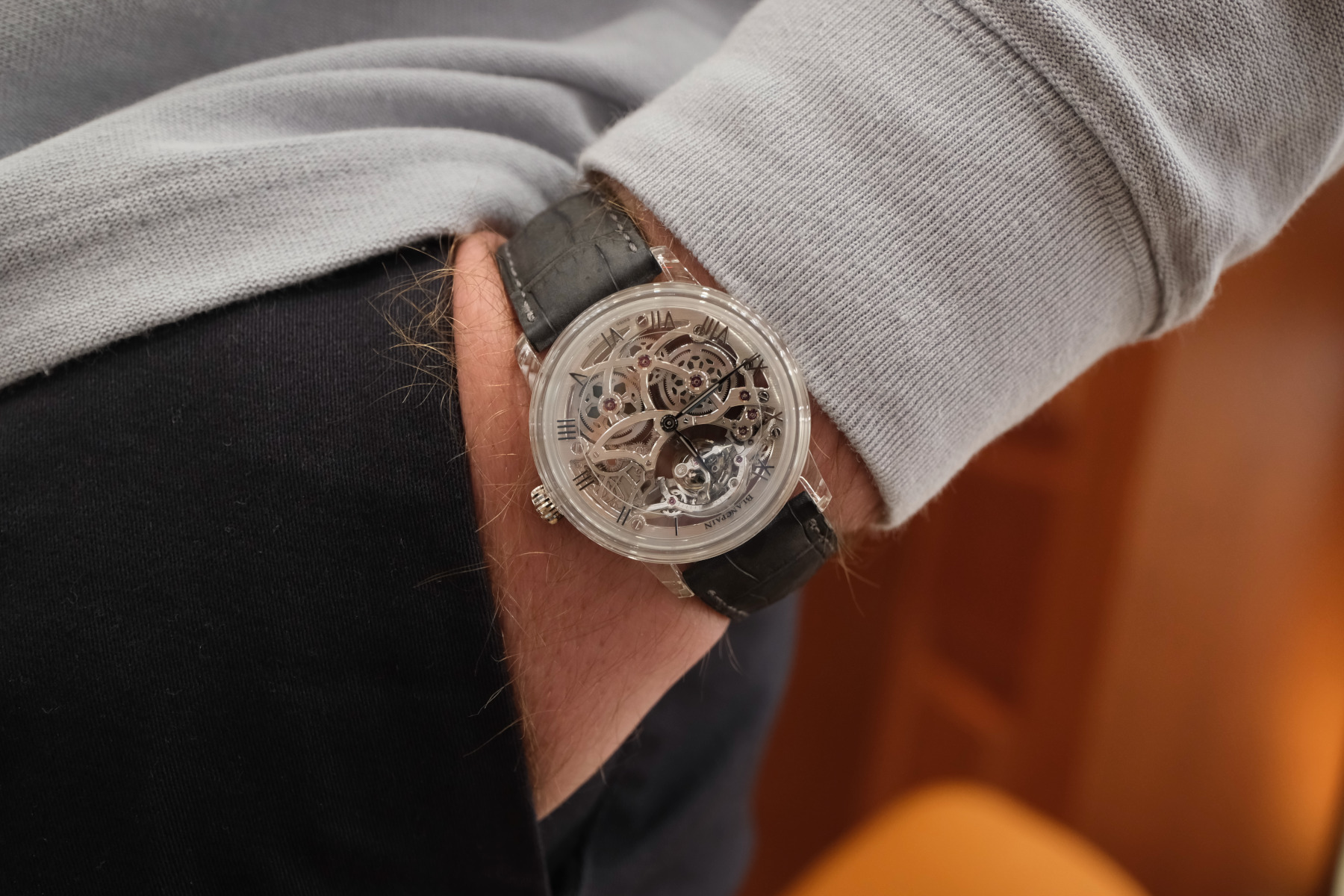
Perhaps the most surprising thing about the Carrousel Incliné is its thickness — or, rather, its slimness. Measuring 40.3mm across and just 11.3mm thick, including the sapphire components, it wears far better than its complicated construction might suggest. The 46.45mm lug-to-lug measurement helps, too. This is a surprisingly compact watch.
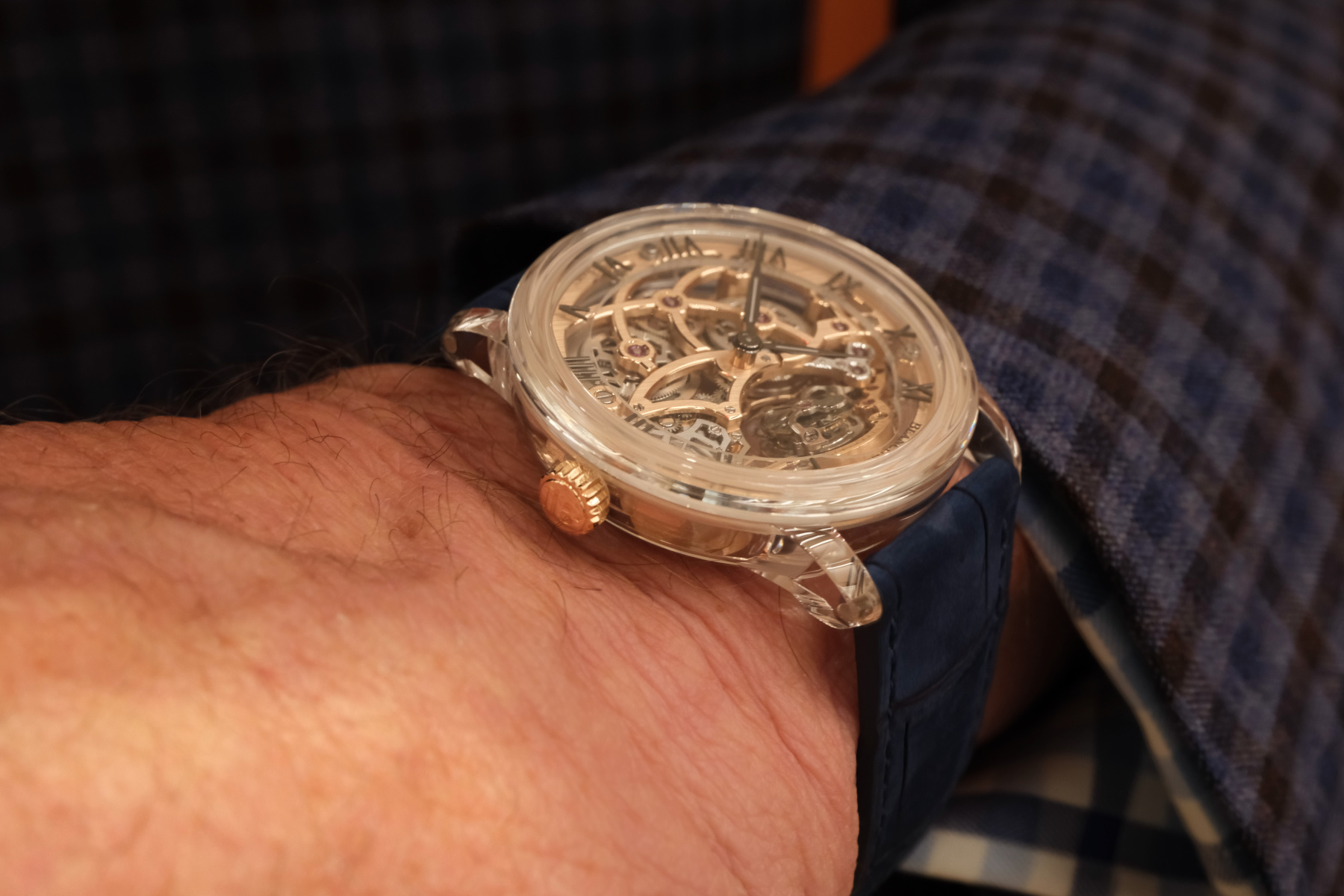
Much of this comes down to the inclined carrousel’s positioning. Rather than stacking the entire mechanism above the movement, Blancpain has split it between the movement’s upper and lower planes. It’s a clever way to accommodate the angle without creating an unnecessarily thick case.
The movement itself measures just 5.3mm thick, increasing to 6.98mm where the cage projects above it. A compact double-ball-bearing support reduces the cage’s thickness while keeping both drive trains visible. All of that is impressive, but the tactile experience matters most when it comes to a watch designed to be worn. The Carrousel Incliné sits remarkably well on the wrist, which I hadn’t necessarily expected given everything happening inside.
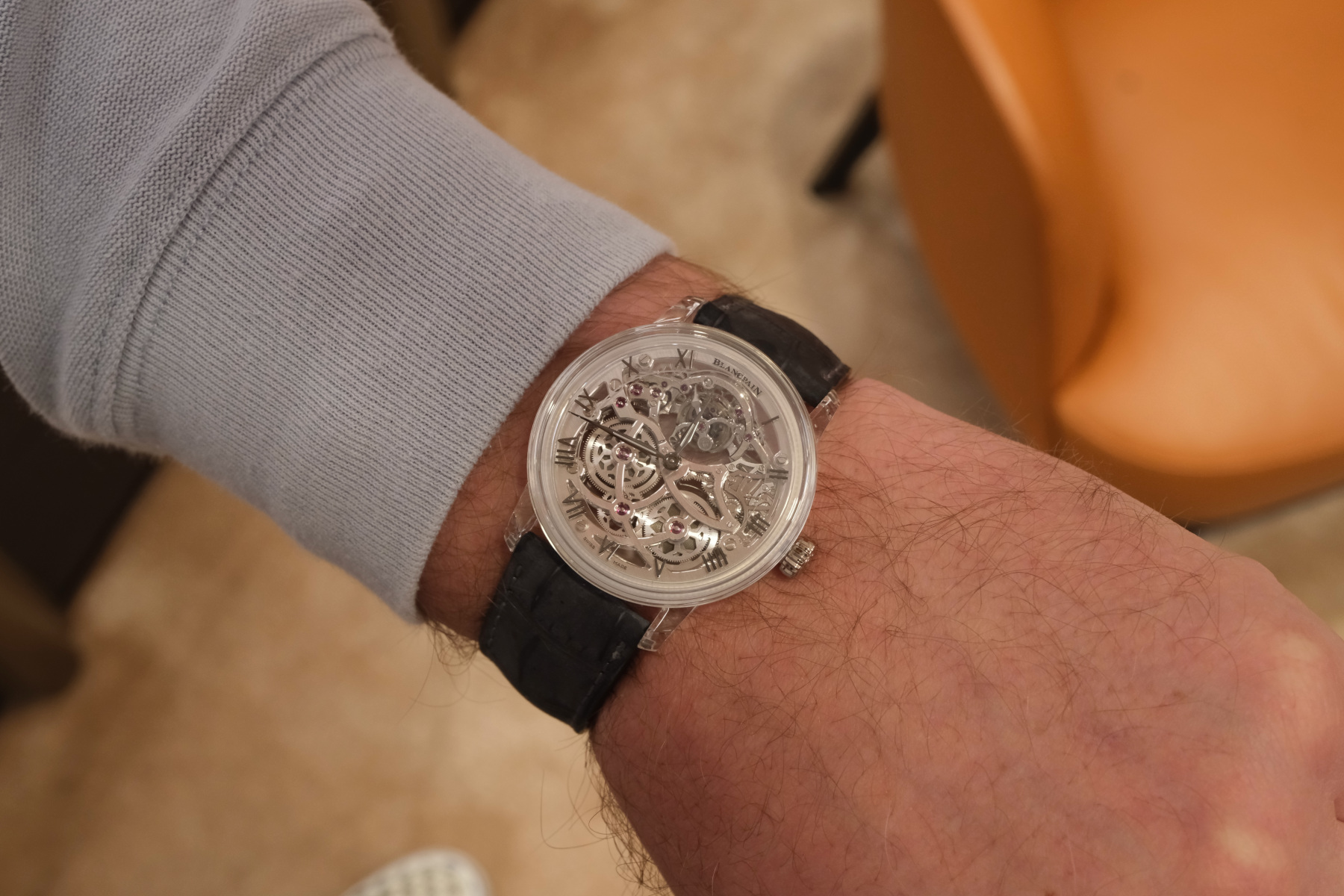
Sapphire was the right choice
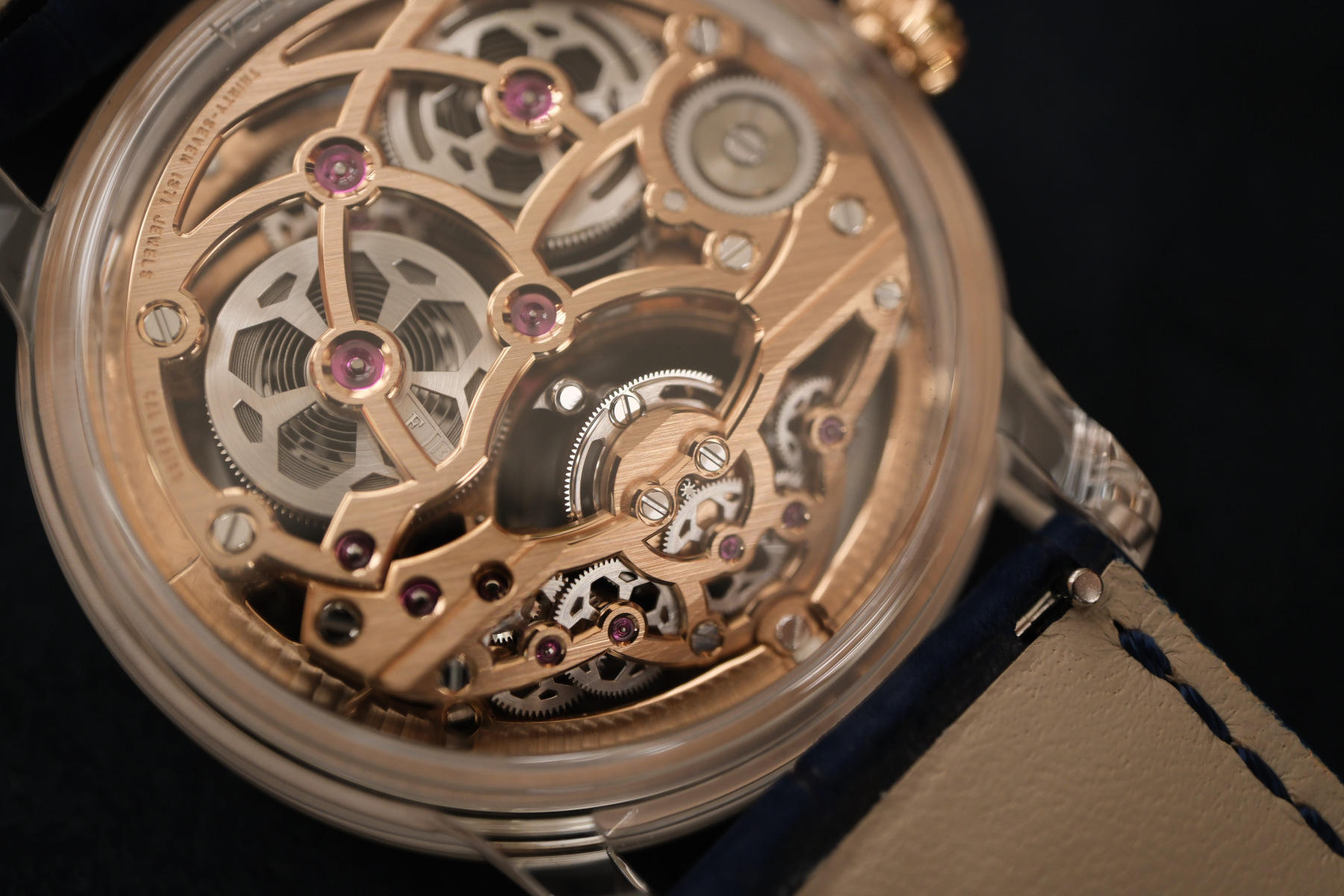
I’ve always liked sapphire cases. Being able to appreciate a movement from the sides, as well as from the front and back, adds another dimension to the experience. I also wouldn’t normally associate such cases with Blancpain, which makes this watch all the more interesting. The Carrousel Incliné is the brand’s first watch with a full sapphire case. The construction comprises two main pieces — an integrated case middle and back, and an integrated bezel and crystal. Blancpain says each takes around 100 hours to machine and polish. Along with the sapphire dial, they offer a clear view of the movement from all sides.
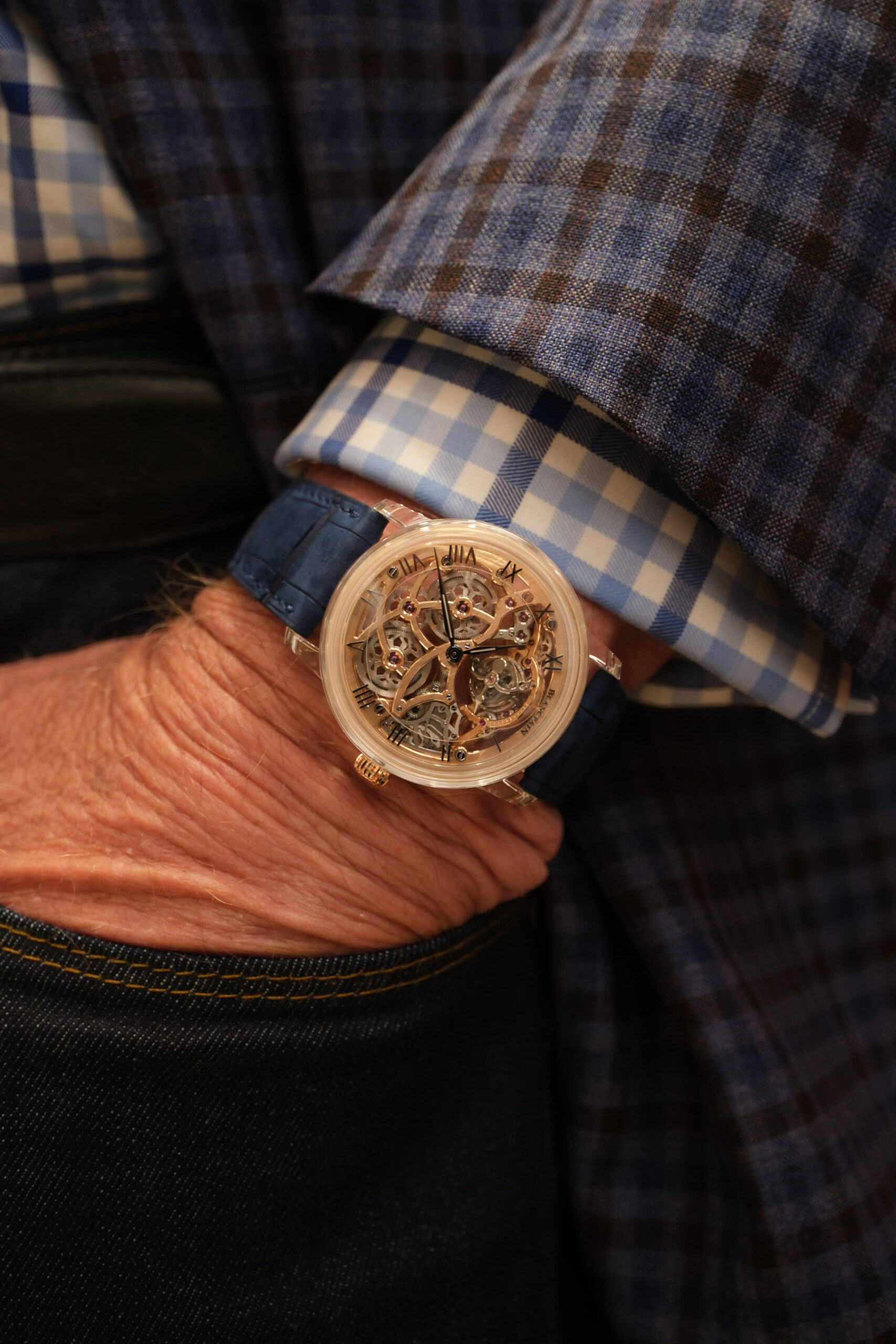
And there’s plenty worth looking at here. The openworked caliber reveals the two drive trains, the winding mechanism, elements of the setting mechanism, and the mainsprings inside their barrels. Even the gear engagements that transfer power to the carrousel are visible from certain angles. Hiding such an involved movement behind a conventional case would feel like a missed opportunity.
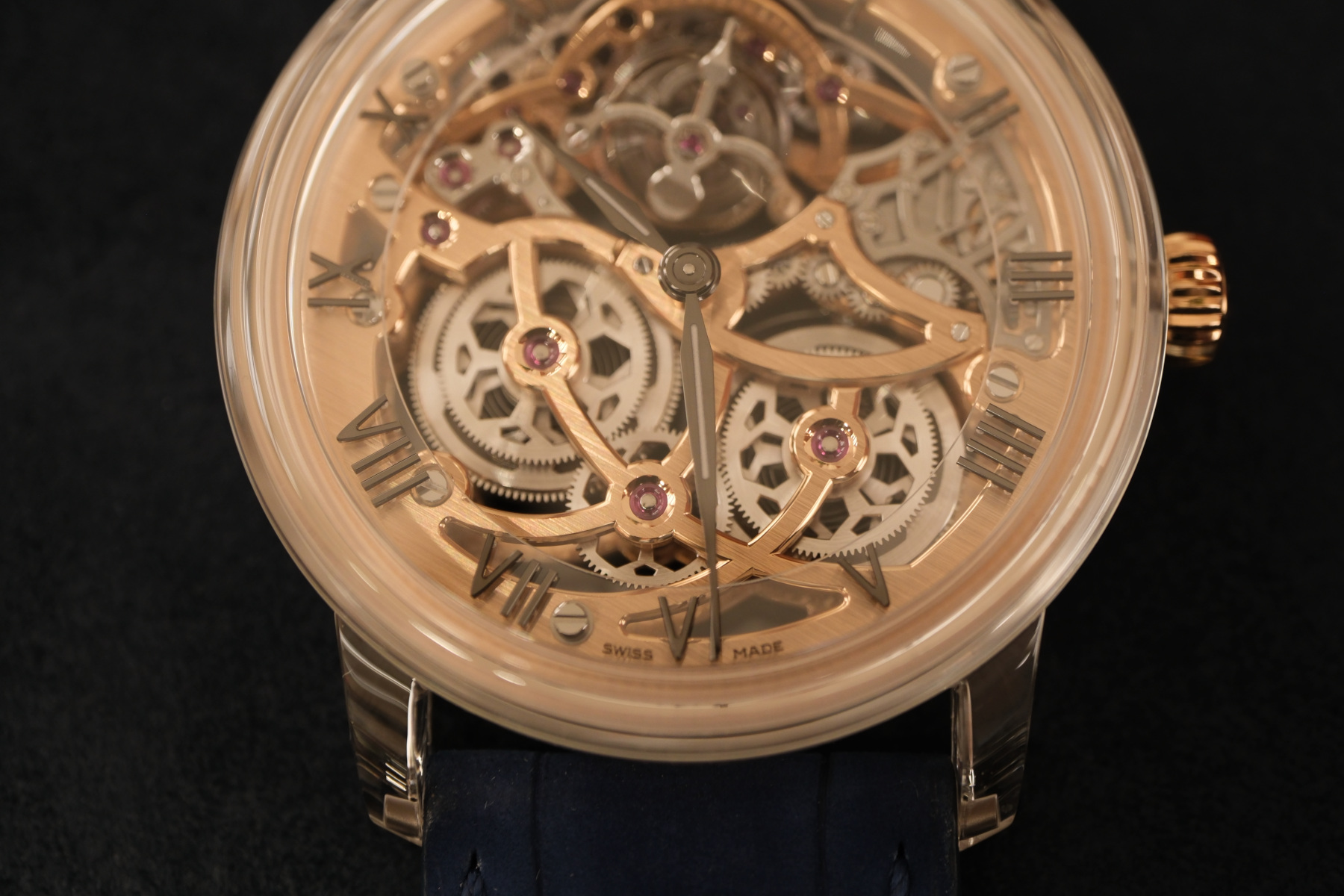
The Carrousel Incliné’s finishing is worth a closer look
Showing off this much of a movement means finishing is especially important. As you’d expect, it was superb. I kept coming back to the inward angles and polished bevels, both of which held up under closer inspection with the conveniently placed loupe. Blancpain states that each caliber 222ISQ receives 210 hours of manual finishing. That includes 253 sharp inward angles, individually shaped and polished, along with a couple of rounded corners for good measure. These are the details I look for in movements at this level. A rotary polishing tool can’t produce a properly sharp internal corner, and those here were on point.
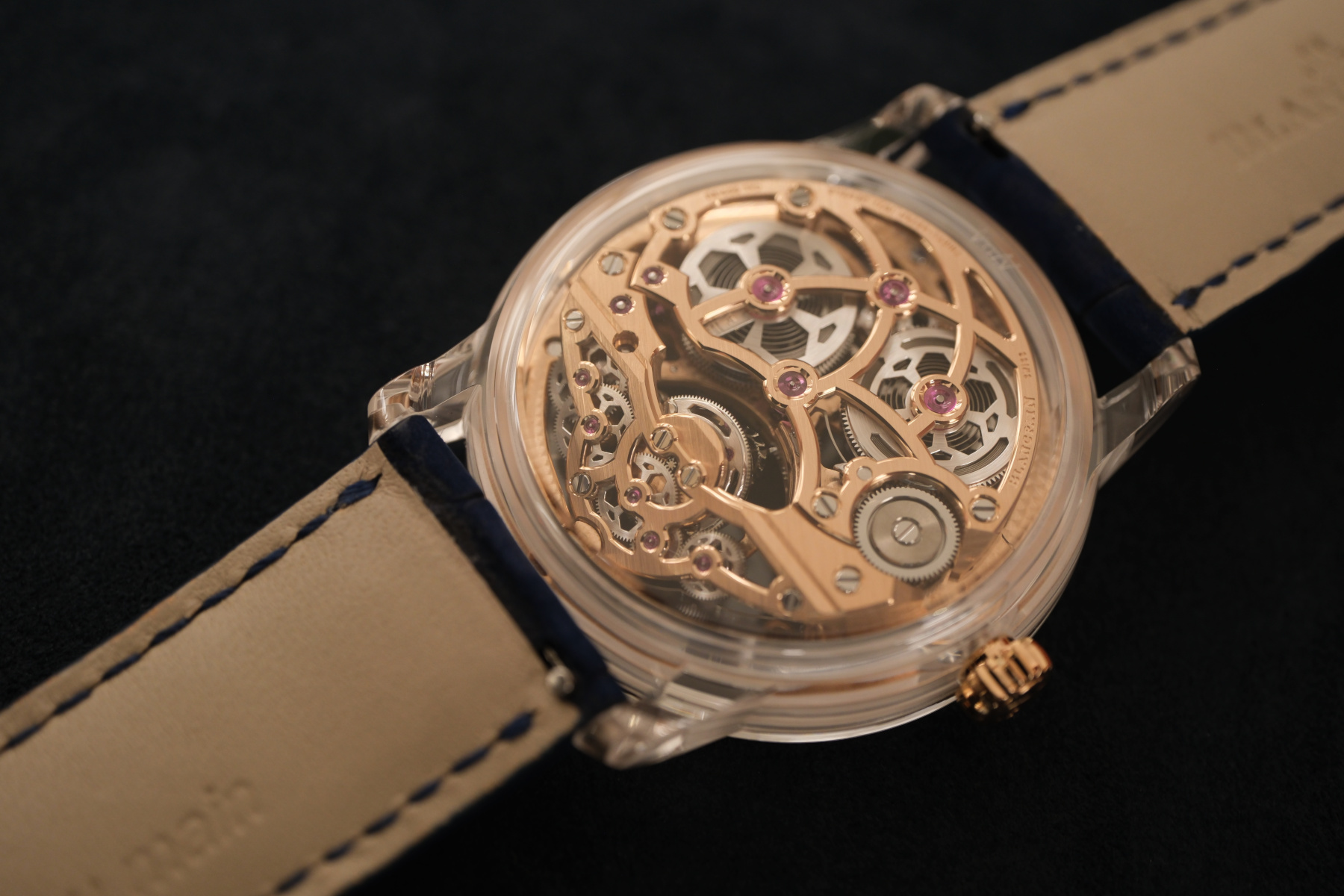
The transparent construction also changes how Blancpain approaches the finishing. The brand describes the movement as having two upper sides. The bridges and mainplate are beveled on both faces, with 30-degree bevels above and 45-degree bevels below. More than 60 custom tools had to be developed for the job. Numbers like these can seem somewhat meaningless when simply written down in a press release. Seeing the result in person gives them some context.
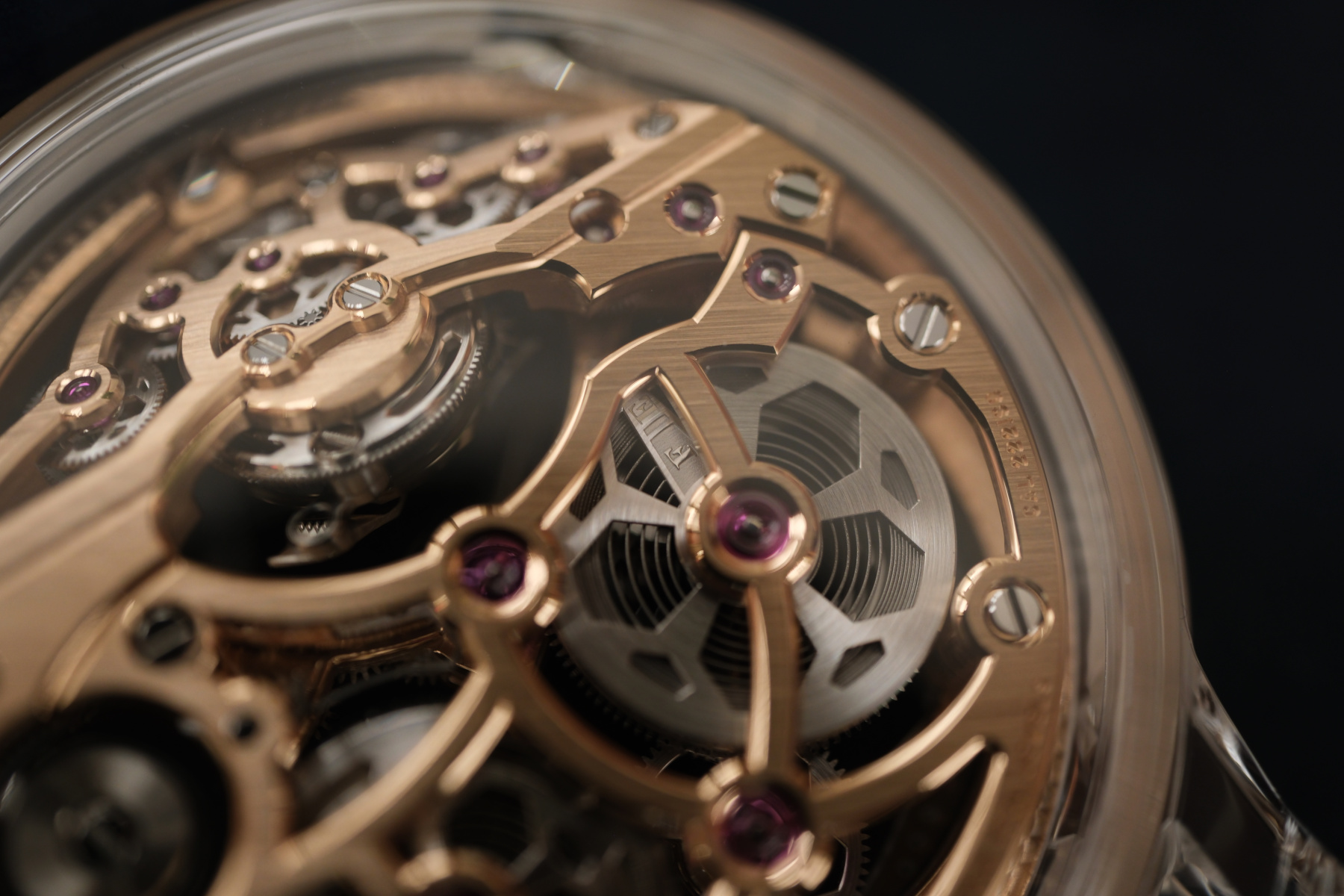
A small power-reserve detail I loved
The manually wound movement has two mainspring barrels in series, delivering a 100-hour power reserve. Okay, that’s cool, but there’s no conventional power-reserve hand or sub-dial, which I might have expected on a watch like this. Instead, the openworked barrels let you see the mainsprings themselves. The tightness of the springs gives you a rough idea of how much energy remains.
That’s nothing groundbreaking, but turn the watch over, and you’ll find a second indication on the barrel near 9 o’clock, marked “F” for full and “E” for empty. It’s easy to overlook among everything else, but I thought it was a neat detail after Jeff pointed it out. Will anyone regularly check the power reserve this way? Probably not. Still, it’s satisfying to find a functional feature integrated into the movement’s architecture rather than added to an already busy dial. It’s hardly an additional complication, but I thought it was a clever little Easter egg. Maybe I’m just easily impressed…
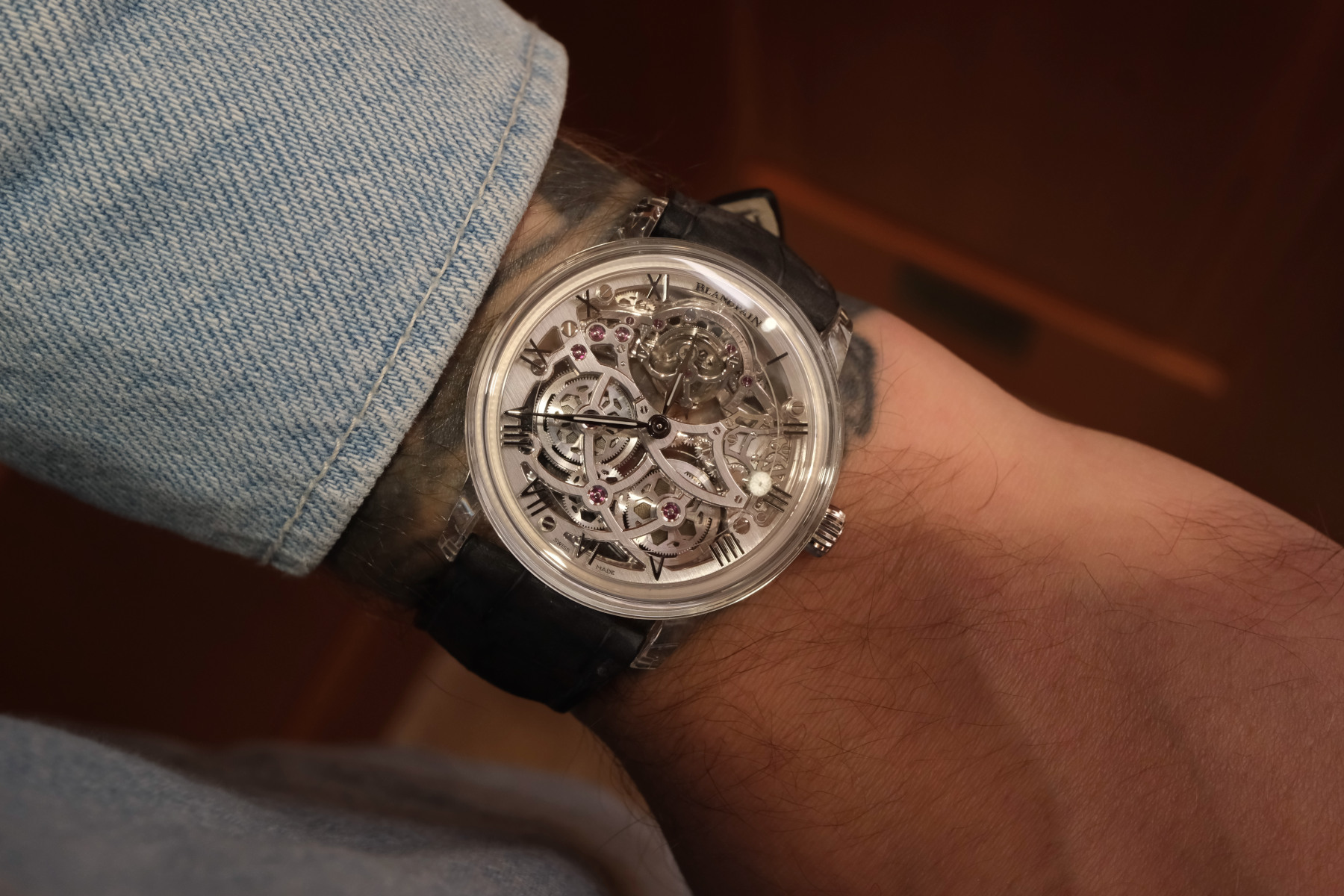
A matter of personal taste
Blancpain offers the Carrousel Incliné with a 5N gold movement, with or without a rhodium plating. Both sit in the same sapphire case, but they look quite different. I preferred the cooler, more monochromatic rhodium-plated version. For my tastes, the restrained color palette helps the architecture and finishes stand out. The unplated version is lovely too, particularly with the blue alligator strap, but it’s a little warmer and bolder than I’d choose.
At CHF 380,000, it’s an aspirational price for most collectors, but it’s also an aspirational watch. Notably, this isn’t a limited edition, although the finishing alone suggests it won’t be made in large numbers. No official annual quantity has been revealed at the time of writing.
I left the boutique that day suitably impressed, particularly by how Blancpain incorporated the inclined carrousel into such a slim case. The finishing and sapphire construction were a pleasure to see, and finally meeting Jeff in person made the visit even better. I’ll just have to remember to call it a carrousel next time…