Guide: Omega Speedmaster Reference Numbers Explained

Since 2014, the Omega Speedmaster Professional has used exceptionally long reference numbers (also referred to as the PIC14 system). The last Speedmaster Professional Moonwatch with a reference number that made sense to me was the 3570.50. Six digits are also easy to digest and dissect. Officially, it was eight digits (3570.50.00), but, as most collectors are pragmatic, the last two digits could be easily ignored. Omega has also used different names for its reference numbers, which I will try to explain in this article without causing too much confusion.
A reference number is not a serial number
Believe it or not, there’s still some confusion sometimes between serial and reference numbers. On rare occasions, you will also see part and caliber numbers put into the mix. Especially when looking at some of the 1980s Constellation (Manhattan) models, you can see them offered either with their caliber numbers (1422 and 1431, for instance) or even with the case part as a reference number.
The confusion is perfectly explainable, as those models have the caliber number engraved on the outer of the case back and the case part number on the underside. If you don’t dive into the topic, it’s easy to mix all these numbers up. The same applies to some Speedmasters during this “transition” period, when Omega went from its Mapics coding system to the PIC (Product Information Code) coding system.
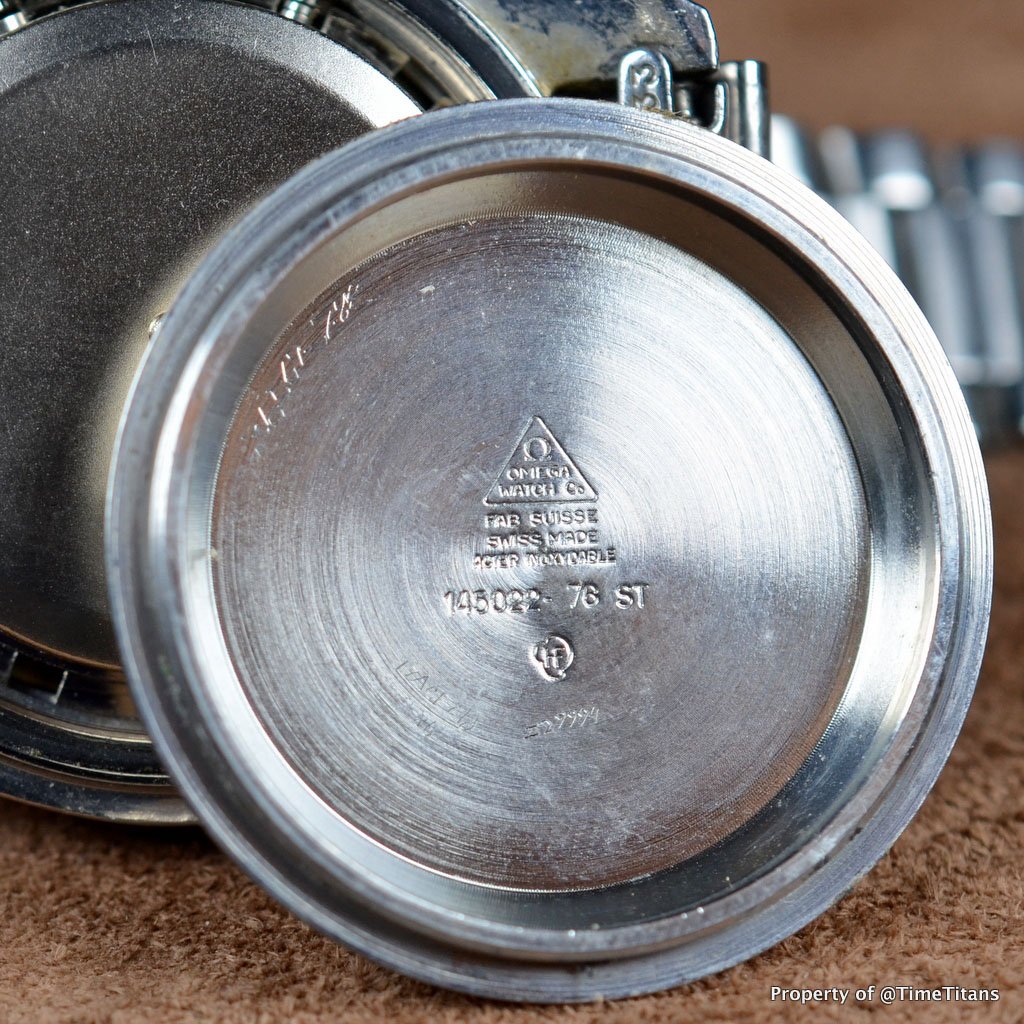
For example, the Speedmaster Professional reference 145.022/145.0022 was in production from 1968 to 1988. In 1988, the Omega Speedmaster Professional received a PIC-based reference number, in this case 3590.50 for the standard stainless steel model with Hesalite crystal. However, on the inside of the case back, you (or your watchmaker) will still find a number that looks very similar to the previous reference number for this model (145.0022). More about this later.
Where to look
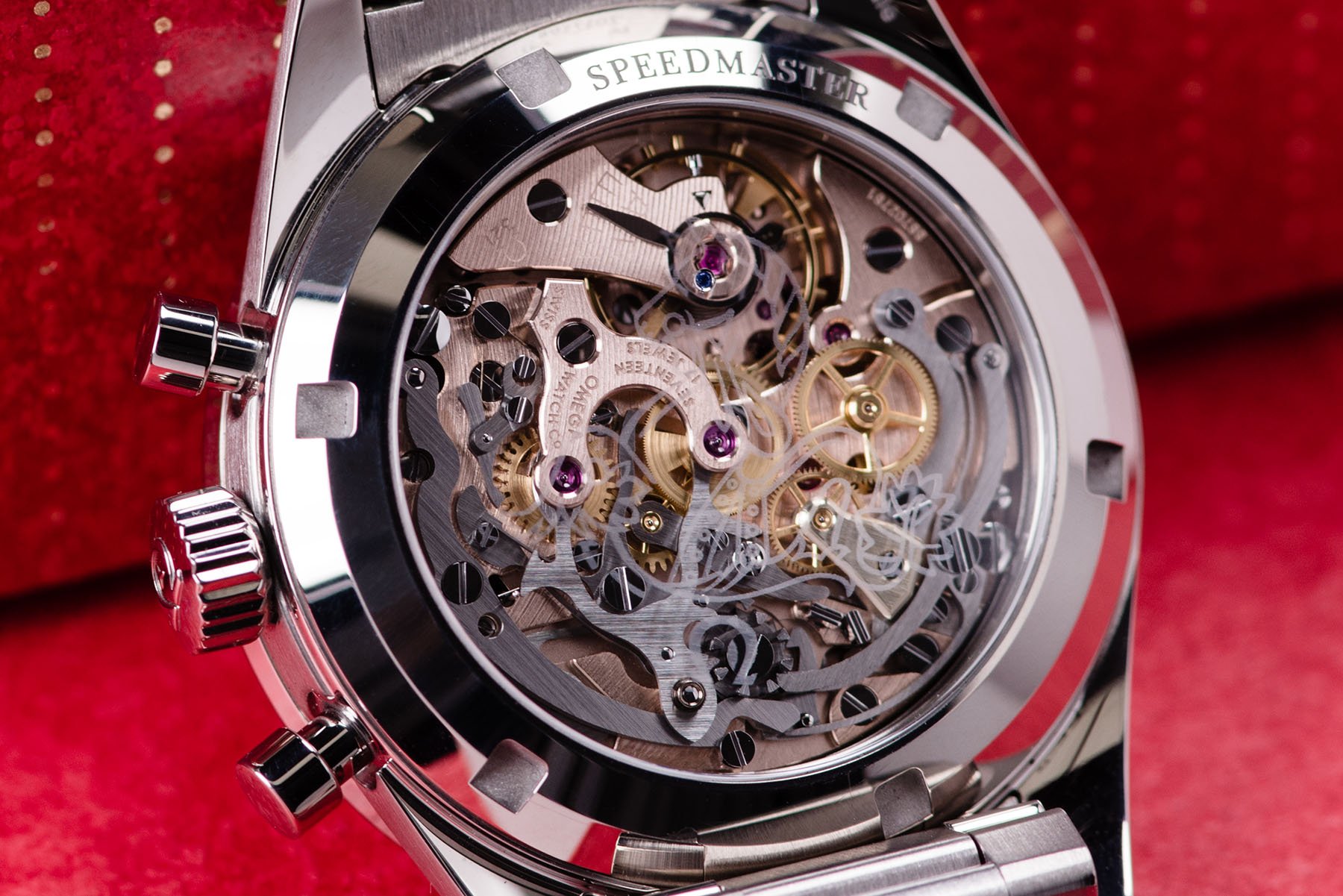
The serial number is unique to each watch and is engraved on one of the movement bridges; since 1990, it has also been engraved on the inside of the lug at 7 o’clock. With the serial number, you can determine the production year of your watch, and with the reference number, you can determine exactly which model it is. Of course, these numbers are linked. Omega’s serial number information will include the watch’s reference number (but not vice versa).
Not everything in this article applies to all Omega models, as our focus is the Speedmaster. Other Omega watches often started using the current PIC14 earlier than the Speedmaster collection did. With that said, let’s get rid of the clutter and guide you through all the different reference coding methodologies that Omega used for its Speedmaster watches.
Two letters and four digits (1957–1962)
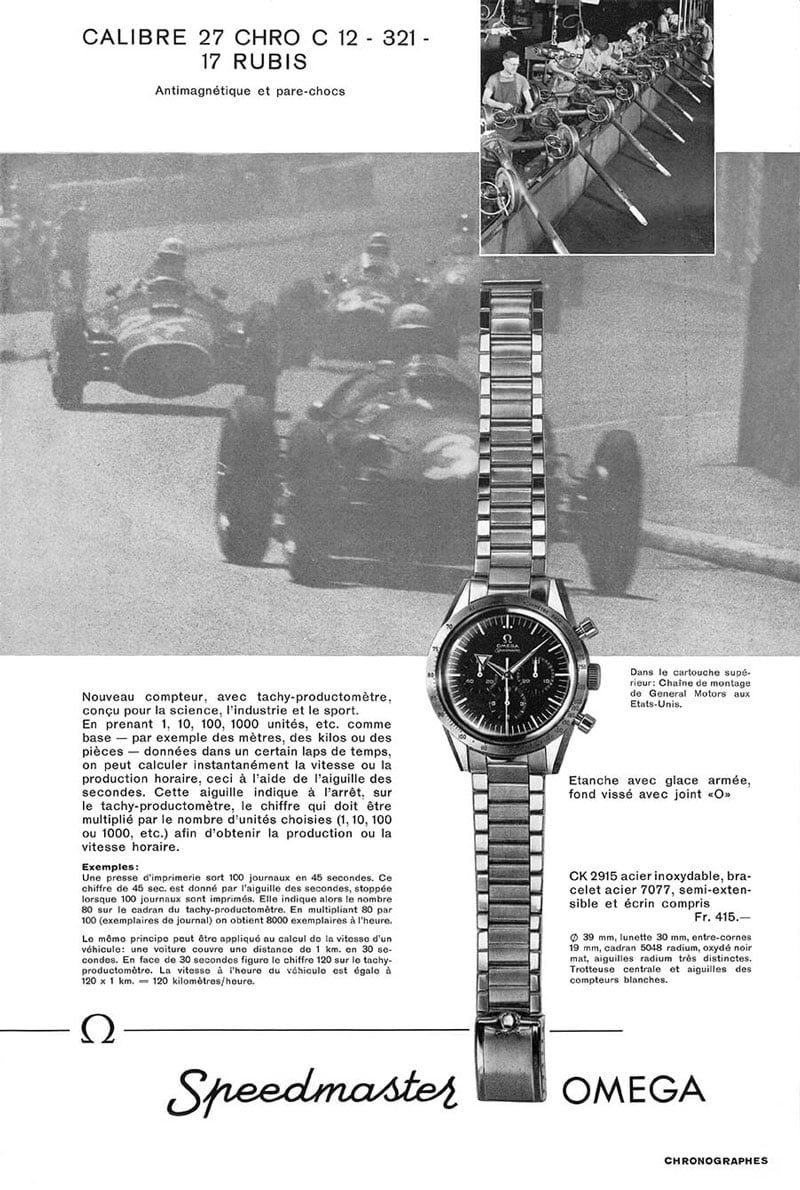
The first Omega Speedmaster debuted in 1957 and received reference number CK2915. The second model followed in 1959, with reference CK2998. But except for the two letters, there wasn’t much logic in the number for the watch. It was just an identifier, and a CK2915 was a completely different model from a CK2910 (dress watch), for example. For the Speedmaster references CK2915 and CK2998, the two letters “CK” denote a stainless steel case. There were also other letter codes — “OJ” for 14K yellow gold, “OT” for 18K yellow gold, “OG” for 18K white gold, and “OK” for gold-capped cases. But as you know, there were only two steel Speedmasters at the time, so both used “CK”. The reference numbers are located on the inside of the case back, while the movement shows the serial number and caliber number (321, in both cases).

Mapics (1962–1988)
In 1962, Omega introduced the Speedmaster ST105.002. Basically, it was the last iteration of the CK2998 with a new reference-number coding called Mapics. In this new coding system, we’ll find a clear classification and type of watch.
The “ST” stands for stainless steel, and for other materials, Omega used “BB” (rose gold), “BA” (18K yellow gold), “BC” (18K white gold), and “DD” (steel & 14K gold). For instance, the 1969 Omega Speedmaster Professional “Tribute to Astronauts” watch had reference BA145.022-69. So let’s have a closer look at what this means.
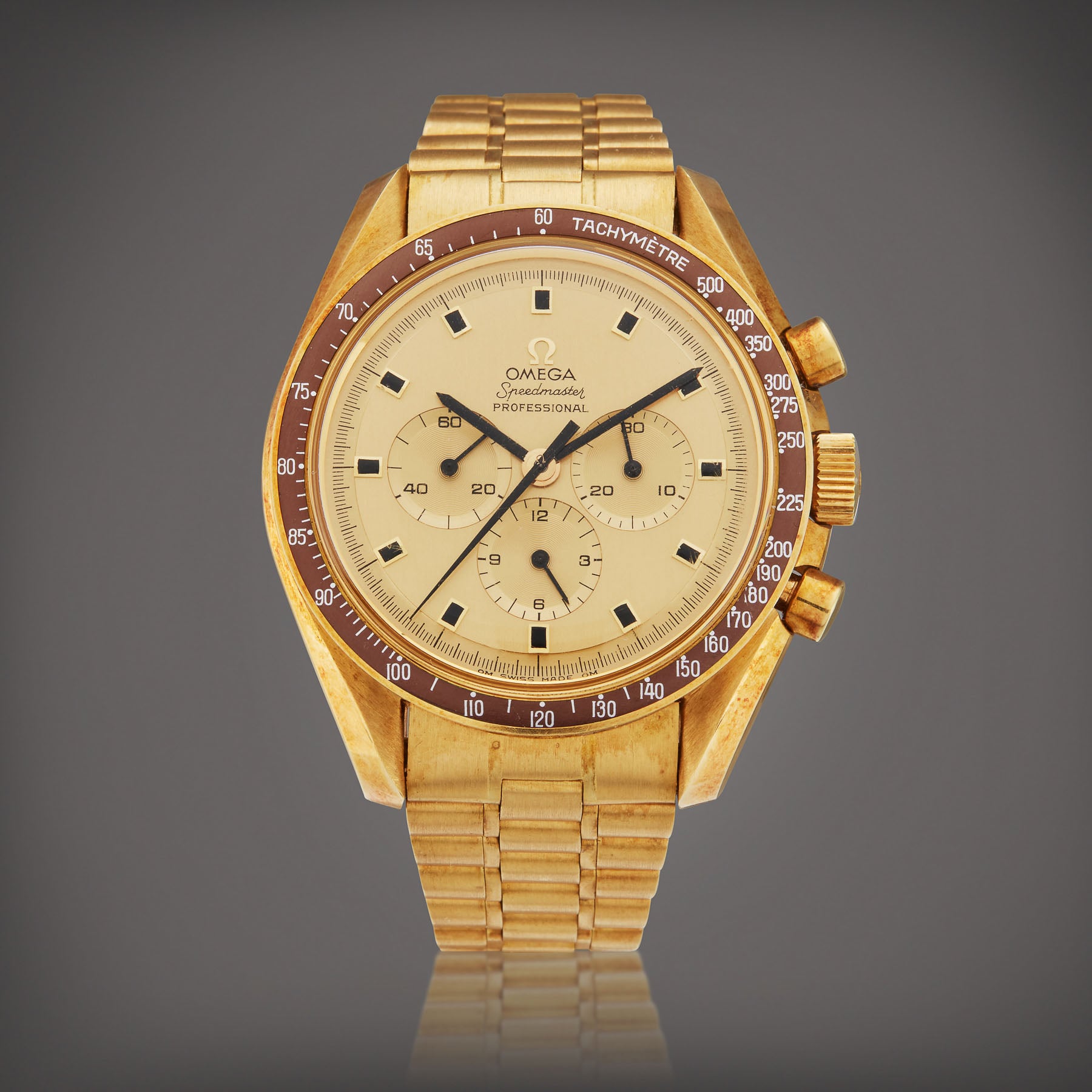
“BA” stands for 18K yellow gold. The first digit, “1”, denotes a gentleman’s watch, “4” indicates manual winding, and “5” represents a non-waterproof model. The last three digits, “022” in this case, are simply an identifier for the watch. For example, a 145.034 is a Speedmaster Professional Mark II series.
The confusing bit
The often-confusing part is the year designation, the “-69” in the case of the BA145.022-69. It’s here that people (and sellers) often believe it is connected to the watch’s production year. This year designator indicates the production year of the case, not the entire watch. So you will find Speedmasters with “ST145.022-69” engraved inside the case back but produced in early 1971. The precise production date can only be determined from the serial number engraved on the movement or on one of the lugs (after 1990).

145.0012 and 145.0022
According to Grégoire Rossier and Anthony Marquié, who did excellent research on this topic for the Moonwatch Only books, Omega updated the Mapics coding in 1970 with an extra digit. After 1970, 145.022 became 145.0022. This means that some of the watches with case backs engraved with “145.022-69” (and the straight-text engraving “First Watch Worn On The Moon”) are officially already a reference 145.0022.
It’s all slightly confusing, but in short, the Omega Speedmaster Professional reference 145.0022 includes watches engraved with “145.022-69”, “145.022-71”, “145.022-74”, “145.022-76”, and “145.022-78”. From 1981 to 1988, the Speedmaster Professional 145.0022 was engraved with “145.022” inside the case back. There are always exceptions to a rule, of course. For many years, Omega has also used 145.0012 and 145.0022 as case numbers for spare/service parts.

3570.50
PIC System (1988–2007)
In 1988, Omega introduced the Speedmaster Professional ref. 3590.50 with 145.0022 as the reference number for the case only. The Speedmaster models used Omega’s PIC (Product Identity Code) from 1988 to 2014. In 2007, all other Omega models received an updated PIC code consisting of a whopping 14 digits. The Speedmaster Professional was spared from using the PIC14 code until 2014.

Constellation ’95 ref. 1210.10
The PIC system is used to identify the specific execution of an Omega watch. A 3570.50 can be decoded as follows: the first digit indicates the product family (“3” for Speedmaster), the second digit indicates the case and bracelet/strap material (“5” for stainless steel), the third and fourth digits are the model code, the fifth digit indicates the color of the dial (“5” for black), and the sixth digit indicates the type of hour markers (“0” for markers, numerals mixed).
Find a full PIC guide below:
| Digit(s) | Value(s) | Meaning |
|---|---|---|
| First digit | 1–5 | Collection 1 = Constellation 2 = Seamaster 3 = Speedmaster 4 = De Ville 5 = Louis Brandt |
| Second digit | 1–8 | Material 1 = Gold case and bracelet 2 = Bicolor case and bracelet 3 = Bicolor case and partially bicolor bracelet 4 = Bicolor case and steel bracelet 5 = Steel case and bracelet 6 = Gold case and leather strap 7 = Bicolor case and leather strap 8 = Steel case and leather strap |
| Third and fourth digits | 00–99 | Product variation |
| Fifth digit | 1–7 | Dial color 1 = Champagne 2 = White 3 = Silver 4 = Grey 5 = Black 6 = Ivory 7 = Blue |
| Sixth digit | 0–5 | Hour markers 0 = Mixed 1 = Indices 2 = Arabic numerals 3 = Roman numerals 5 = Diamonds |
| Seventh and eighth digits | 00–04 | Strap combination 00 = Metal bracelet 01 = Black strap 02 = Brown strap 03 = Blue strap 04 = Green strap |
The third and fourth digits are interesting, as “10” would indicate it’s the Speedmaster Reduced model, “70” is the Moonwatch, “72” is the Moonwatch with sapphire crystal, and “94” is the ’57 Replica. At this point, a list of all model variations is not available.
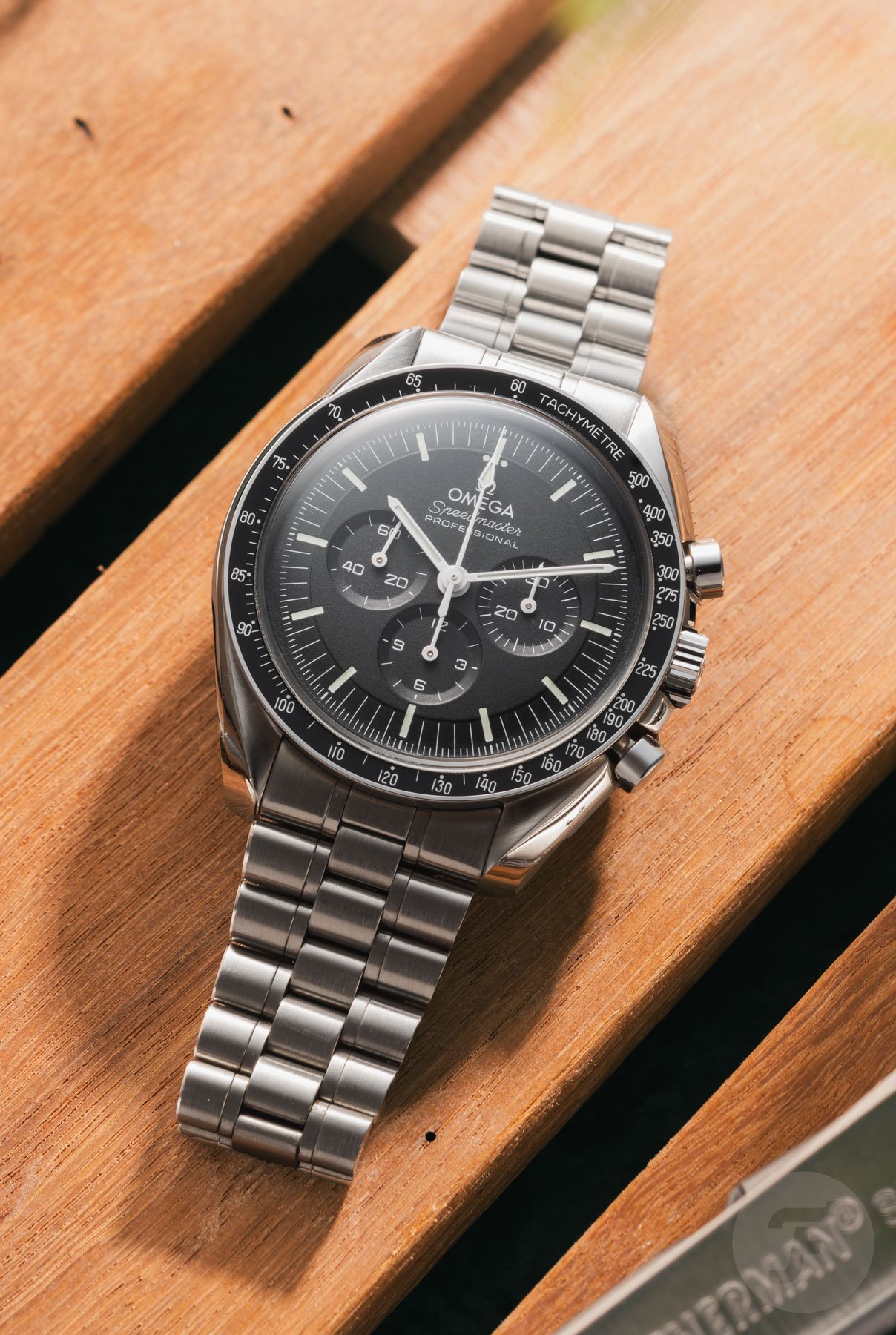
Ref. 310.30.42.50.01.001
PIC14 System (2007 onwards)
In 2007, Omega began using a longer coding system to indicate specific details about a watch, such as the diameter and type of movement. However, it would take the brand until 2014 to apply this to the Speedmaster Professional. In 2014, the 3570.50 transitioned into the 311.30.42.30.01.005 (today’s Moonwatch with Hesalite has reference 310.30.42.50.01.001). We can break this PIC14 format down to AAA.BB.CC.DD.EE.FFF:
| Code | Value(s) |
|---|---|
| AAA | Collection Code |
| BB | Material and strap |
| CC | Case diameter |
| DD | Movement and complications |
| EE | Dial |
| FFF | Sequence number |
AAA
For now, the (AAA) collection code has the following values:
| Code | Speedmaster |
|---|---|
| 304 | Co-Axial Master Chronometer Moonphase Chronograph |
| 310 | Speedmaster (Professional) Moonwatch Master Chronometer |
| 311 | Speedmaster Professional Moonwatch |
| 318 | X-33 |
| 324 | Co-Axial Chronograph (e.g. Speedmaster 38) |
| 329 | Chronoscope & Racing Master Chronometer |
| 332 | Speedmaster ’57 Master Chronometer |
Currently, you will find the Speedmaster Dark Side of the Moon series starts with “310” as AAA code, but so do the Speedmaster Professional Moonwatch and the Speedmaster Silver Snoopy Award. The other codes (BB.CC.DD.EE.FFF) depict the specific Speedmaster variation.
The other collection codes are:
| Collection | AAA Code(s) |
|---|---|
| Constellation | 130, 131 |
| Seamaster | 210, 215, 220, 227, 233, 234 |
| De Ville | 424, 425, 428, 435, 528, 529 |
| Olympic Game Collection | 522 |
| Specialties | 511, 518 |
BB
The BB value indicates the material of the watch case and bracelet (or strap). For instance, the Moonwatch (reference 310.30.42.50.01.001) has a value of “30” — according to Omega, this means “stainless steel + other material.” In this case, “other material” refers to the use of aluminum in the bezel. An Omega Speedmaster Professional in full Moonshine Gold has a value of “60” (reference 310.60.42.50.10.001, for example). Here, “60” refers to “gold + other material,” as it’s 18K gold and ceramic in this case.
CC
This value translates to the case diameter in millimeters. Hence, the Moonwatch (310.30.42.50.01.001) has “42” as the value, and the recently introduced Speedmaster 38 has, of course, “38” as its value (reference 324.30.38.50.01.002).
DD
This value is interesting, as it not only indicates the type of movement but also the number of complications.
| First Digit | Type of Movement |
|---|---|
| 0 | Mechanical |
| 1 | Mechanical Chronometer |
| 2 | Mechanical with Co-Axial |
| 3 | Mechanical Chronograph |
| 4 | Mechanical Chrono Chronometer |
| 5 | Mechanical Chronograph with Co-Axial |
| 6 | Quartz |
| 7 | Quartz Chronograph |
The second value simply indicates the number of complications, not their type. Interestingly, when the first digit is “5” (as on the Moonwatch), the second digit remains “0”. It’s the number of complications on top of the chronograph. The 45mm Speedmaster Chrono Chime model has “52” in its reference (522.50.45.52.03.001), meaning it has 2 complications (split-seconds and a chiming function) in addition to the time and chronograph (as “5” already indicates it’s a chronograph). The Speedmaster X-33 Skywalker has reference 318.90.45.79.01.001, and the DD field consists of “79”. This means it is a quartz chronograph (7) with 9 (or more) complications.
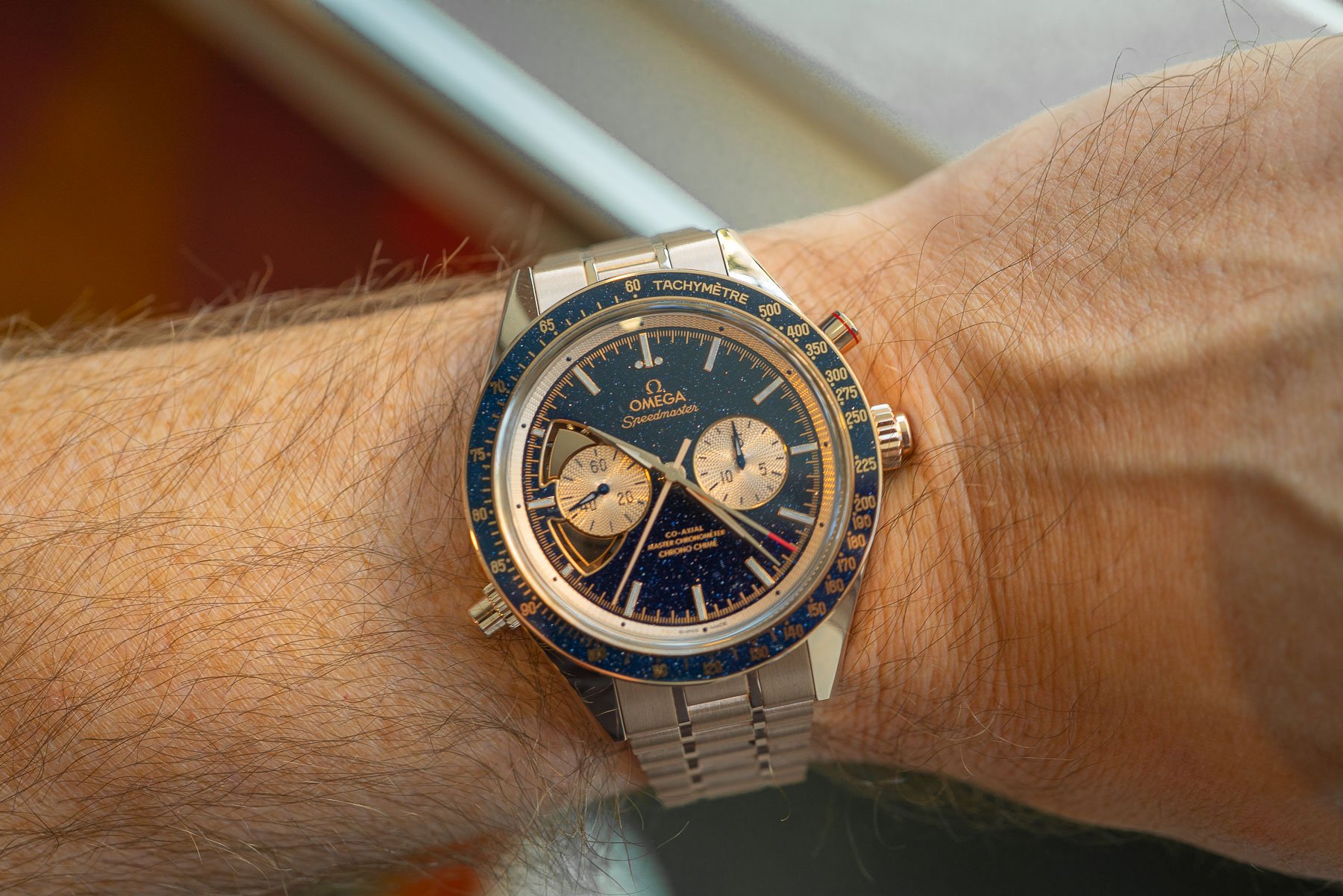
Chrono Chime ref. 522.50.45.52.03.001
EE
This value denotes the dial color. Note that ceramic dials are not considered a special material; they are just coded by their color.
The numbers and colors are different from the PIC(8) coding used from 1988 to 2007. Now, the colors are as follows: 01 = black, 02 = silver, 03 = blue, 04 = white, 05 = white MoP, 06 = gray, 07 = color mother-of-pearl, 08 = champagne, 09 = ivory, 10 = other colors, 11 = red, 12 = yellow, 13 = brown, 99 = other (gem-paved/titanium/special and precious materials). Values 51–63 indicate specific dial colors with precious stones added, and 64 = sapphire.
FFF
This value is simply the model’s sequence number. Omega’s Moonwatch with Hesalite is reference 310.30.42.50.01.001, and the sapphire version is reference 310.30.42.50.01.002, for instance.

Decoding your Speedmaster reference
If you’re not into Speedmasters, this article is probably not for you. The Omega reference numbers only matter to those interested in buying a specific Speedmaster model or learning more about its quirks.
Although the current Speedmaster (or Omega) references have become difficult to remember by heart, there’s certainly logic to them. I hope this article will help readers understand the different reference coding systems Omega has used, as well as that detailed information about production years and so on is only available based on the watch’s serial number.
If you have any additions or corrections to this article, feel free to comment below, and I will be happy to insert any additional useful information.