After Hours In Glashütte: Nomos Dims The Lights With The Six-Piece Noir Series

Picture a Nomos Glashütte timepiece. You’ll likely see a silver-plated dial, crisp black numerals, and slender, thermally blued hands in a svelte stainless steel case. Nothing is superfluous. Every detail reflects clean, German restraint. For more than three decades, this has defined the Nomos aesthetic.
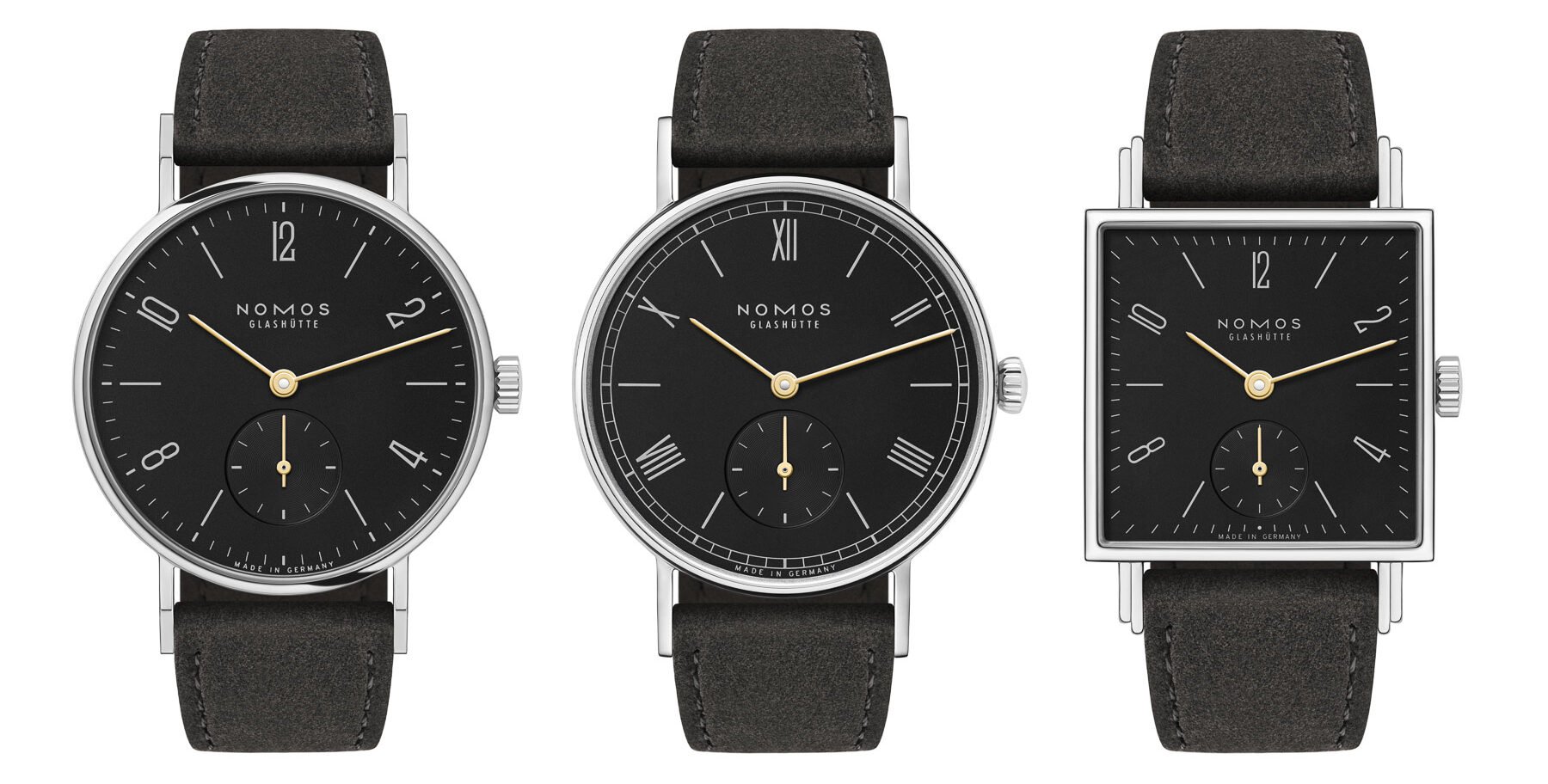
Even the most disciplined watchmakers, however, occasionally like to stay out past midnight. With the new Noir Series, Nomos dresses three of its smallest and most storied hand-wound models for the evening. The collection comprises the Tangente 33, Ludwig 33, and square Tetra 27. Their familiar white dials give way to galvanized, matte black ones with warm, gold-colored hands. The six-watch lineup includes each model in stainless steel or solid 18K yellow gold with hand-wound movements inside.
This certainly isn’t Nomos’s first time using yellow gold. You might remember the brand’s recent precious-metal offerings, the Tangente Gold and Ludwig Gold. Along with earlier Neomatik Gold editions, these releases showed that stark Bauhaus geometry could accommodate some opulence without losing its restraint. However, this marks the first time Nomos has grouped these models into a tuxedo-inspired sub-collection.
Three shapes, two metals
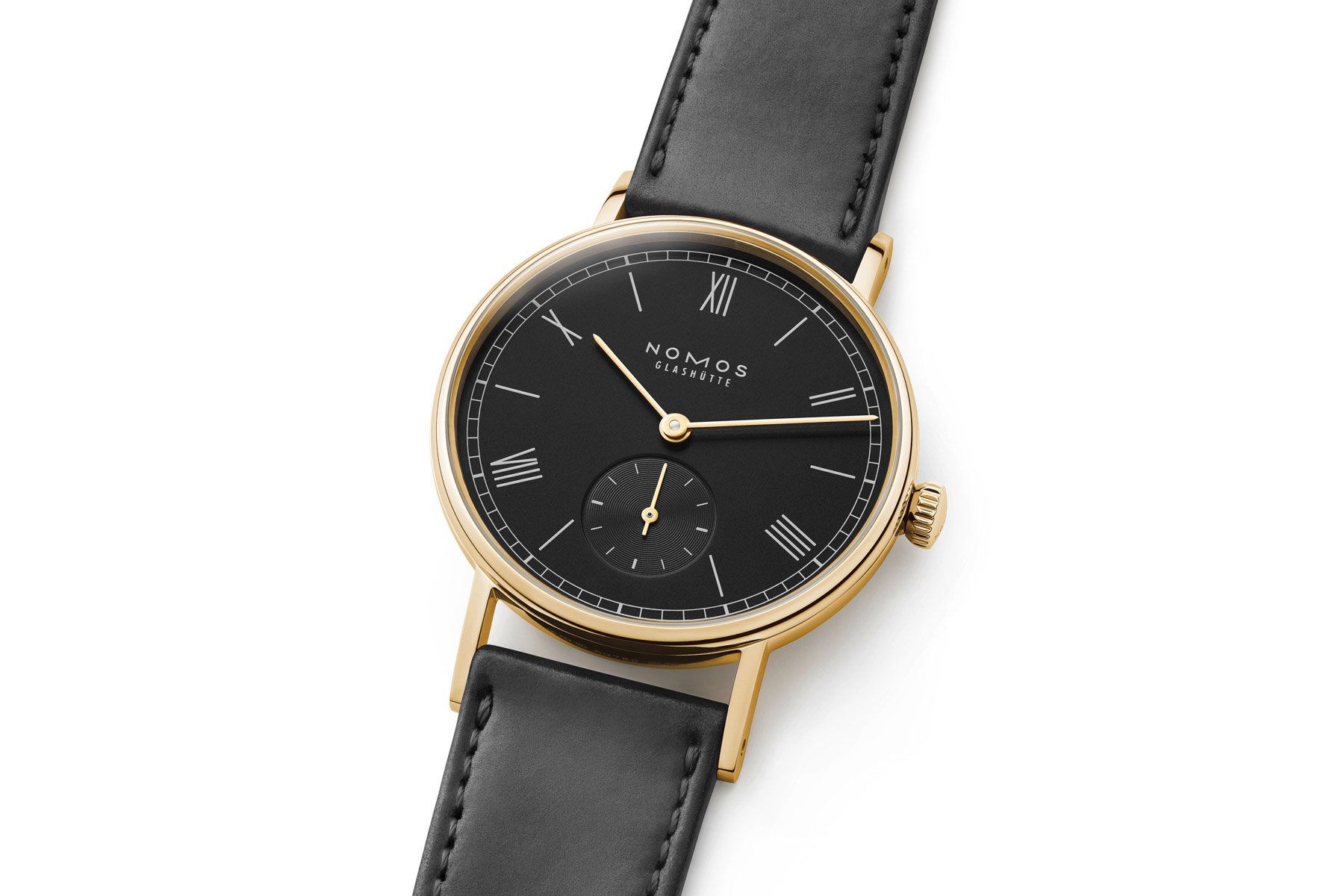
If you’ve worn a Tangente or Ludwig, you’ll recognize their proportions. Nomos’s wafer-thin bezels and characteristically long lugs give these small watches plenty of wrist presence. Both models share a 32.8mm diameter, a 42.2mm lug-to-lug span, and a 6.6mm thickness. They wear more like classic 35mm dress watches. The matte black dials visually reduce their presence just enough to keep things tidy. Despite their shared dimensions, the two models have distinct personalities. The Tangente retains its flat, drum-like profile and sharply angled lugs. The Ludwig takes a softer approach, with a rounded bezel and gently curved lugs.


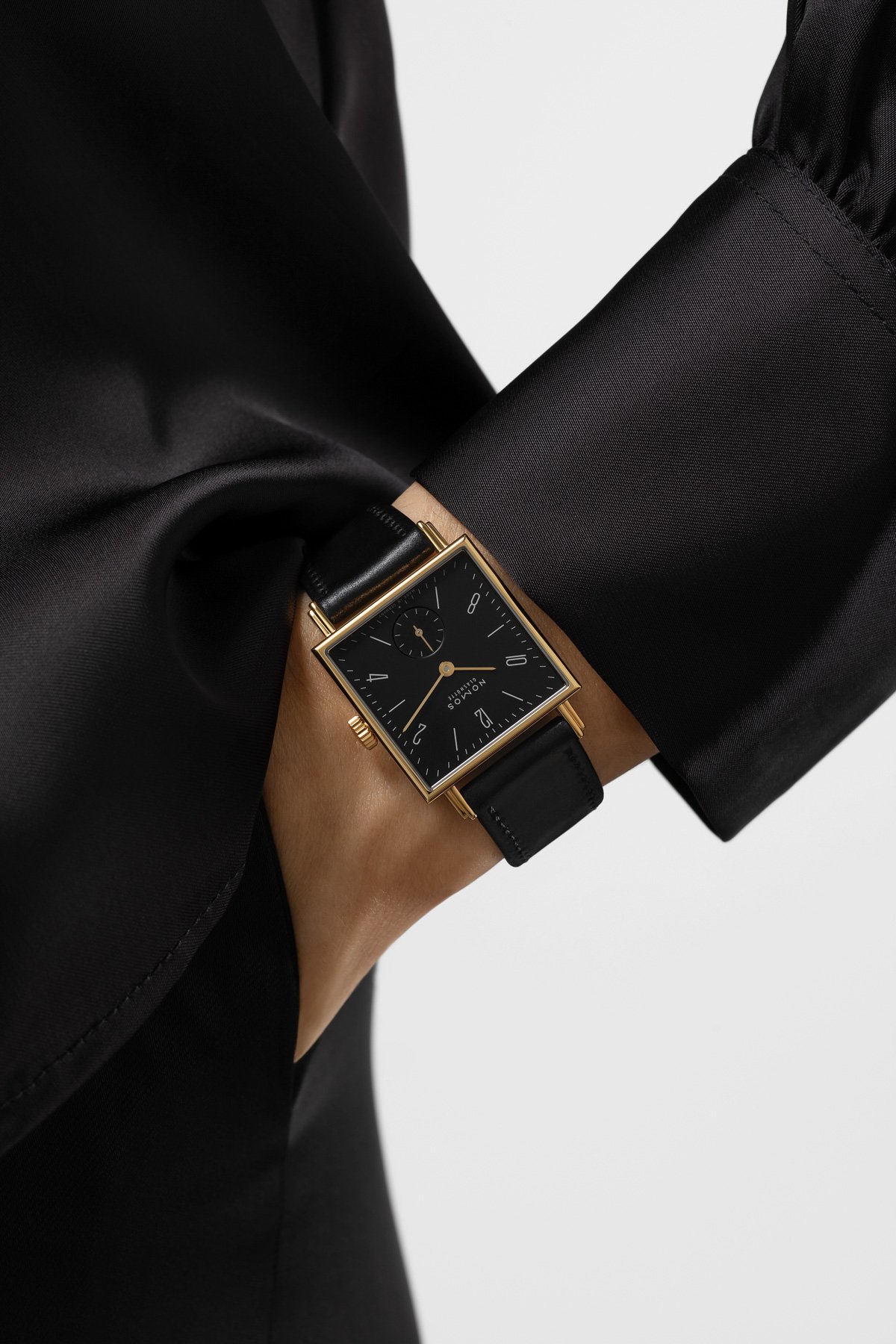
Then there’s the Tetra 27 Noir. Its 27.5mm case might seem modest on paper. However, its square shape occupies more wrist space than a round watch of the same diameter. The 38.5mm lug-to-lug span and signature stepped lugs add to its presence. Combined with the slim 6.4mm profile, these details give the Tetra a crisp Art Deco character. The result is a compact, refined watch that doesn’t disappear on the wrist.
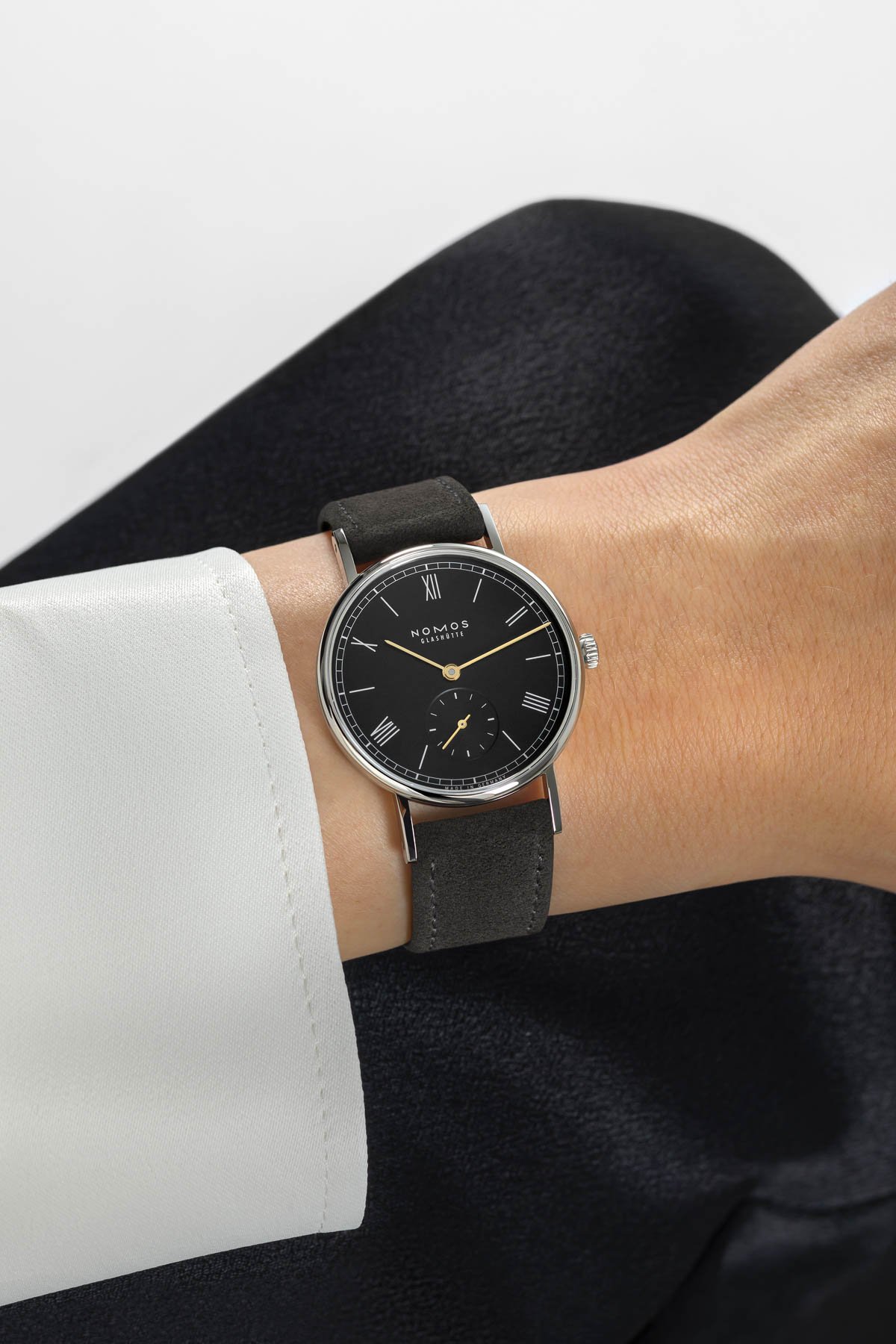
The entire range is remarkably slim. All models measure less than 7mm thick, letting them easily slide under a shirt cuff. That makes the Ludwig, Tangente, or Tetra a natural companion for anyone who regularly wears formal attire.
Those buying the steel versions can also choose between two case backs. Traditionalists can opt for a solid steel cover, while people who enjoy viewing the mechanics can choose a sapphire-equipped display back. The 18K yellow gold versions come exclusively with the latter.
High-contrast minimalism
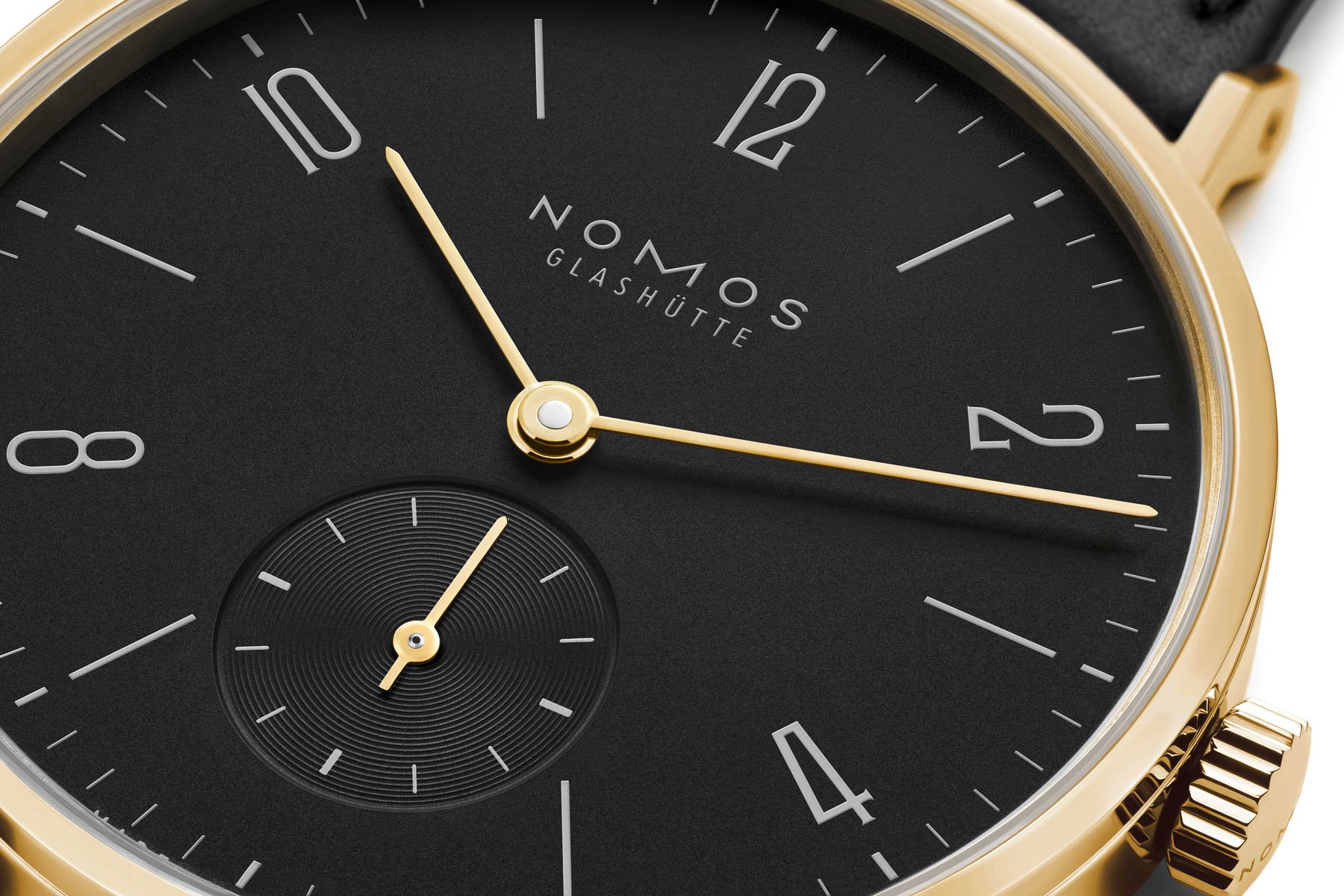
Nomos regularly experiments with color, but moving away from its signature white, silver-galvanized dials is never a small undertaking. This time, the brand has handled the transition with its usual good taste. All six references feature matte black, galvanized dials with crisp, silver-toned markings. Each also has a recessed small-seconds sub-dial at 6 o’clock. The Tangente and Tetra retain their familiar Arabic numerals. The Ludwig, meanwhile, pairs Roman numerals with a traditional railway-style minute track.
Slender gold-colored hands add warmth to each dark display. They lack luminous material, but their metallic surfaces catch enough light to remain legible in dim surroundings. They also preserve the watches’ formal character.
The straps further distinguish the two metals. Stainless steel variants each come exclusively with an anthracite vegan velour strap or a thin, supple bracelet, lending them a more relaxed character. The Tangente and Ludwig also have somewhat uncommon 17mm lug spacings. Nomos pairs the gold versions with glossy black Horween Genuine Shell Cordovan straps, though vegan velour is also an option.
Familiar Glashütte mechanics
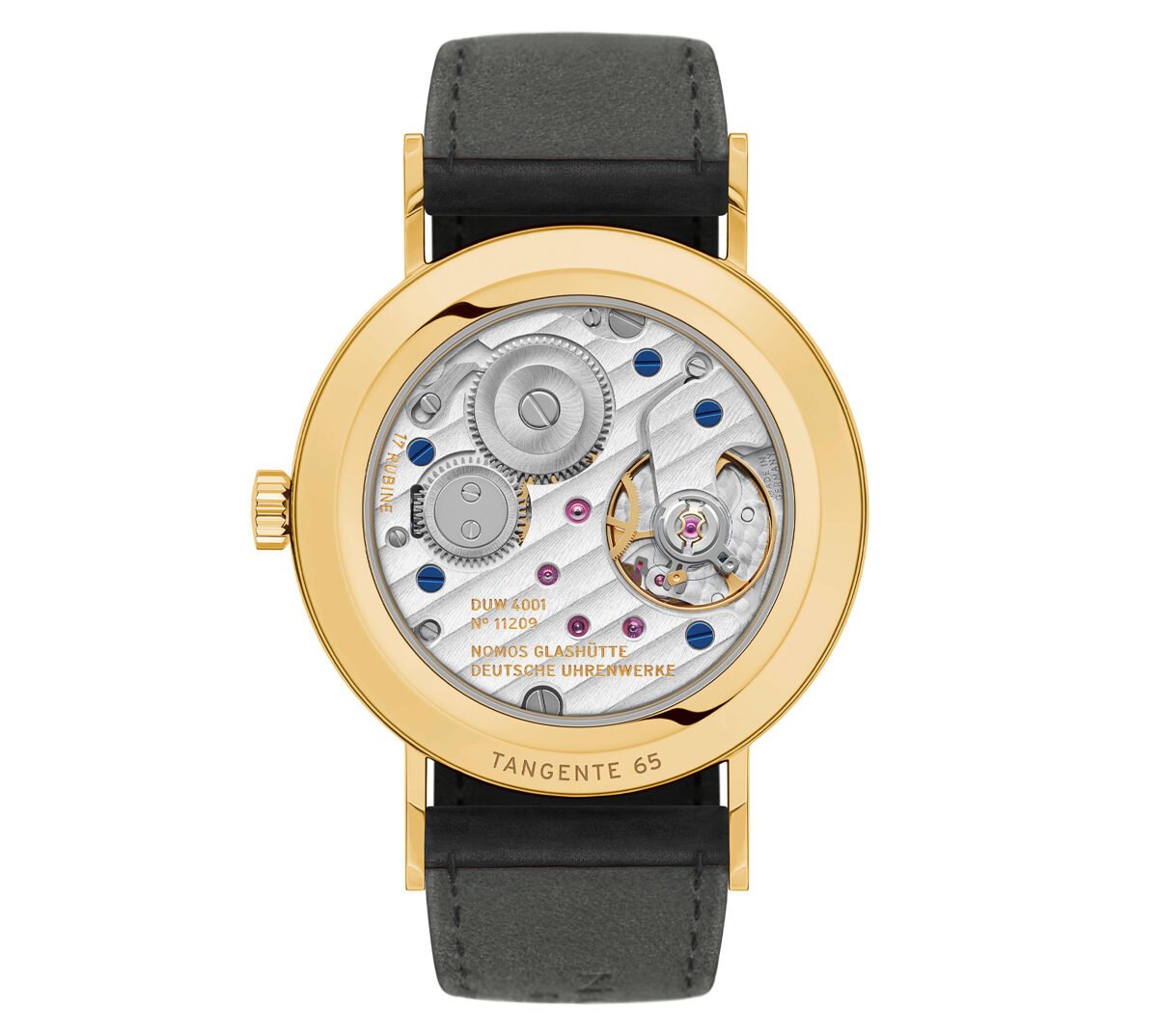
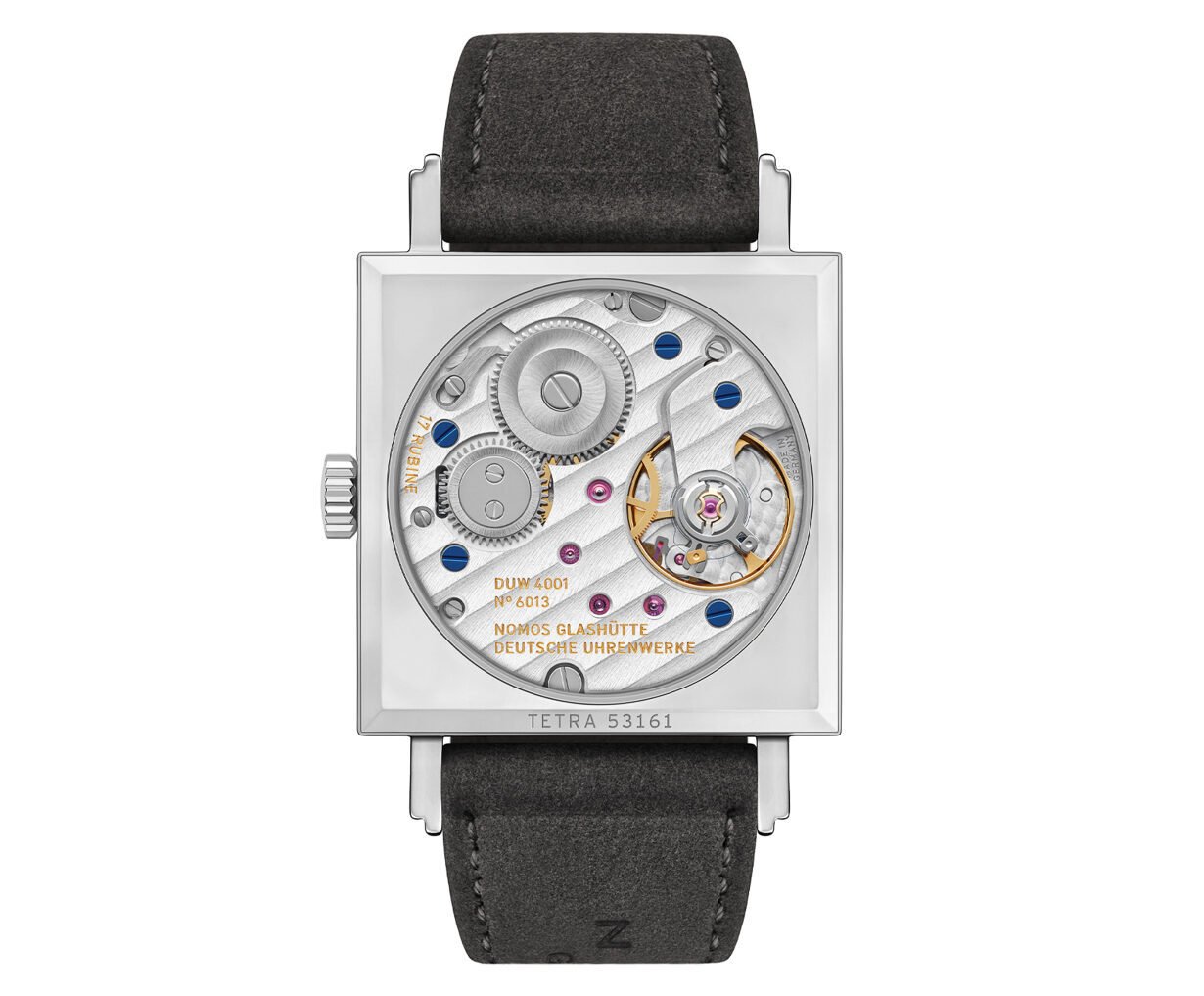
The Noir Series runs on Nomos’s in-house, hand-wound DUW 4001. This caliber builds on the brand’s longstanding Alpha, retaining its slender 2.6mm profile. It also incorporates Nomos’s proprietary Swing System escapement with a blued balance spring. The caliber also includes a revised mainspring, extending the power reserve from 43 to 53 hours. Anyone familiar with an Alpha-powered watch will appreciate those extra 10 hours. They comfortably bridge the gap when you leave a watch unworn for a day.
Nomos adjusts the DUW 4001 in six positions and equips it with a stop-seconds mechanism for precise setting. Traditional Saxon finishing completes the package. Through the exhibition back, you’ll see Glashütte ribbing across the three-quarter plate, tempered blued screws, and snailing on the ratchet and crown wheels. Gold-toned engravings provide the finishing touch.
Pricing and final thoughts
In stainless steel, the Noir models range from €1,720 (steel case back and strap) to €2,000 (exhibition case back and bracelet) for the Ludwig 33, €1,760–2,040 for the Tangente 33, and €1,940–2,220 for the Tetra 27.


The 18K yellow gold versions cost €9,460–9,500, €9,560–9,600, and €9,760–9,800, respectively. That’s a premium of more than €7,500 over the steel ones. Understandably, some collectors might hesitate to pay that much for a precious-metal case with the same dial and movement. However, Nomos extends the solid gold to the crown and pin buckle, too.
In today’s market, a solid-gold dress watch with an in-house caliber for less than €10,000 remains a compelling proposition. The new Noir Series also gives Nomos enthusiasts something a little different without abandoning the design language that made the brand recognizable in the first place. Sometimes, even a purist deserves an evening out.