A Touch Of Watch Heaven: Patek Philippe 6105G-001 Celestial Sunrise And Sunset

An oversized white-gold case inspired by space modules, paired with a seamlessly integrated X-patterned composite strap and a dial depicting the sky as seen from Geneva on a sapphire-crystal dial. The Patek Philippe 6105G-001 Celestial Sunrise and Sunset is a contemporary take on the eternal celestial theme. Inside the oversized case beats the caliber 240 C LU CL LCSO, which displays sunrise and sunset times and summer-to-winter time correction; a world’s first. The development of the mini-rotor movement took more than five years and involved the filing of six patents. In the US, the price of the 47mm-diameter grand complication watch is US$437,610, meaning you pay US$9,310.85 per millimeter of horological heaven. That’s prime heavenly “real estate” we’re talking about, so, all things considered, the price doesn’t sound entirely absurd.
What’s the most impressive part of the Patek Philippe 6105G-001 Celestial Sunrise and Sunset? I think the correct answer to that is “everything,” but I understand when your answer is “the case.” The 47 × 12.39mm white gold case is indeed something to behold. And it’s not just the size that is striking; the decoration also catches the eye. Patek Philippe decided to create a contemporary watch based on an ancient theme. So, no mythological figures depicting star signs or anything like that are engraved on the side of the case, but an “X” shape pattern inspired by the design of space modules. It’s executed with contrasted polished and sandblasted finishes, making the space-age industrial look come across as very luxurious. And on the case back, instead of sapphire, you will find a white gold bulwark with a similar pattern, which is a bit puzzling.
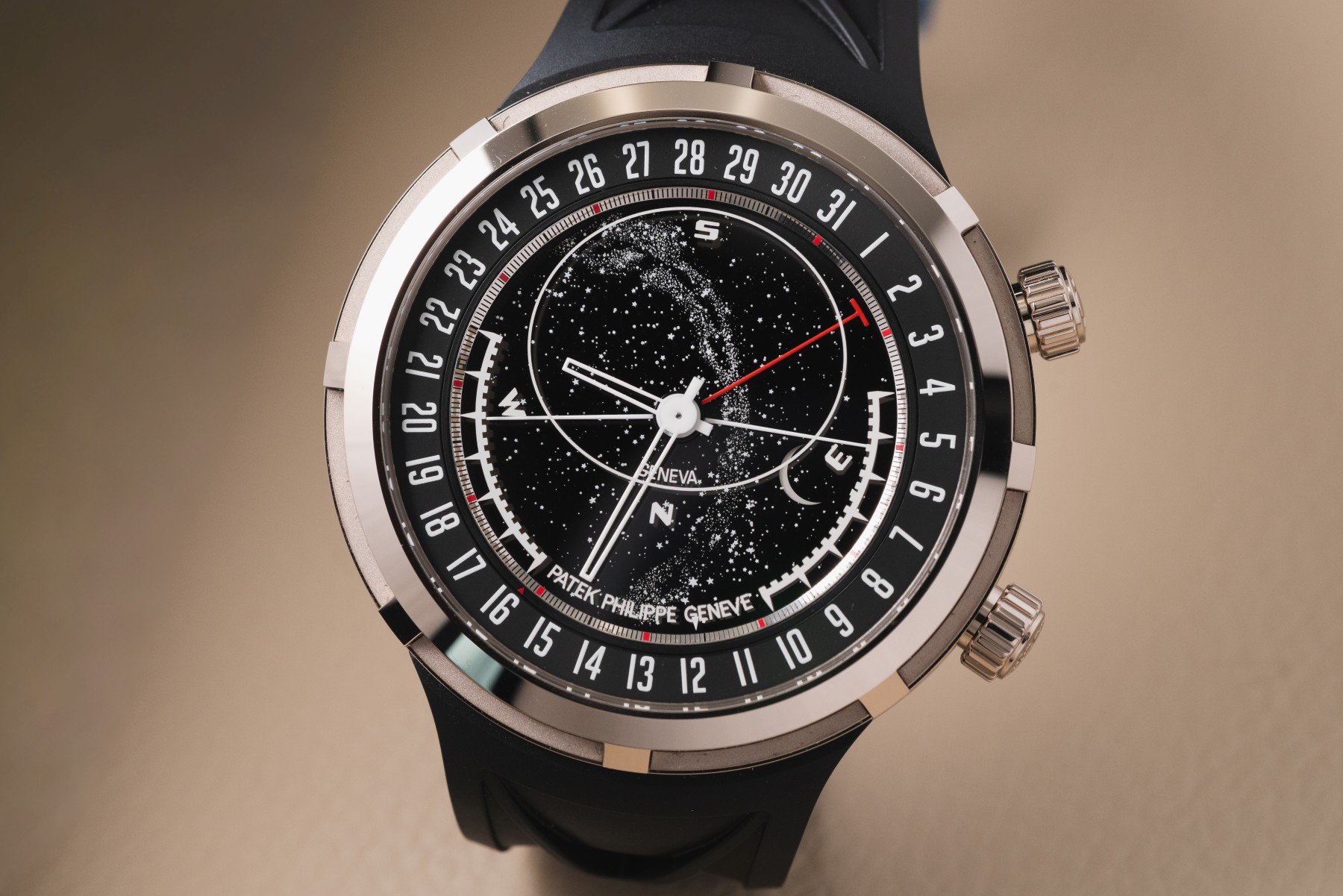
Patek Philippe 6105G-001 Celestial Sunrise and Sunset
Patek decided that the futuristic space-themed styling trumps a movement that took five years to develop and involved filing six patents. That’s why the case back is not transparent, and why you won’t ever see the caliber 240 C LU CL LCSO in action. And that’s too bad, because the 3Hz movement, outfitted with a 22K gold off-center mini-rotor and a Gyromax balance, carrying the Patek Philippe Seal, must be a sight to behold. All 426 components of the movement, measuring 38 × 7.93 mm, are finished to a very high standard, creating a stellar micro-machine.
The 240 C LU CL LCSO caliber is an evolution of the 240 LU CL C found in the Ref. 6104 and the discontinued Ref. 6102. Despite the addition of 121 components for the sunrise and sunset indications and the patented system that allows correction of the time and the sunrise and sunset indications during daylight saving time changes, it’s only 1.12mm thicker than the caliber 240 LU CL C.
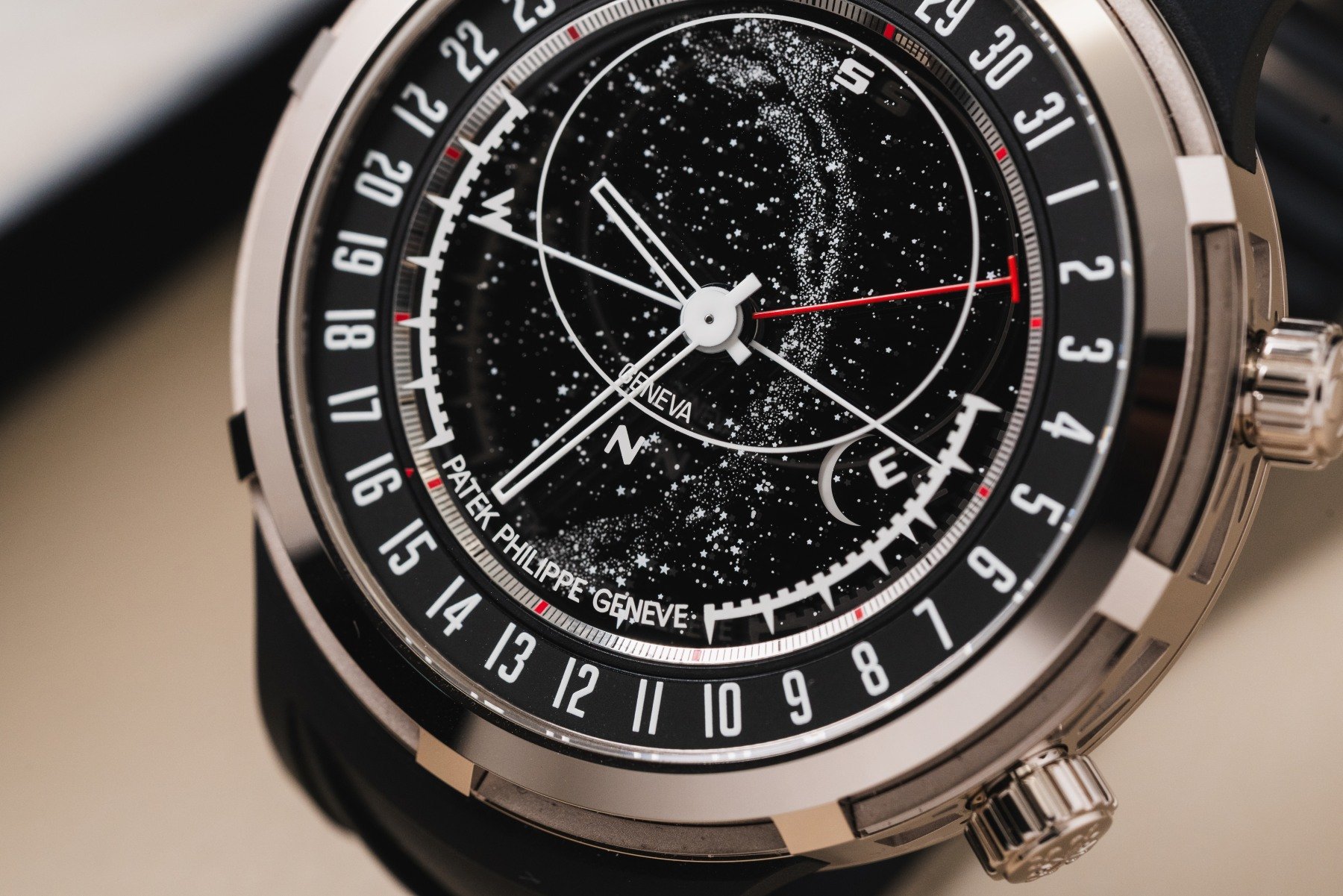
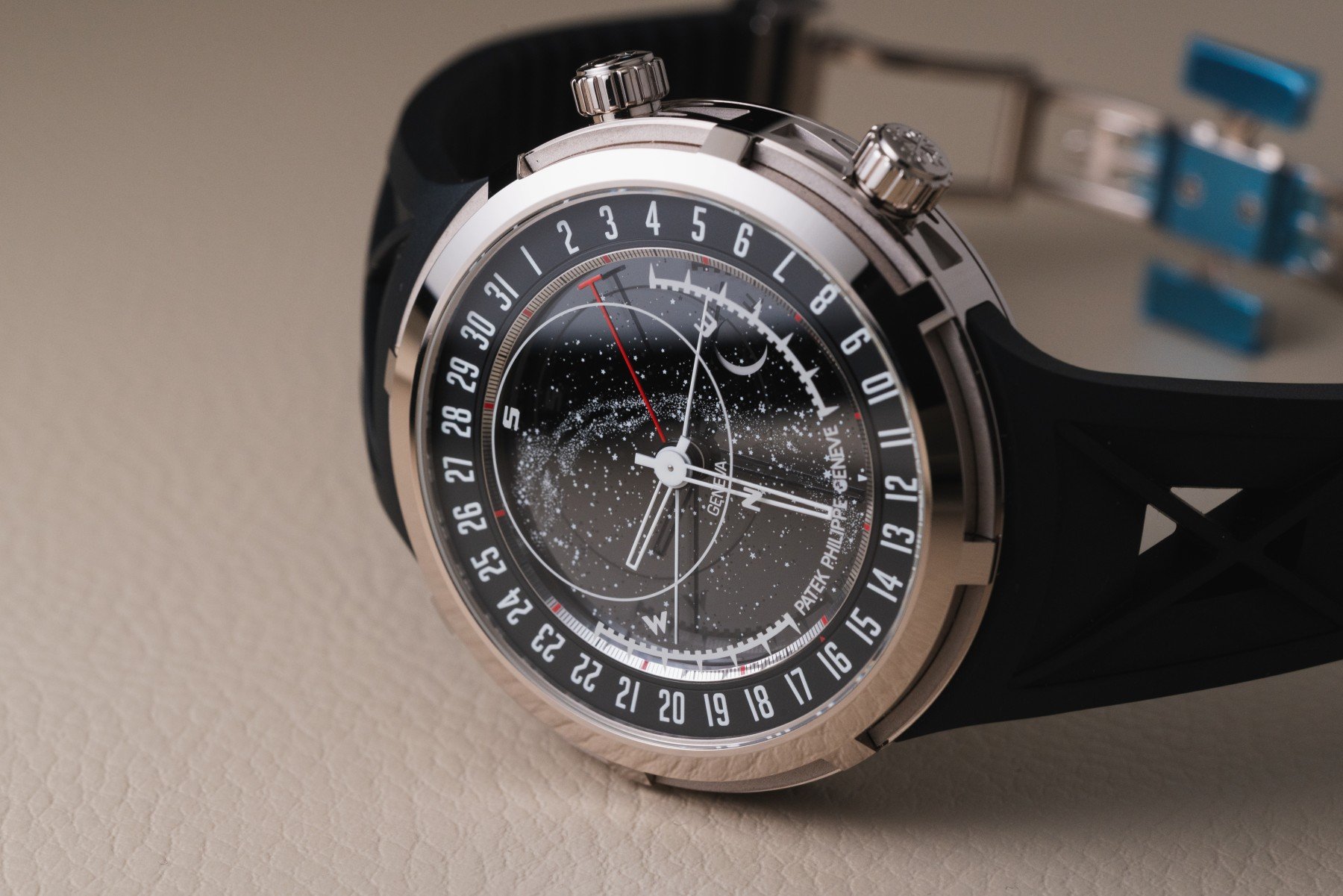
The astronomical watch also shows a sky chart, with the ellipse representing the visible part of the sky for a given latitude, the meridian, the times of meridian passage of Sirius and the Moon, and the angular motion of the Moon and its phases. More earthly is the presence of a peripheral date indicated by a red hand. To correct the date, you press the hidden corrector at 7 o’clock as often as needed to display the correct date. Since this watch looks to the skies every year, the date here on Earth must be corrected five times: at the end of each month with fewer than 31 days. Is that going to pose a problem?
Too much to grasp
It’s virtually impossible to understand the vastness, complexity, and origins of the universe. The same applies to the inner workings of the 6105G-001 Celestial Sunrise and Sunset. One of the most intriguing aspects of this watch is the way Patek Philippe recreates the night sky. Rather than relying on a simple printed display, Patek developed a layered system of ultra-thin rotating discs that creates a convincing sense of depth and movement across the dial.
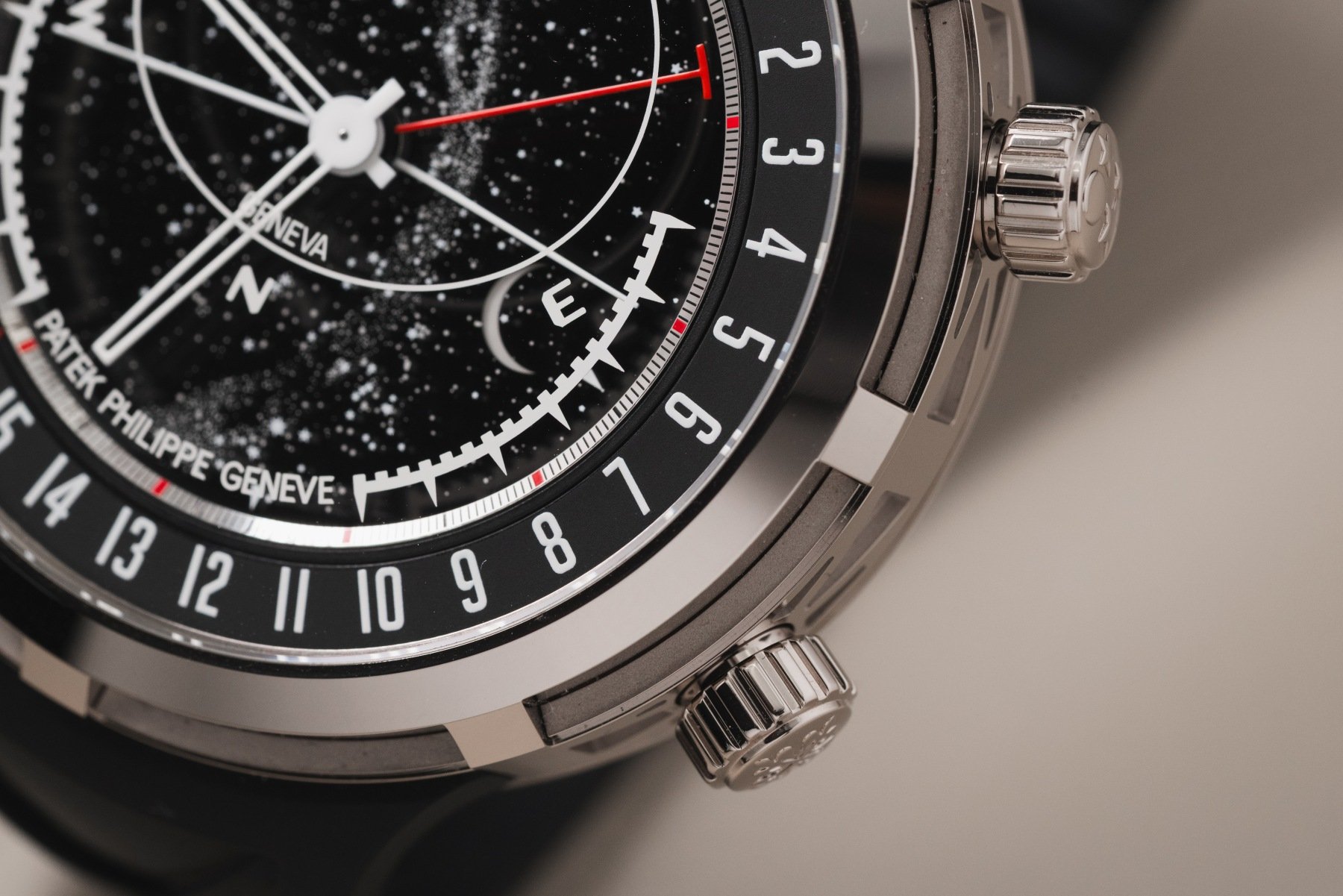
At the base sits a mineral disc shaped as a 279-tooth wheel that follows the moon’s orbital position. Through a planetary gear system, it also drives the moon-phase display, which appears in a small circular aperture. Above it, a 356-tooth wheel rotates a transparent sapphire disc carrying the celestial chart on its front surface. And on the reverse, there is a depiction of the Milky Way. Working together, the discs complete their rotations at different speeds, producing the illusion of a living sky.
Remarkably, each of the three discs measures just 0.2mm thick. They are protected beneath a sapphire crystal whose underside is printed with an elliptical frame representing the portion of the night sky visible from Geneva (and other locations sharing the same latitude).
Stellar looks and performances
You might not see the movement powering this display, but what you will witness on the sapphire-crystal dial compensates for the lack of view of the complicated movement. As just mentioned, the shiny midnight-black dial, featuring white-gold skeletonized baton-style hands with white varnish, shows the exact configuration of the sky in the northern hemisphere. An ellipse frames the portion of the sky visible from Geneva and all other cities located at the same latitude. You also get to see the apparent movement of the stars and the phases and orbit of the Moon. The sunrise and sunset times are indicated by two thin white hands. The crown at 4 o’clock winds and sets the watch. The crown at 2 o’clock lets you adjust the annual index, which governs the hands indicating sunrise and sunset. And you also use it to set the moon and the sky chart.

In case you’re wondering if all this celestial creation not only walks the (space) walk but also talks the talk, it is. For instance, the deviation for the lunar day is 0.05 seconds per day, 18.385 seconds per year, or 30 minutes and 38.5 seconds per century. And for a sidereal day, the deviation is 0.088 seconds per day, 32.139 seconds per year, or 53 minutes and 33.9 seconds per century.

The Patek Philippe 6105G-001 Celestial Sunrise and Sunset on the wrist
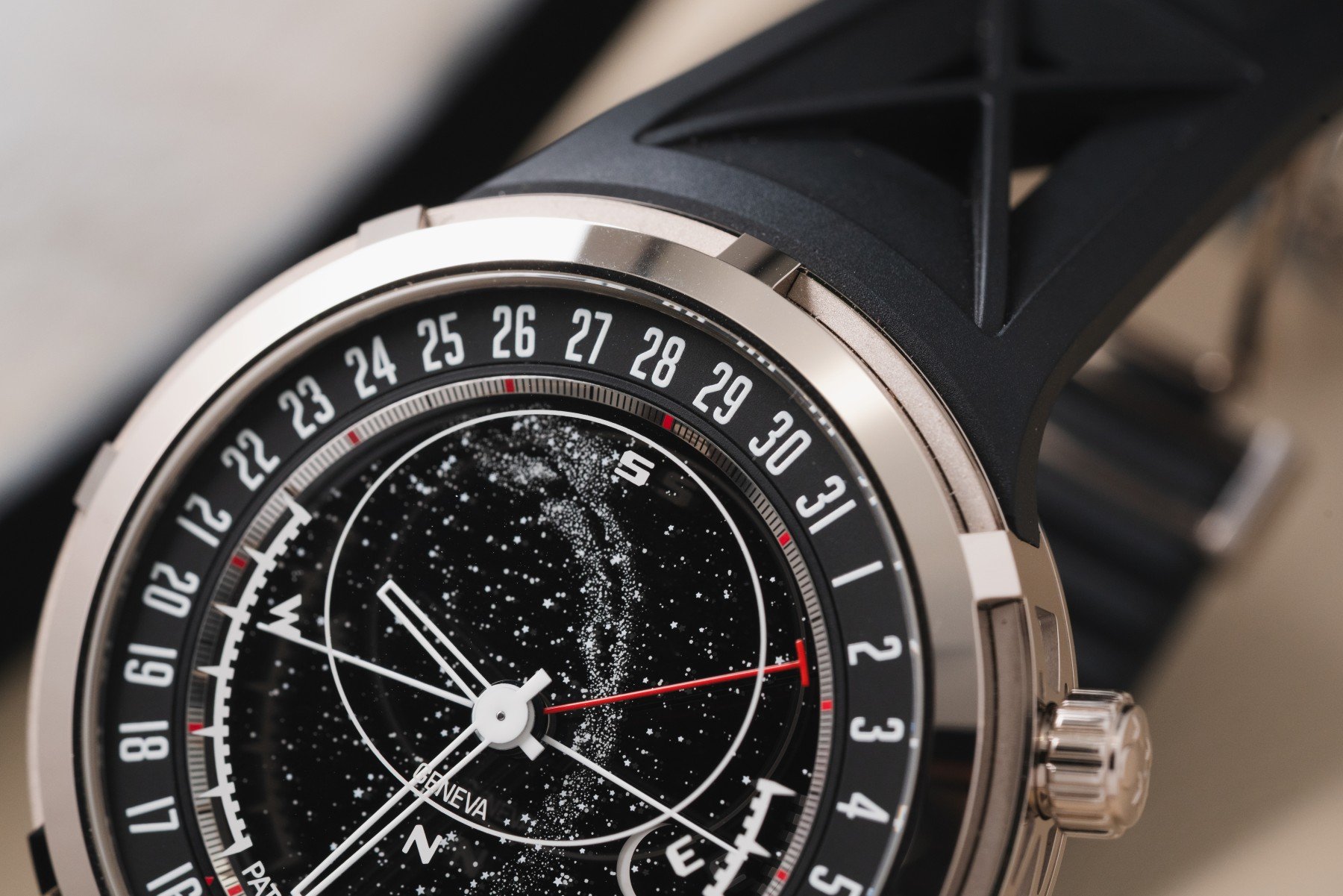
For those who found the discontinued Ref. 6102 a bit too traditional, not outspoken enough, even too ordinary, this Ref. 6105G-001 might be just what you’re looking for. Patek bravely and boldly did away with conservative aesthetics, trading them in for a modernist design infused with spacecraft-inspired elements. The geometric X-shaped detailing evokes space-module struts, but this time white gold is used instead of titanium. To be honest, if this watch were executed in that space-age alloy, it would have been no less impressive. It would have been lighter, but the size of that 6105T would still make an enormous impression.
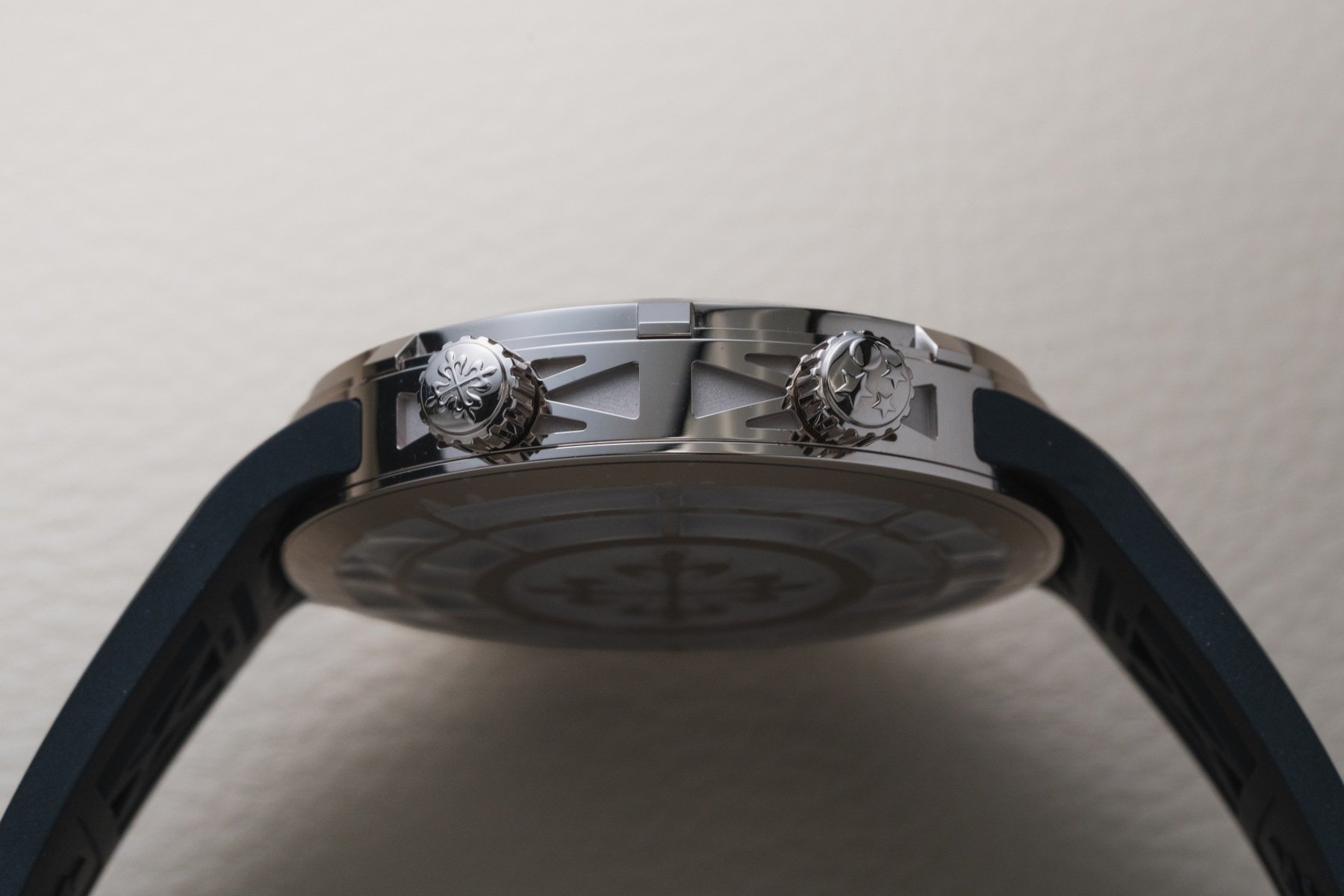
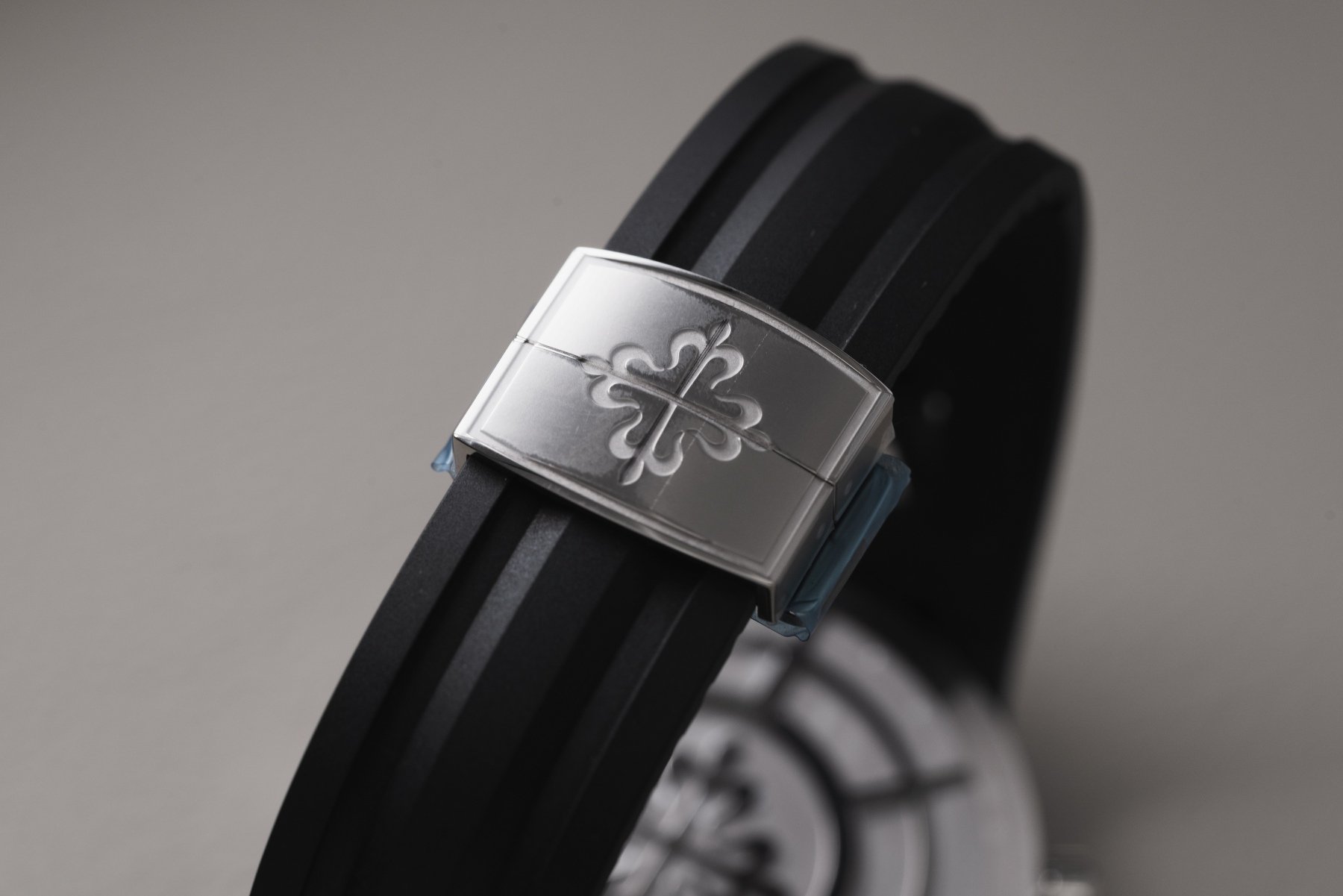
Speaking of size, since the 6105G is a lugless watch, the 47mm timepiece sits comfortably on the wrist. Yes, it’s big, but the complete roundness of it — did anybody say flying saucer? — does not make it unwearable. And there are two other factors in play: the moderate 12.39mm thickness and the strap. The perfectly round 6105G is paired with a supple, integrated black composite strap. The partly open-worked strap features the same X-shaped pattern as on the case band. The strap closes with a solid-feeling, patented fold-over clasp in white gold.
Fill your universe
Allow me one final remark regarding the size. A 47mm-diameter grand complication priced at CHF 350,000 / US$437,610 / €412,400 will hardly ever be a daily beater. With that in mind, practicality and optimal wrist comfort are not really criteria. This is a watch for a seasoned Patek collector. One who lusts after having the full set of Patek-made astronomical watches. In that case, the 6105G-001 Celestial Sunrise and Sunset needs to be added to that micromechanical mini-universe.


What are your thoughts on the Patek Philippe 6105G-001 Celestial Sunrise and Sunset? Is this futuristic astronomical grand complication to your liking in terms of design? Would you like to see more contemporary styling making its way in the Patek line-up? Please let me know in the comments section below.