Shadow Icons: The Underappreciated References — Audemars Piguet Royal Oak Offshore

Icons are icons for a reason. Some watches deserve the moniker, no question about it. But quite often, an icon casts a long shadow on other interesting timepieces in a brand’s catalog. The original Genta-designed Audemars Piguet Royal Oak has always overshadowed the Royal Oak Offshore. Due to the Offshore’s large size, bold styling, and a design departure from Genta’s original vision, people see it as a derivative. They have a point, but that’s also a bit of a closed-minded, purist approach to the matter. Yes, the 1993 creation got off to a rocky start, but it also became Formula 1 drivers’ chrono of choice for a while and, therefore, the hottest watch around. Now it’s back where it once was, in the shadow of the Royal Oak. Let me drag this shadow icon back into the limelight where I think it belongs.
Yes, it was a bold decision when, in 1989, Audemars Piguet appointed young designer Emmanuel Gueit to create a fresher, more youthful version of the Royal Oak, a watch originally designed by Gérald Genta. The brief was simple: give a younger generation of men the opportunity to wear a large, sporty watch. This sparked heated debates and significant friction within AP. When Gueit, the son of a respected watch designer, presented his concept sketches internally, Georges-Henri Meylan, the long-serving CEO, could only exclaim, “I’m sorry to say this, but you’re crazy!” Crazy or not, after four years of internal wrangling, the Royal Oak Offshore (ref. 25721ST) was unveiled in 1993.
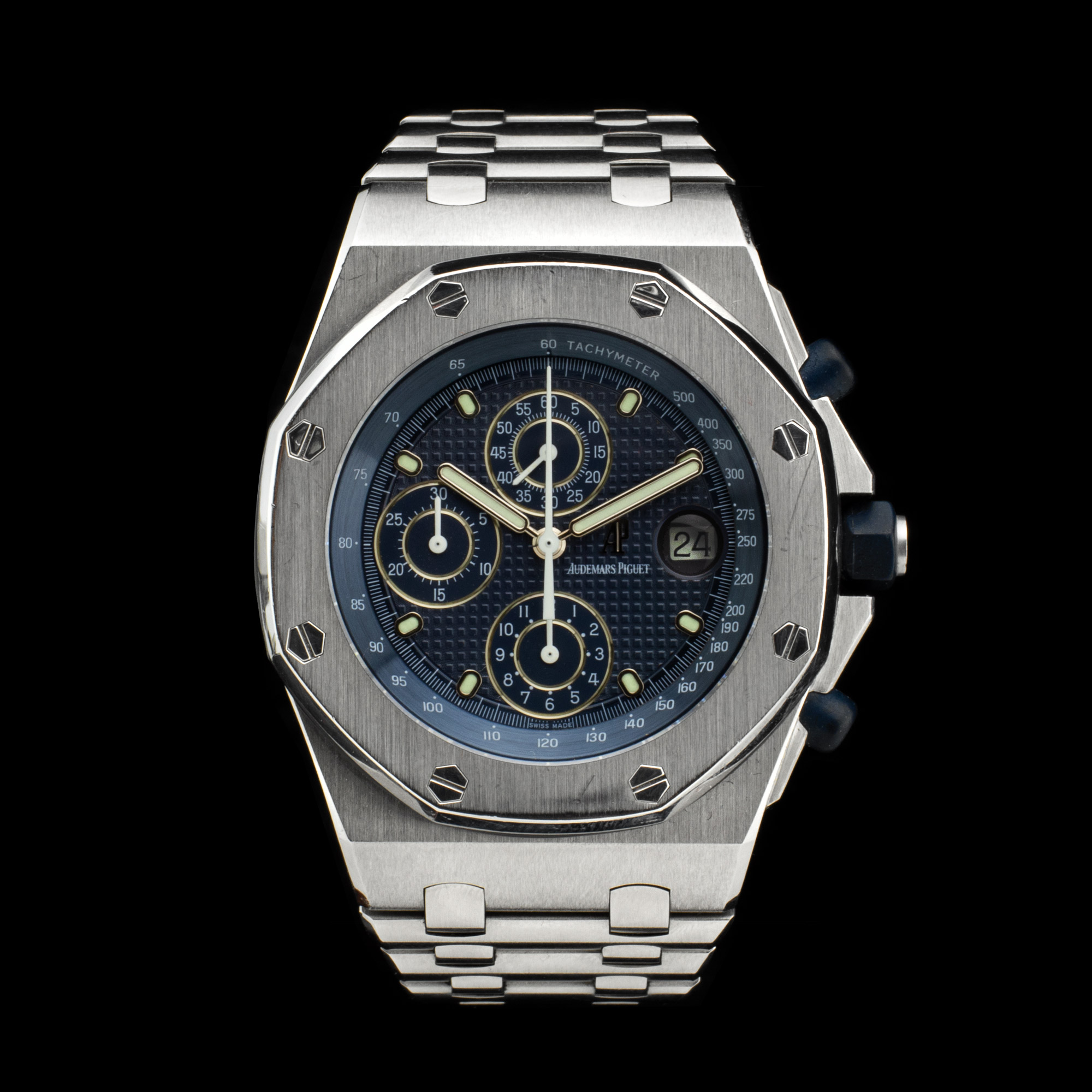
The original 1993 Offshore ref. 25721ST
Shadow icons: The underappreciated Audemars Piguet Royal Oak Offshore
Gueit’s Offshore variant retained the Royal Oak’s aesthetic hallmarks, such as the octagonal bezel prominently featuring eight hexagonal screws, but the new watch’s 42mm case defied established conventions. Shocked reactions were inevitable. Genta himself made his feelings known in dramatic fashion. During the Offshore’s presentation at the Baselworld watch fair, he stormed into the AP pavilion and, according to legend, loudly proclaimed, “You’ve killed my baby!” However, the scathing nickname Genta gave the new Offshore, “The Whale,” did not stick. The moniker that did endure was “The Beast.” This nickname also seemed less than flattering at first, yet when a revolutionary watch is unveiled, initial aversion often foreshadows success.


“The Beast” changed the Royal Oak forever. In addition to its prominent 42mm case, the watch stood out for the massive, visible black gasket beneath the bezel and the rubber-clad crown and pushers. That rubber was a clear visual reference to the sporty, water-resistant nature of this chronograph, which housed an automatic movement within its steel case. The fact that AP stood behind Gueit’s design ultimately paid off.


The Royal Oak Offshore (ROO) proved to be a pioneer for XL watches, and over time, it became a platform for innovation. Steel was followed by variants in gold, platinum, titanium, ceramic, and even forged carbon. Alongside the classic chronograph versions, a “simple” diver and various high-horology complications debuted in the ROO collection.

Gueit’s personal reference 25721
“The Beast’s” backbone
The foundation of the Royal Oak Offshore collection was, is, and will remain the Selfwinding Chronograph ref. 25721ST. In 2013, to mark the 20th anniversary of “The Beast,” AP unveiled the first major redesign. By then, the initial shock and disapproval had long since given way to admiration and desire. The anniversary was celebrated quite modestly with the 26218ST, a limited edition of just 20 pieces. While the original ROO featured a steel case back with an engraving, the first hundred chronographs bore the inscription “Royal Oak.” Once the collection proved viable, the engraving was changed to “Royal Oak Offshore.” The 2013 tribute model featured a sapphire-display case back revealing the movement. That caliber, the 3126/3840, was based on an AP movement fitted with a Dubois Dépraz chronograph module.

Royal Oak Offshore Selfwinding Chronograph ref. 26237ST from 2018
Five years later, history repeated itself during the 25th-anniversary celebrations with the Royal Oak Offshore Selfwinding Chronograph ref. 26237ST. This time, the case back was all steel, mirroring the original design. Also, with this model’s introduction in 2018, the signature Petite Tapisserie pattern returned to the Royal Oak Offshore collection. The movement remained unchanged.
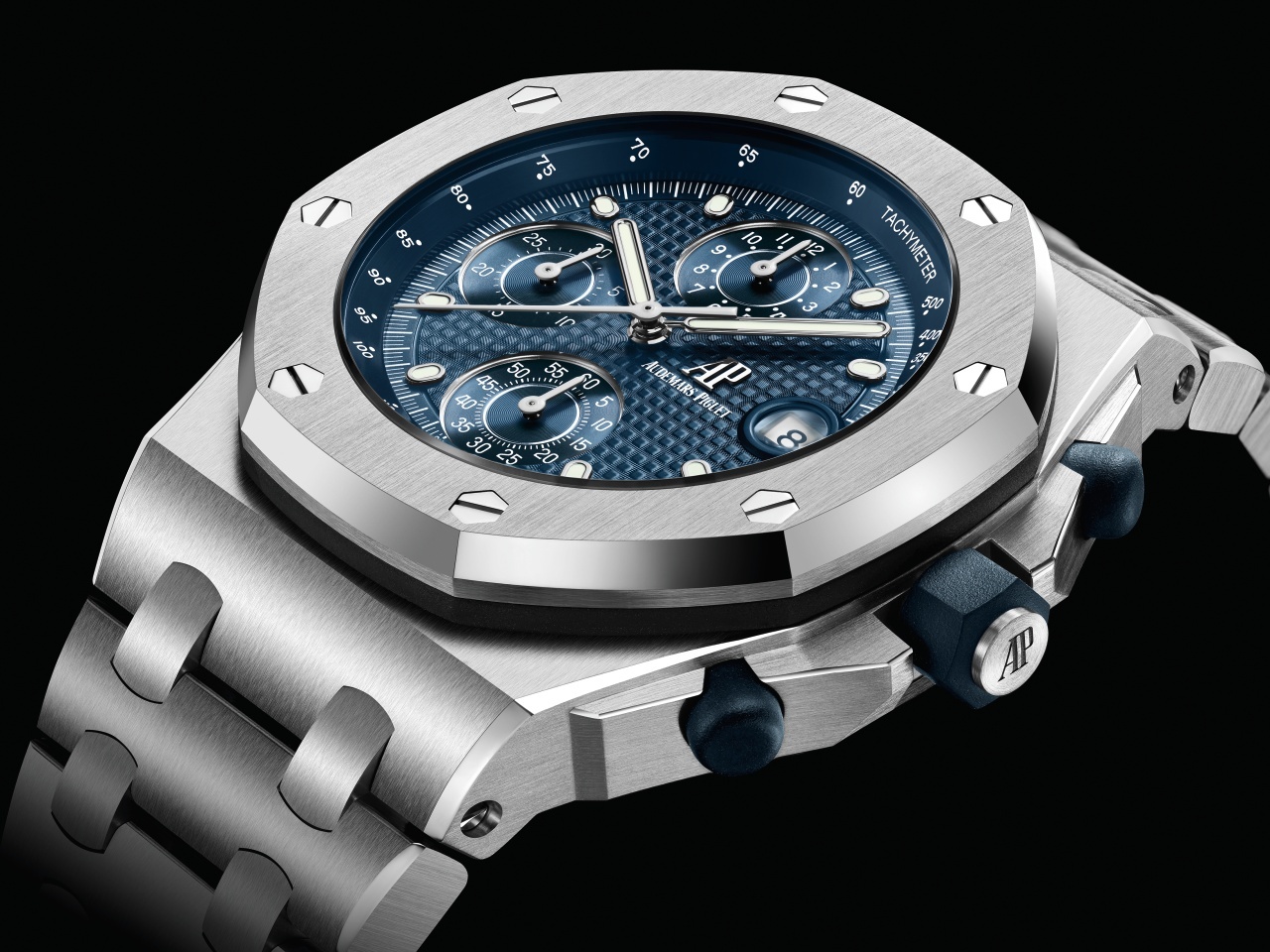
Ref. 26238ST is part of the current collection
The first in-house-equipped Royal Oak Offshore chronograph
Year after year, Audemars Piguet received constant inquiries about a fully integrated automatic chronograph caliber from the brand’s manufacture in Le Brassus. Yet, it was not until 2021 that such a movement finally made its way into a Royal Oak Offshore. That new movement was certainly worth the wait. Caliber 4404 features a column wheel and a vertical clutch, ensuring highly precise chronograph activation. It’s a version of the 2019 4400 caliber, reworked to match the original 1993 sub-dial layout. Its flyback function lets the wearer stop, reset, and restart the chronograph in a single, simple action, while a patented reset mechanism ensures the chronograph hands snap back to zero instantly.

The colorful ref. 26238TI.OO.A001VE.01 in titanium debuted in 2026
Current models
Enough about past models; let’s talk about the current references. The 43mm versions of the Offshore Selfwinding Chronograph, with their rectangular pushers and Méga Tapisserie dials, do not qualify for shadow-icon status. The true shadow icons are the latest 42mm evolutions of the original Offshore, which are available in different alloys and ceramics. These watches, with their historical 42 × 55 × 15.3mm cases featuring round pushers, are the direct descendants of the “The Beast,” but only one of them has a chance of becoming my shadow icon. Which version is that? It’s not a watch from the recently released trio of Royal Oak Offshores with “sprinkles.” That said, the titanium ref. 26238TI(.OO.A001VE.01) is a very interesting, contemporary, and colorful take on a historically significant watch. If you manage to ignore the Méga Tapisserie dial, that is.

Royal Oak Offshore Selfwinding Chronograph ref. 26238CD in blue ceramic
The Royal Oak Offshore Selfwinding Chronograph ref. 26238CD, with its Bleu Nuit, Nuage 50 ceramic case and matching Méga Tapisserie dial, looks super cool at first. But it is also very, very blue, and this shade is too closely linked to the original Royal Oak, the icon that put the Offshore in its shadow. The Méga Tapisserie dial doesn’t seem right either.


Ref. 26238CE, dressed in black ceramic, is more “beastly” and cooler. But there is a catch here: the 2023 version’s dial features Petite Tapisserie, while the current 26238CE has Méga Tapisserie. The updated version gets it “wrong,” I’m sorry to say. It’s also extremely costly. CHF 75,700 (including taxes) is a price that casts a shadow over my possible shadow icon, and I struggle to comprehend it, even hypothetically.
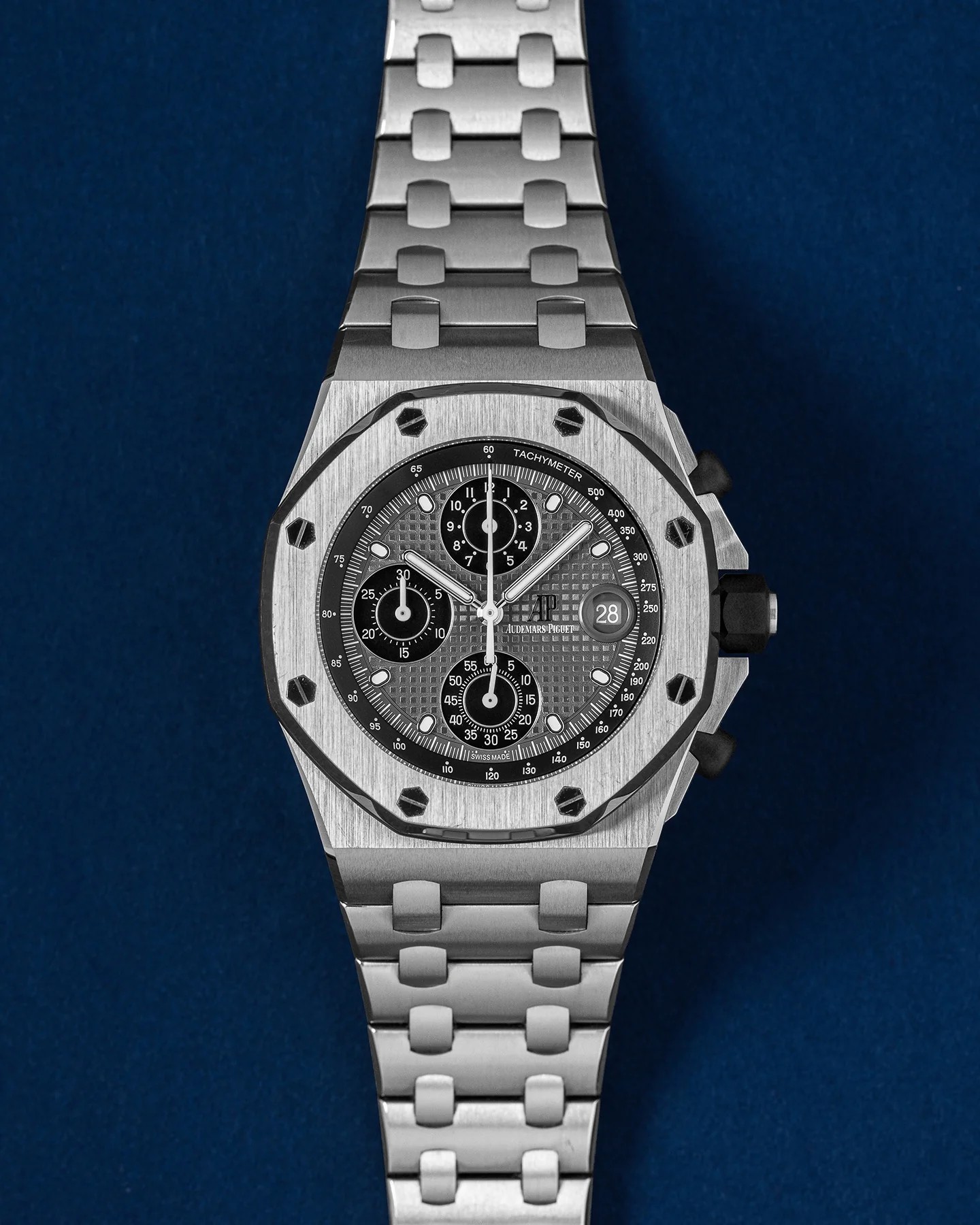
The current Royal Oak Offshore Selfwinding Chronograph ref. 26238TI
Steel or titanium?
Logic tells me the steel ref. 26238ST, with its blue Petite Tapisserie dial, is the way to go. But it isn’t. It looks too perfect. Yes, it’s very much like the original, but a bit too polished and clean. My pick is the titanium ref. 26238TI with a very appropriate shadow-like gray-and-black dial and matching rubber pushers. Titanium symbolizes evolution, and the gray dial with its black counters and flange shows functional restraint.


Yes, the price of CHF 40,600 (including taxes) is steep. But that’s the premium you pay for a veritable shadow icon. I agree that the Royal Oak is the OG and, therefore, the icon in the Audemars Piguet range. Still, Emmanuel Gueit’s Royal Oak Offshore, a youthful evolutionary design that looks as fresh now as it did in 1993, warrants praise and recognition. It’s a veritable shadow icon that deserves the spotlight.