The New Hublot Classic Fusion Tributo Takes Us Back To 1980

Forty-six years ago, Carlo Crocco put a gold watch on a rubber strap, and everyone told him he was mad. Now, Hublot has brought it back as the Classic Fusion Tributo. I sat down with him in Nyon, a week before his 82nd birthday, to hear where it really came from.
Picture the showroom at Hublot’s manufacture in Nyon just two weeks ago. Someone from the Hublot PR team was watching the clock very closely and later introduced himself cheerfully as “the time police.” And across the table sat the man who started all of this. We were on a short leash regarding his schedule, as many people wanted to speak with Carlo Crocco, who founded Hublot in 1980.

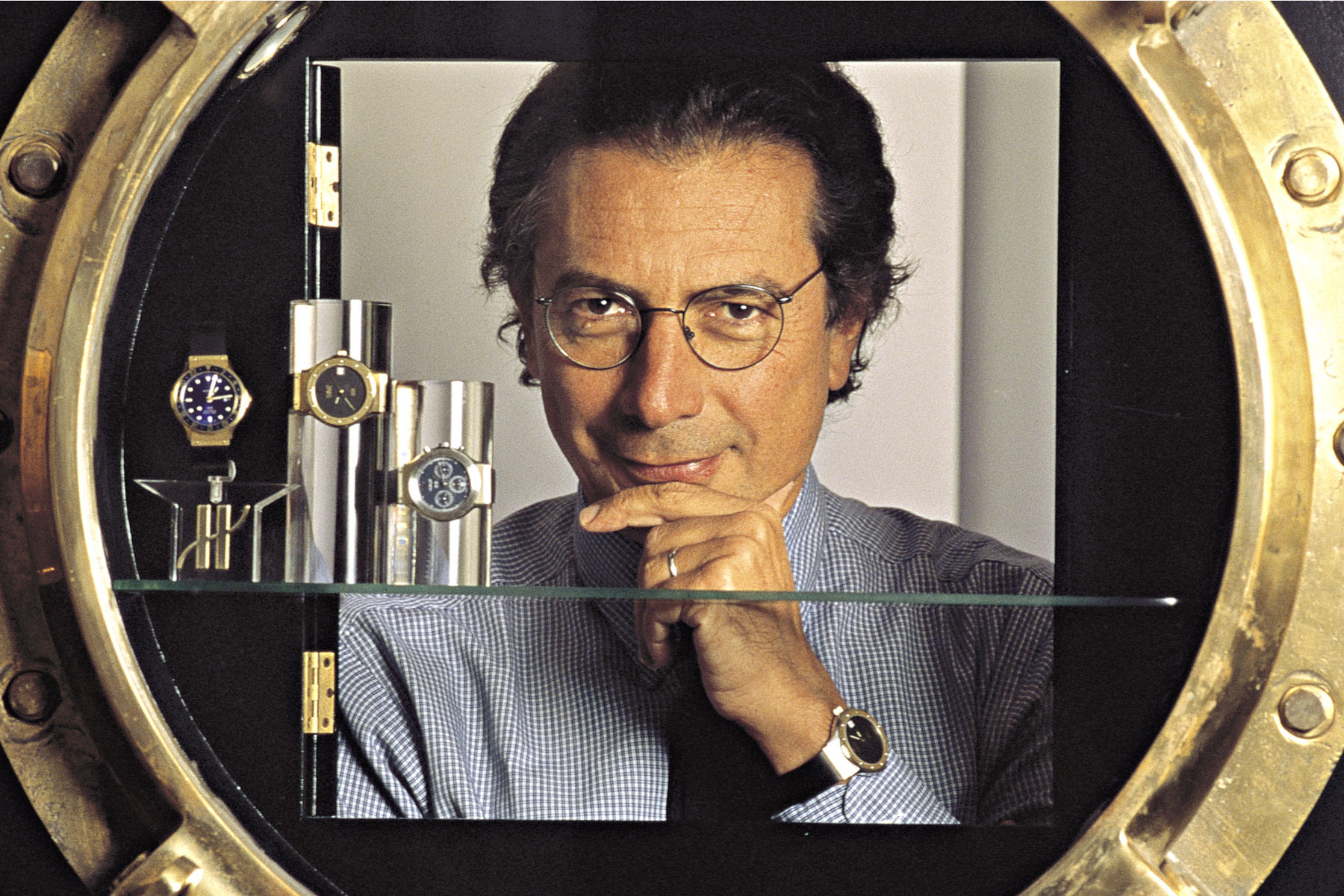
Carlo Crocco wearing the new Classic Fusion Tributo
Across the table from Carlo Crocco
Between us sat three watches — the original in gold on its iconic black rubber strap, with “MDM Genève” printed on the dial, and both of the new Classic Fusion Tributos, one in yellow gold and one in white. There was another Tributo on Carlo Crocco’s wrist, which was funny because he admitted he rarely wears a Hublot. “I wear another watch,” he told me. “I made it after Hublot. I made another watch that didn’t have any success.”
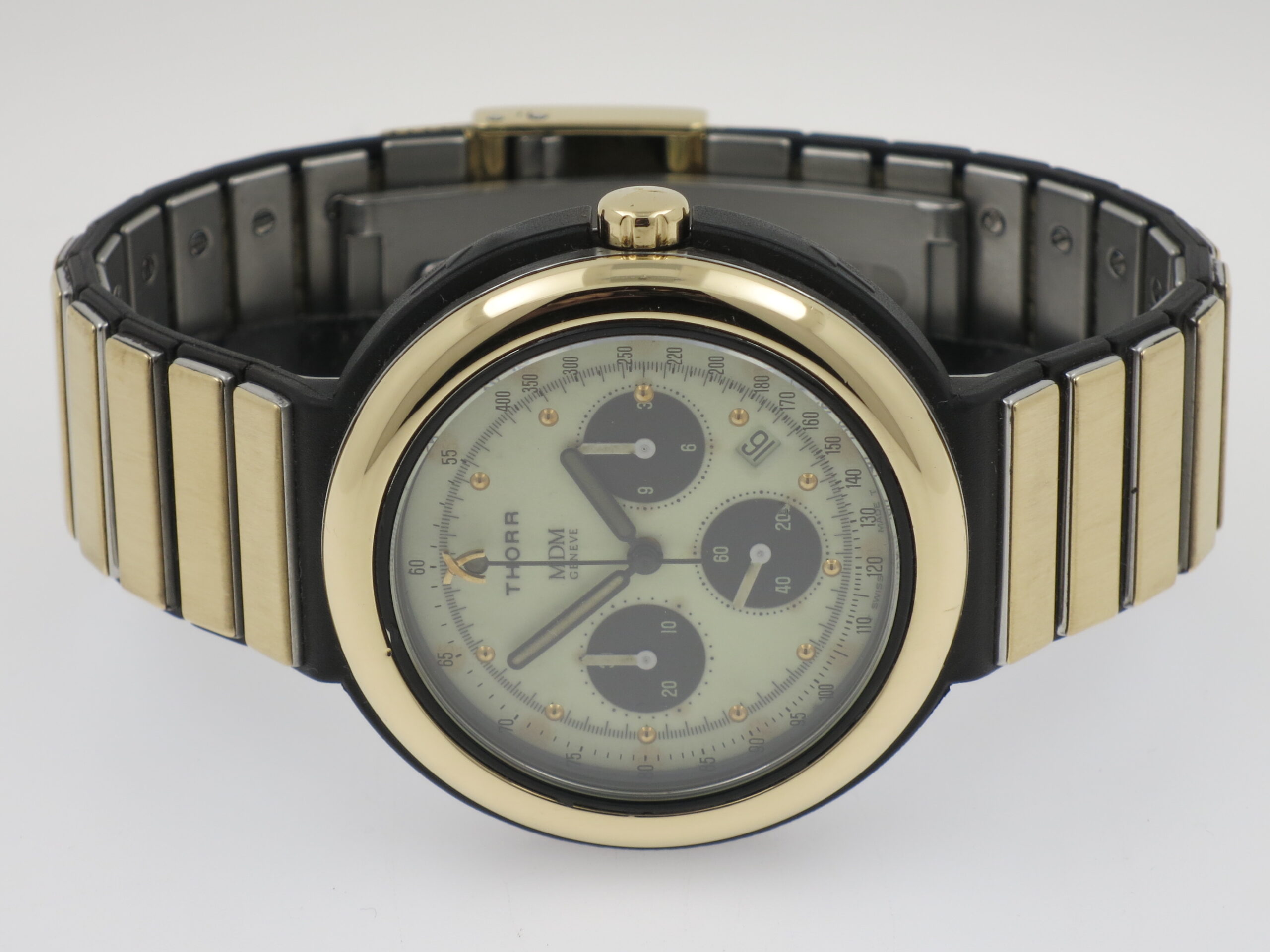
The MDM Thorr came in various metal combinations, a three-hand version, and a chronograph — Image: https://www.horloge-sieraden.nl/
That’s the Thorr, a 1988 chronograph that never really found its audience. He talked about the two the way a father might talk about his favorite son and the one who struggled. “But from now on,” he said, “I have to wear Hublot again — because of this Tributo.” I loved that. Before we’d even started properly, it told me something about him. He made one of the most recognizable watches of the last 50 years, stepped away from it, and chose to wear the one nobody remembers instead.
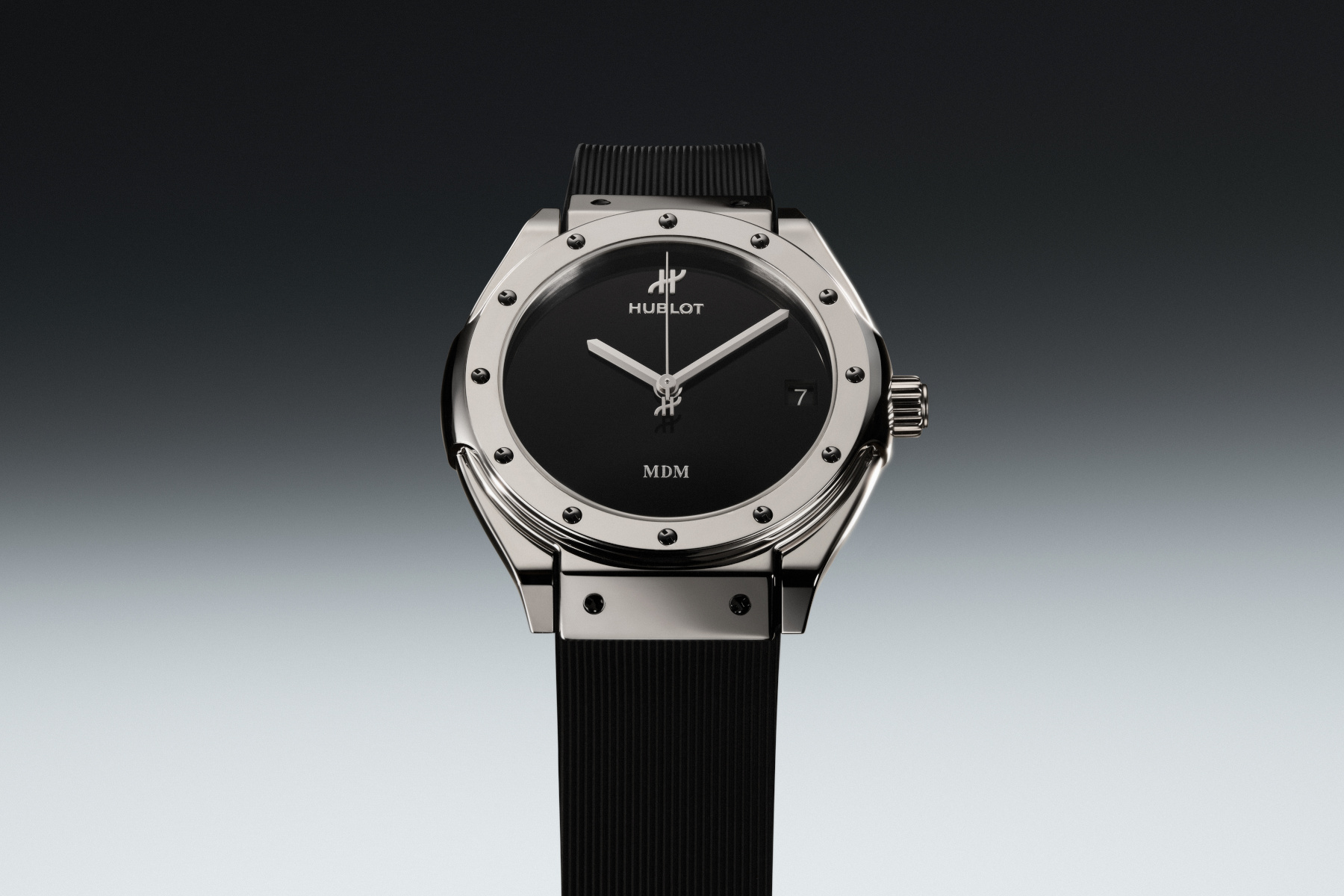
Introducing the new Classic Fusion Tributo
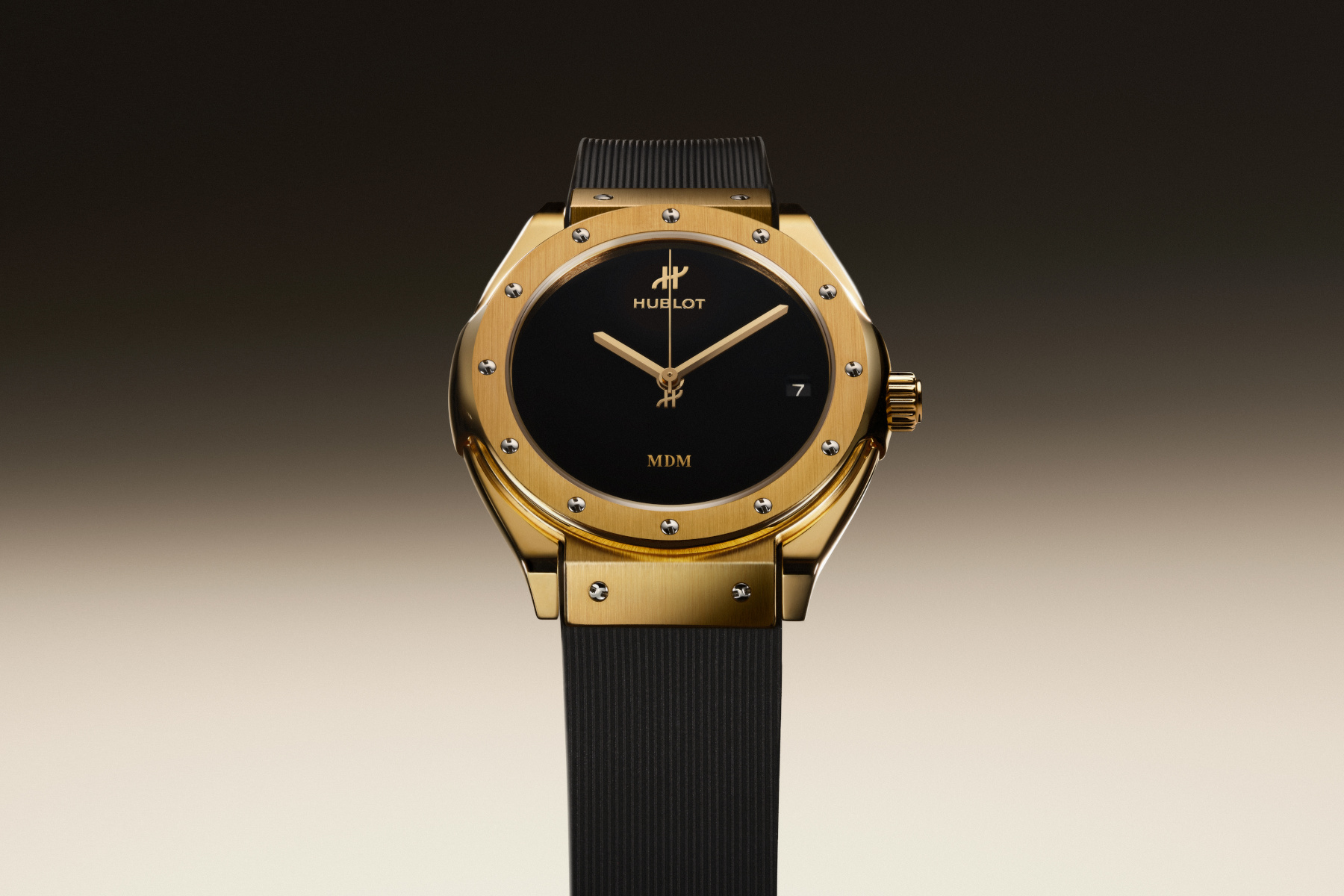
The Classic Fusion Tributo takes that 1980 design and brings it into the present. The case grows from 36 to 38 mm, you can have it in yellow or white gold, and the original quartz movement gives way to Hublot’s in-house HUB1711 automatic. The yellow gold version features “MDM” at 6 o’clock, and Hublot is donating CHF 100,000 to Crocco’s Main dans la Main Foundation to mark the launch. Both versions cost CHF 25,000 / £23,600. The full specs are at the bottom. But the watch is only half the story. The other half starts with those three letters on the bottom half of the dial.
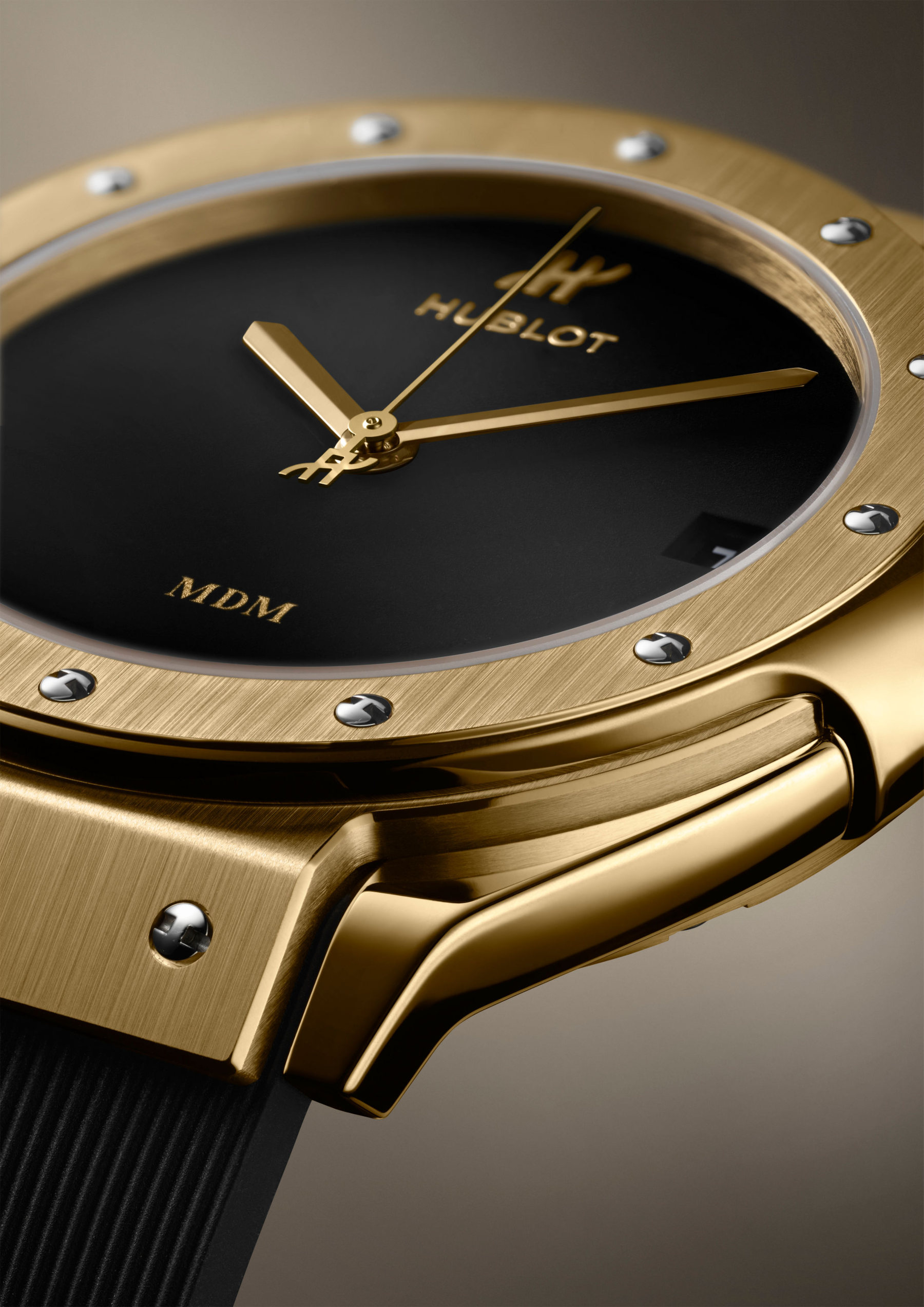
“MDM” makes its return to the dial
Three letters, three lives
Let’s start with a bit of context because this confuses many people. In 1980, Hublot wasn’t the company; it was the name of the watch. The company was MDM Genève, which is why those three letters are on the original dial. The watch was so successful that its name eventually took over.
The story goes that the letters stood for “Montre des Montres,” or “the watch of watches,” until Edmond Kaiser, the founder of Terre des Hommes, looked at the logo and saw something else — “Main dans la Main,” meaning “hand in hand.” Crocco lit up when I put that to him. “Yes, exactly. Perfectly.”
Then he told me the part I didn’t have. “It was a long story. In the beginning, MDM was inspired by the name of my wife.” Her name is Danielle Marie, and his first company was Montres Danielle-Marie. When Hublot came along, the letters became Montres des Montres. And when he met Kaiser, they became the name of the children’s foundation he set up in 1998, starting with a program in India. Three letters, three chapters of his life — his wife, his watches, and the work he cares about most now.
You can tell which one that is. “The name is very beautiful, ‘Main dans la Main,'” he said. “Don’t you think so?” I did, as it happens. Then, he got up, walked to the other side of the showroom for his wallet, and came back with a business card bearing the foundation’s logo, a big white hand holding a smaller, darker one. “It means help for children. A big hand and a small hand. I like it very much.”
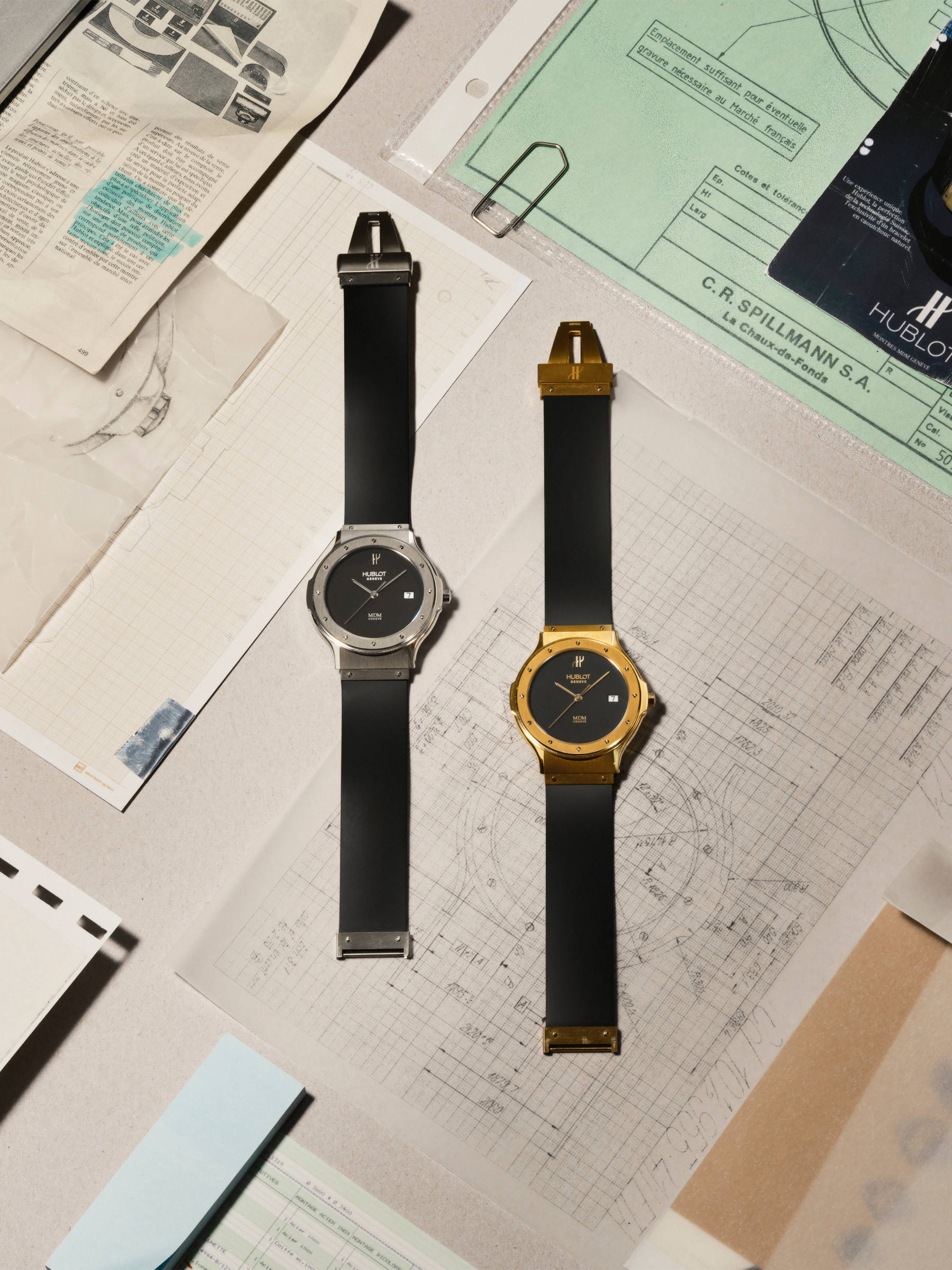
The strap came from a wheel maker
As he picked up the original watch from 1980, he held it with real affection and just the slightest hesitancy. I wondered if it was a bit like being handed an old photograph of yourself.
Then, there’s the strap, the thing everyone remembers. It came, it turns out, from a man who made rubber for wheels. “We developed this with an Italian engineer, Guido Gamberini, who manufactured caoutchouc rubber, but in big pieces.” Getting a company used to wheels to work at the scale of a watch strap was hard work. “Very piccolo tolerance,” as Crocco put it, reaching for the Italian. They also needed steel inserts inside them. And then came the touch that has become Hublot legend — a drop of vanilla in the rubber to hide the smell.
“You are crazy”
Not everyone was convinced, though. A gold watch on a rubber strap, at the price of a gold watch? The Swiss case manufacturer had a simple verdict. “Oh, it is not possible. You are crazy!” Ordinary people thought the same. “It was very risky,” Crocco said. “It could also have been a flop, a complete flop. We didn’t do any market research. We came with our idea, our concept, our fancy. But if you risk, you can also have success.”
And Basel 1980 very nearly proved the doubters right. Crocco’s stand was opposite Cartier, which sounds glamorous until you hear that for the first two days, literally nobody came. You can imagine how those evenings felt. Then on the third day, suddenly, everyone was talking about it. The first customer, he remembered, was a Mexican visitor, “really enthusiastic”, whom he never saw again.
You probably know what happened next: the advertisement in Time Magazine, the former King Constantine of Greece buying two, and a line of admirers that included Giorgio Armani, the designer Vico Magistretti, and the car designer Giorgetto Giugiaro.
Fusion without a name
Here’s what surprised me most. If you read the Tributo press release, you’ll find it described as a return to “the roots of the Art of Fusion.” Crocco’s statement in it uses the same phrase. So what did he call it in 1980? “The Art of Fusion was made by Jean-Claude Biver in 2004. He started to theorize.” It just was back in 1980 — no fancy moniker, just an ethos with no name.
Switching to Italian, he explained the original idea: “To combine the classicism of the Swiss watch with Italian design was something innovative and revolutionary.” So the watch came first, and the philosophy arrived 24 years later. He wasn’t following a big idea. He was just making the watch he wanted, and someone else gave it a name.
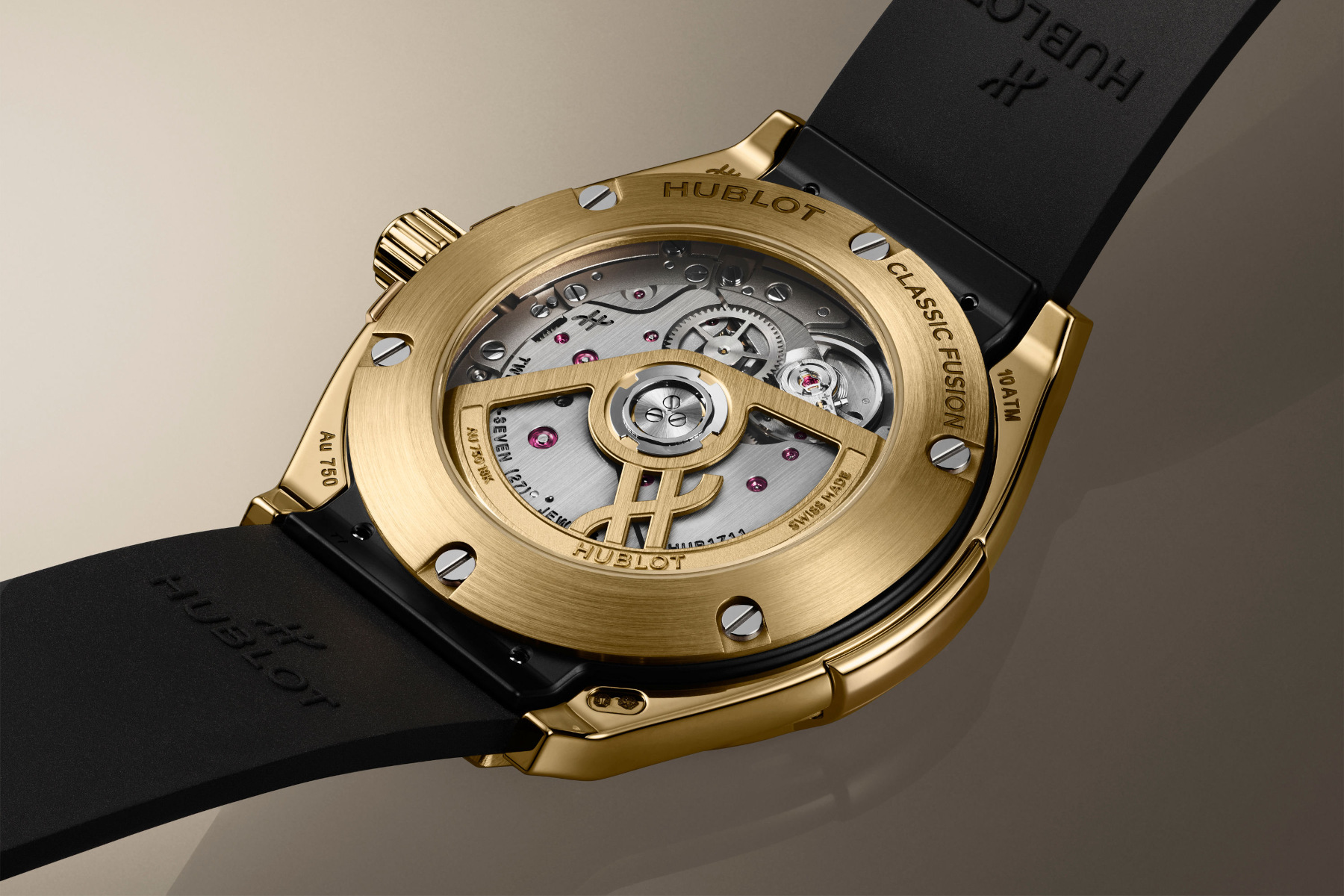
Crocco was just as candid about the movement. The original was Swiss quartz, chosen in the middle of the Quartz Crisis because it was precise and, in his words, “rationally very good.” He has since changed his mind. Mechanical movements, he agrees, have more soul. “But in the beginning, people didn’t mind. Quartz was very good.” That makes the Tributo’s automatic movement feel like a small correction he’s rather pleased about.
Back in Nyon to see the Tributo
He’d only been back to the Hublot manufacture recently, and you could hear that it made an impression. “This is fantastic here now. We were very small. Here in Nyon, we were only, I don’t know, 40, 45, 50 people working. Here, I don’t know how many people they have. So it’s incredible.” What seemed to matter most to him was that Hublot now makes movements in-house, something his company never did. And he liked that the Tributo goes back to where it began. “If we can keep the image of the beginning, the spirit, the DNA of the product, this I appreciate very much.”
So how did it feel, walking back in? “I’m very proud. I’m very happy that I could initiate this brand, and now it’s so strong and known all over the world.” And then, “I don’t know another man lucky like me.”
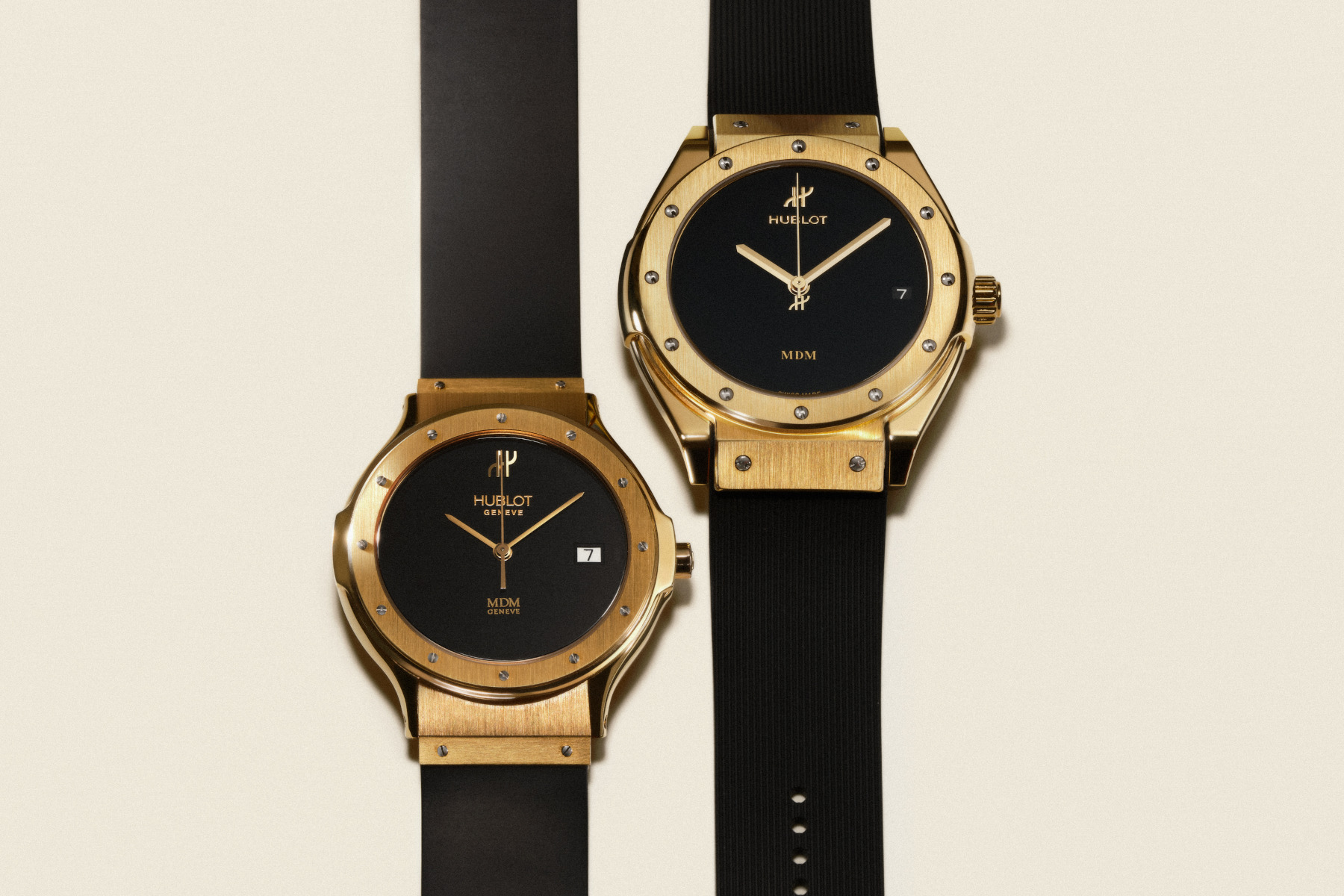
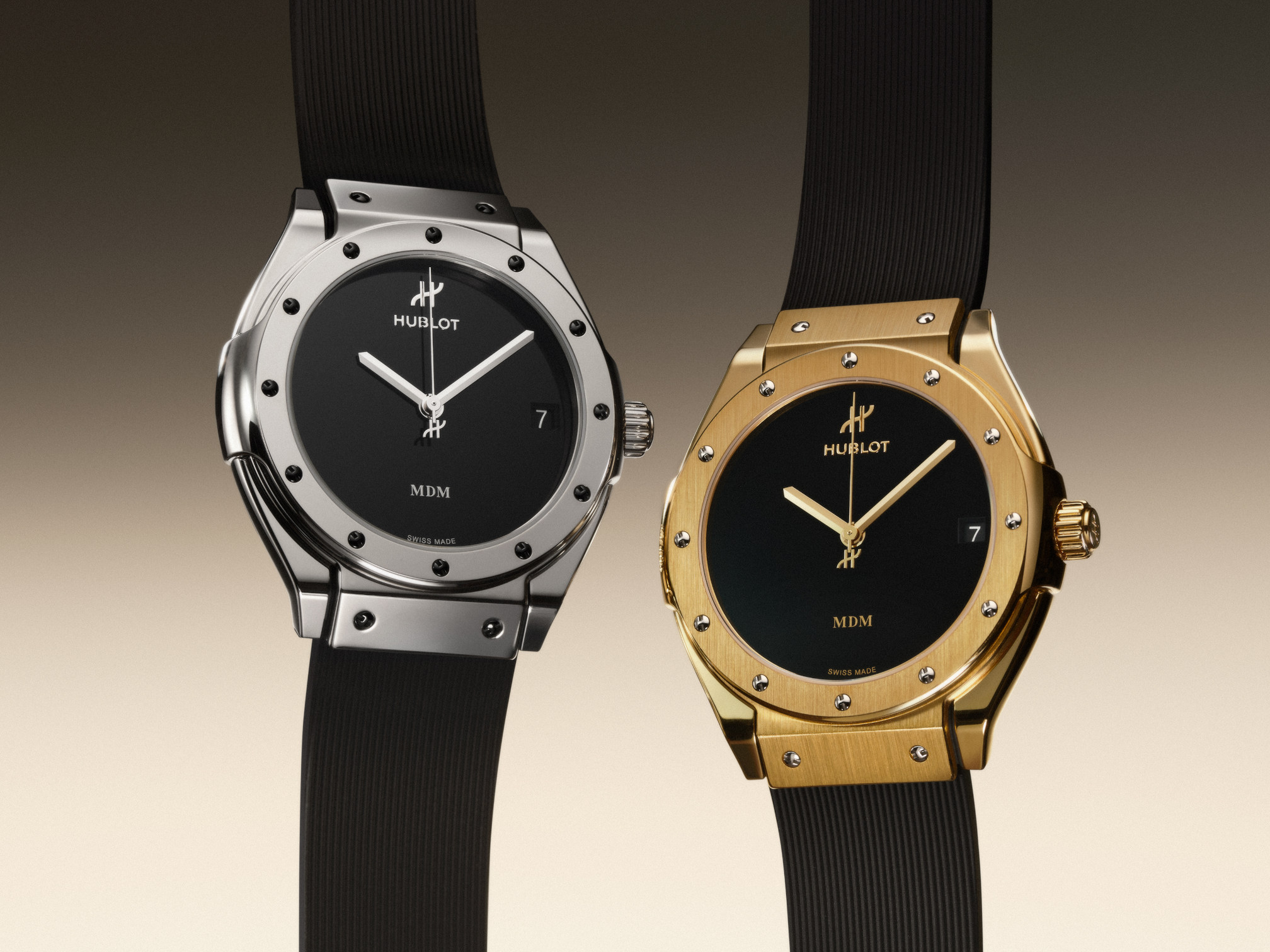
Side by side, the old (L) and the new (R)
Old and new, side by side
Put the original and the Tributo side by side, and you’ll see the differences straight away. Crocco saw what stayed the same. “There are some differences, but we still keep the idea. The main points are still there.” For him, the key was the 12 screws. “Because with these, we can have a clean dial. We don’t need anything else.” Then the black rubber and the black dial. “The main points are present, so I’m happy about it.” Would he change anything? “No, I think I am happy.” And the “MDM” back on the dial, along with the donation to his foundation, “made me proud in many senses.”
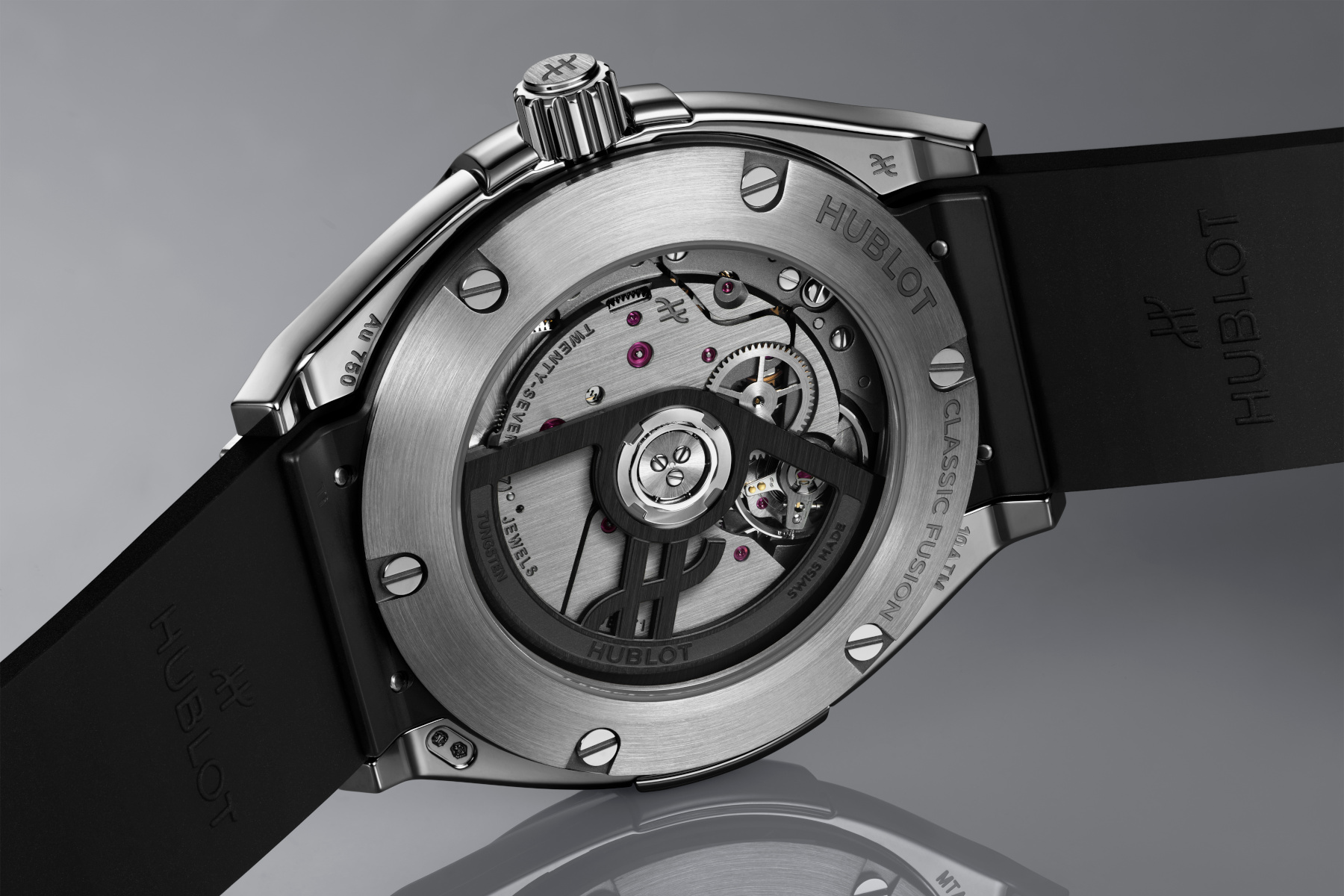
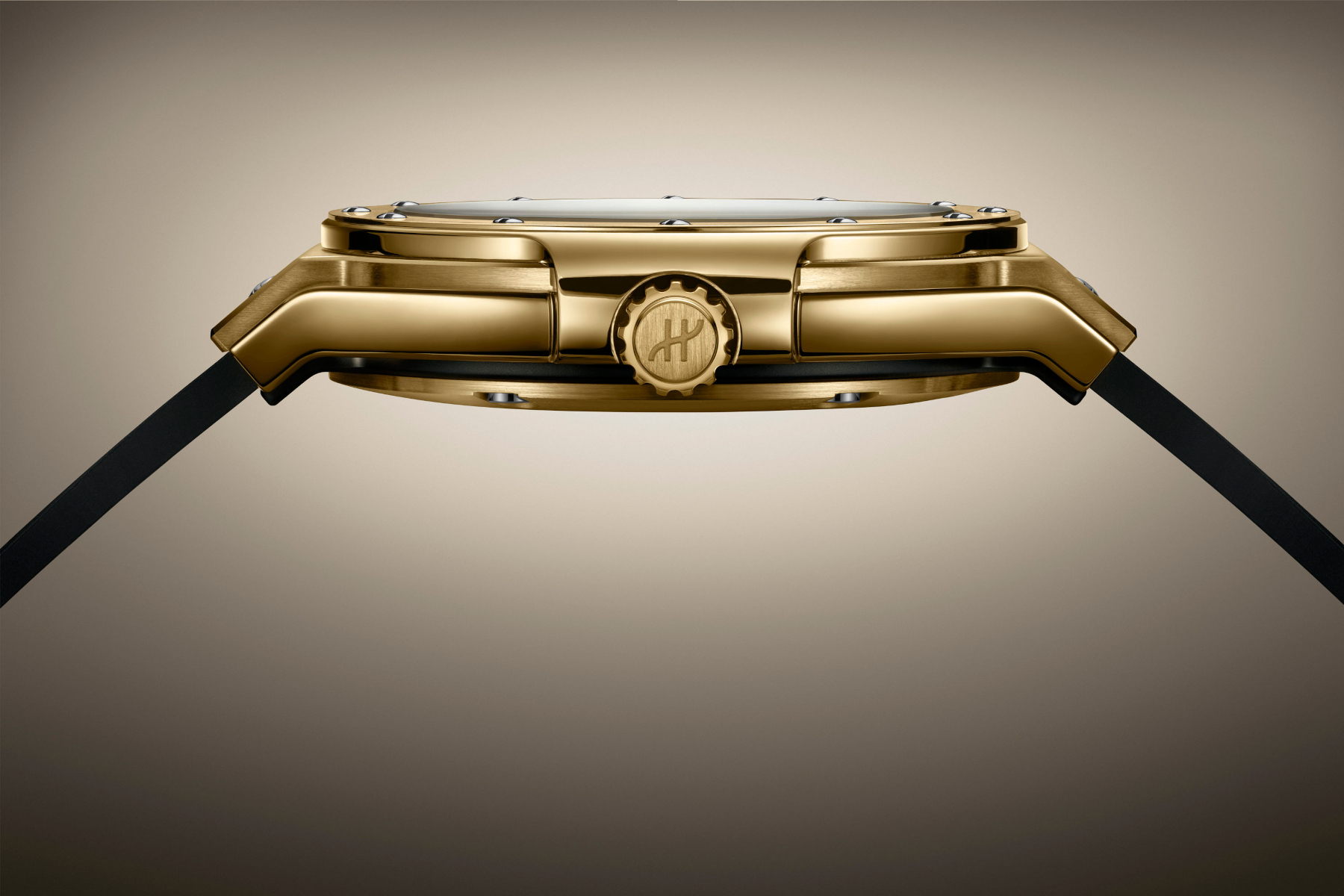
For the spec-minded, here’s what has changed. The case is now 38 mm across and 9.5 mm thick, with those 12 H-shaped titanium screws on the bezel and exposed lugs that show how it’s built. There are still no indexes, and the date stays at 3 o’clock. A screw-down crown supports the 100m water resistance rating, and Hublot has deliberately eschewed its One-Click strap system to keep things faithful to the original. Inside is the in-house HUB1711 with 185 components, a 4Hz frequency, a 60-hour power reserve, and an openworked “H” rotor visible through the case back’s sapphire display.
The two versions have quite different personalities. The yellow gold one stays closer to the watch Crocco made, with a black dial, “MDM” at 6 o’clock, and an 18K gold rotor. The white gold one is more formal and a bit moodier, with a polished black onyx dial, black-plated screws, and a black tungsten rotor.
Warm minimalism
My last question was a little more on the philosophical side: what should Hublot never lose? He started with the product. The round shape, the rubber strap, the screws. “With this, they can continue, yes, forever.” And the brand? You could see him searching for a diplomatic way to put it. “It’s quite different because we were an understatement. Now we’ve become more visible.” It’s certainly true that, to some, the brand is on the more ostentatious side, but it’s interesting to hear that its founder notes the same.
I should be clear about his tone here, though, because it’s important. He was immensely proud of what Hublot has become and said so more than once. But there were some things from the beginning he’d like to hold on to — discretion, simplicity, and purity. “For me, it’s important to keep the minimalism. Not cold minimalism, just minimalism. Warm minimalism.” Whether Hublot takes the hint is another matter. But for now, at least, its founder has a Hublot back on his wrist.
Learn more about the new Classic Fusion Tributo on Hublot’s official site.
This is a partnership post. Learn more.