Introducing: Three New Jaeger-LeCoultre Master Grand Complications

Just as Stevie Wonder is the musician’s musician, Jaeger-LeCoultre is the watchmaker’s watchmaker. But what is meant by this? Well, for starters, Jaeger-LeCoultre is a prolific movement manufacturer that supplies other high-end brands. Famously, Jaeger-LeCoultre’s ultra-thin caliber 920 powered the big three ’70s sports watches — Patek Philippe’s Nautilus, AP’s Royal Oak, and Vacheron Constantin’s 222. In a surprise twist, JLC never used caliber 920 in any of its watches. “Don’t get high on your own supply,” as Scarface would say. The second reason for JLC’s revered moniker is its vast movement count of over 1,200. Among these mechanisms are some of the most complex and intricate bespoke watch movements you won’t find elsewhere. For Watches and Wonders 2026, JLC flexes its muscles with three exceptional timepieces. Meet the Master Grande Tradition Tourbillon Jumping Date, Hybris Mechanica Ultra-Thin Minute Repeater, and Inventiva Gyrotourbillon À Stratosphère.
With three watches of significant complexity, let’s start with the least limited one. The 100-piece Master Grande Tradition Tourbillon Jumping Date iterates upon a high-precision movement with new architecture. Caliber 978 debuted nearly 20 years ago and, in 2009, received first prize for chronometry in the modern era. Inspired by 19th-century observatory competitions, the Swiss International Museum of Horology conducted the contest. With two independent bodies officiating, the event marked the museum’s 50th anniversary with a grueling 45-day trial. Many brands submitted watches to claim the accuracy and precision targets alongside resistance to magnetism and shock. Caliber 978 won, and 10 years later, this movement received an upgrade to harness new technology. For 2026, Jaeger-Lecoultre restructures its caliber 978 to highlight the jumping date function in a 42 × 12.5mm pink gold case.
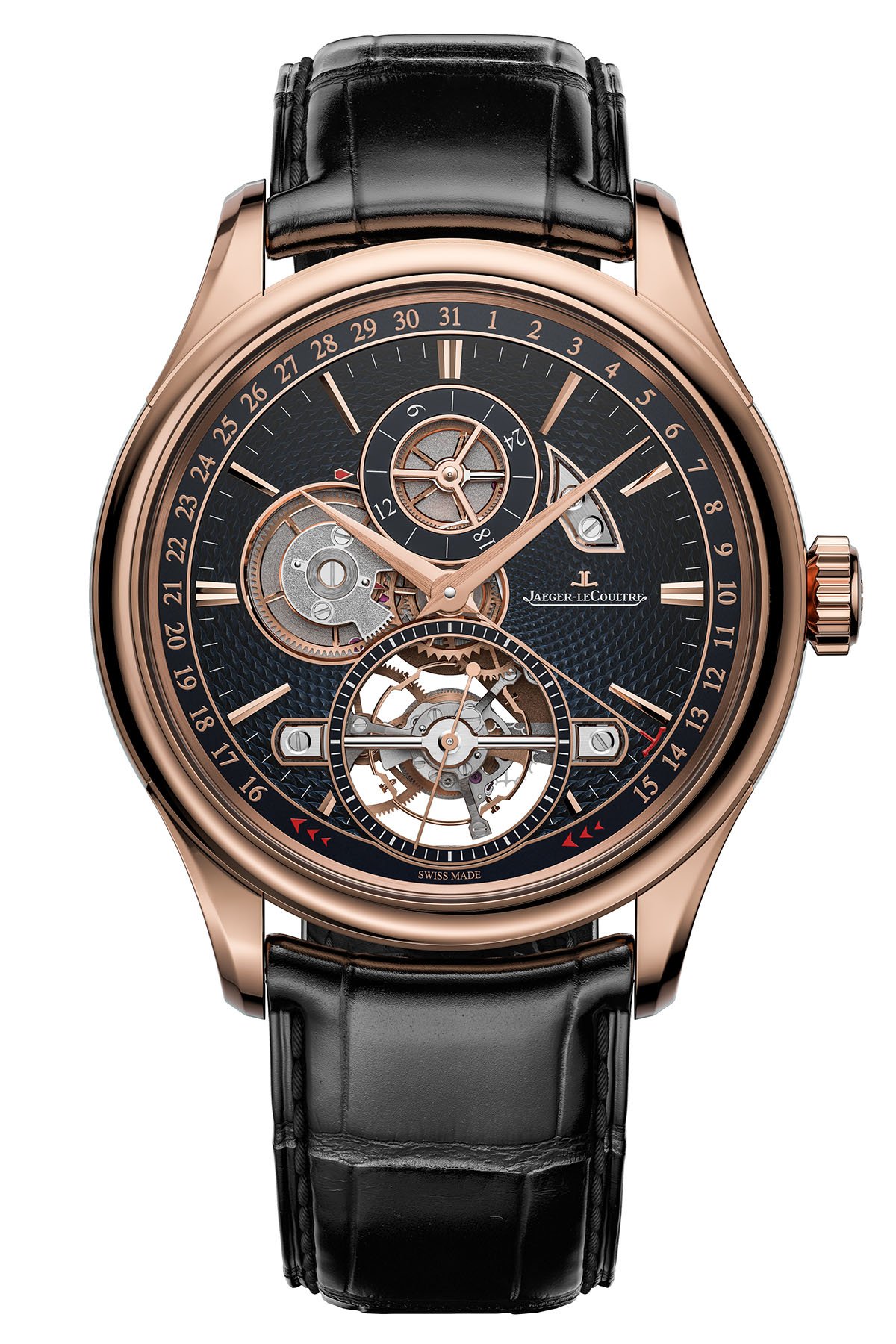
Jaeger-LeCoultre Master Grande Tradition Tourbillon Jumping Date
The main alteration is switching the date display from a sub-dial to a track around the main dial. Known as a pointer date, this structure provides more space for the date scale, improving readability. However, with a tourbillon at 6 o’clock, this layout also creates a problem. With the openworked regulating organ providing dramatic animation, obscuring the tourbillon with a date hand would be a shame. It’s acceptable for the hour and minute hands to cross over temporarily throughout the day. But on certain dates, the indicating hand would sit obtrusively over the tourbillon aperture for an entire day. Depending on the spacing, it could even remain there for a few days. JLC overcomes this with a jumping date mechanism powered by the calendar driver, viewable at the 9 o’clock position. This component triggers a rapid glide of the date hand at the stroke of midnight on the 15th of each month.
Any of the lucky 100 owners can stay up late watching as the hand gracefully shifts from 15 to 16. This addition keeps the tourbillon window unobstructed by the date hand at certain times of the month. There are even red chevrons guiding the jump and match the red anchor-like “JL” logo on the slim date hand. The tourbillon also serves as subsidiary seconds, with a gilt brass hand pointing to a blue track and white markers. Above the central pinion is the 24-hour disc, providing a day/night indication with a static red arrow below 11 o’clock. You can also set this disc independently of the main hands for a second timezone. The gilt brass dauphine hour and minute hands feature split finishing with straight graining and high polish on adjacent sides.
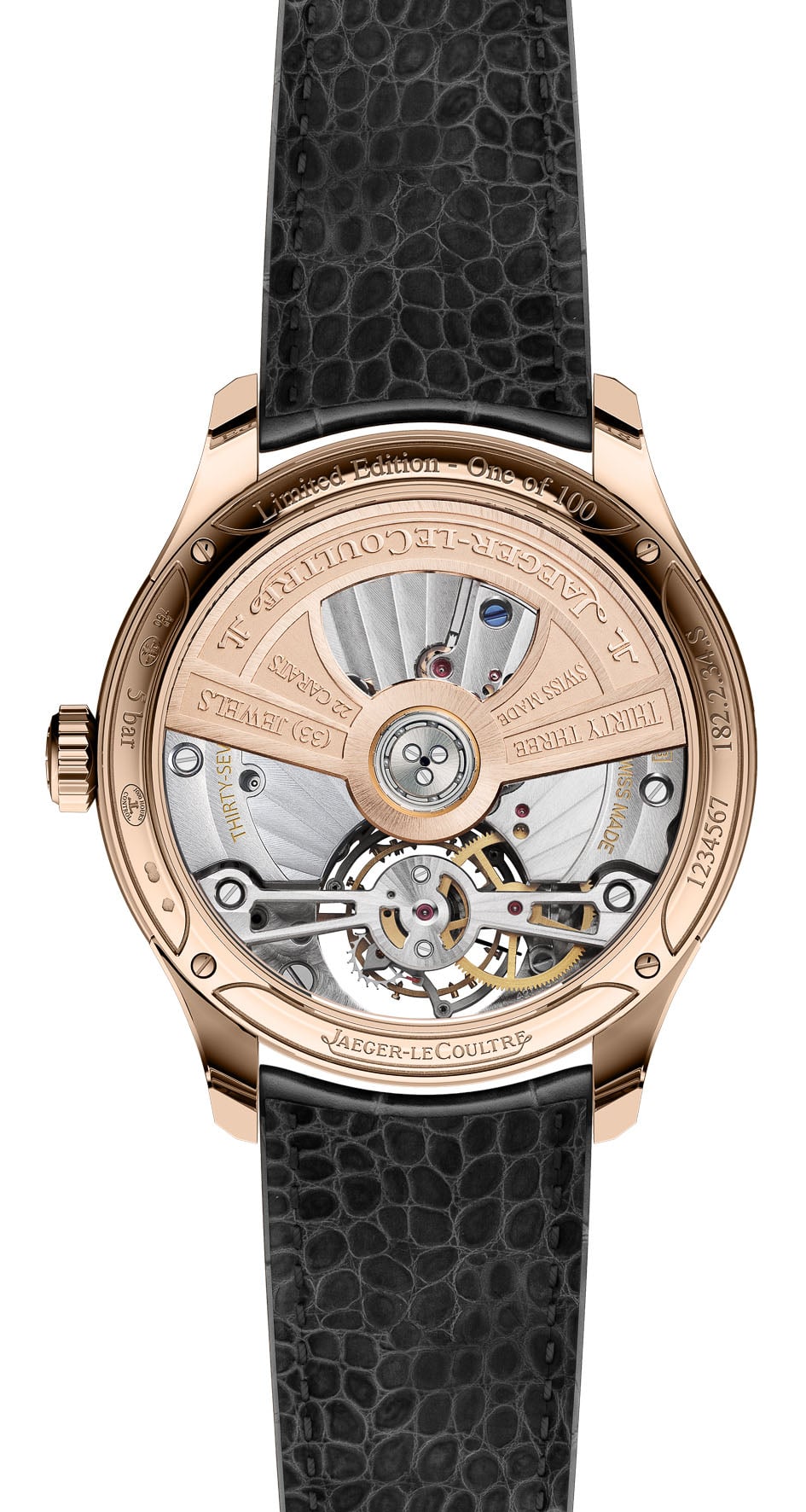
Sublime finishing
As this is an openworked dial and not skeletonized (more details here), there is still room for embellishment. The dial features a guilloché radiating barleycorn pattern on a pink gold base, overlaid with a translucent blue enamel layer. Every facet, angle, and corner is lovingly graced with a beautiful mix of finishing. From straight graining, perlage, bevelling, sand-blasting, and black polishing, the Master Grande Tradition Tourbillon Jumping Date showcases next-level refinement. Through the case back’s sapphire display, you’ll see further flourishes, such as Côtes de Genève and a 22K pink gold rotor. The rotor strategically incorporates a cutout to allow light to pass through the dial-side window. Finally, affixing the watch to the wrist is a black alligator strap with curved ends and an 18K pink gold folding clasp.
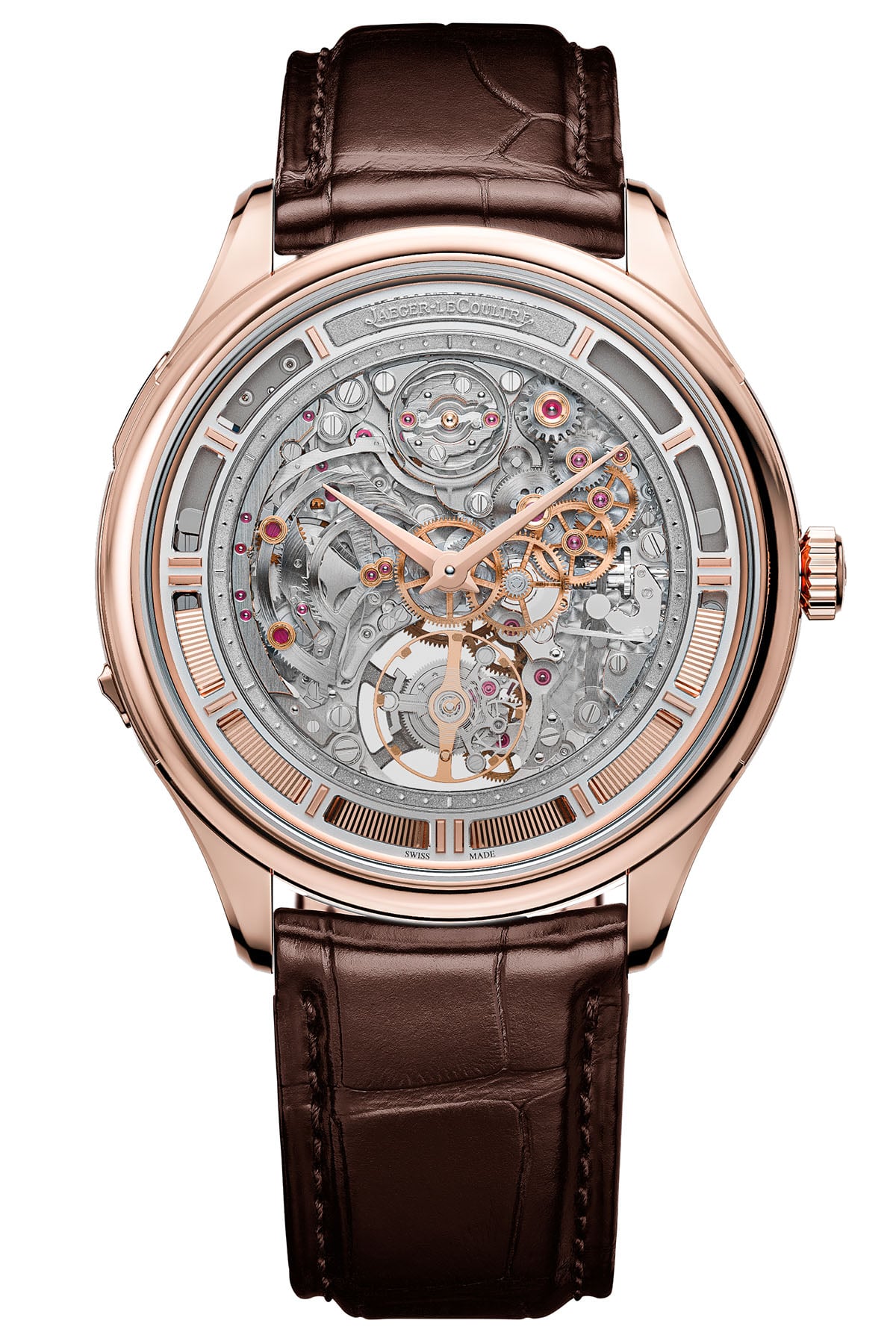
Jaeger-LeCoultre Master Hybris Mechanica Ultra Thin Minute Repeater Tourbillon
Next, we’ll move from the least limited grand complication of this trio to the most. The Master Hybris Mechanica Ultra Thin Minute Repeater Tourbillon, limited to 10 pieces, elevates artistry to new heights. Packing 593 components, caliber 362 pulls no punches with its mechanical display. If the previous watch defines openworking, this minute repeater is a wonderful example of skeletonization. Even the impressive 60-second flying tourbillon with 59 components weighing 0.248 grams takes a slight backseat. Launched in 2014, this movement’s most striking feature is the bidirectional peripheral rotor visible from the dial side. With fluting on the 18K pink gold oscillating mass, it spins with splendid animation. The 10 scalloped openings create a visual feast that even the flying tourbillon can’t distract you from.
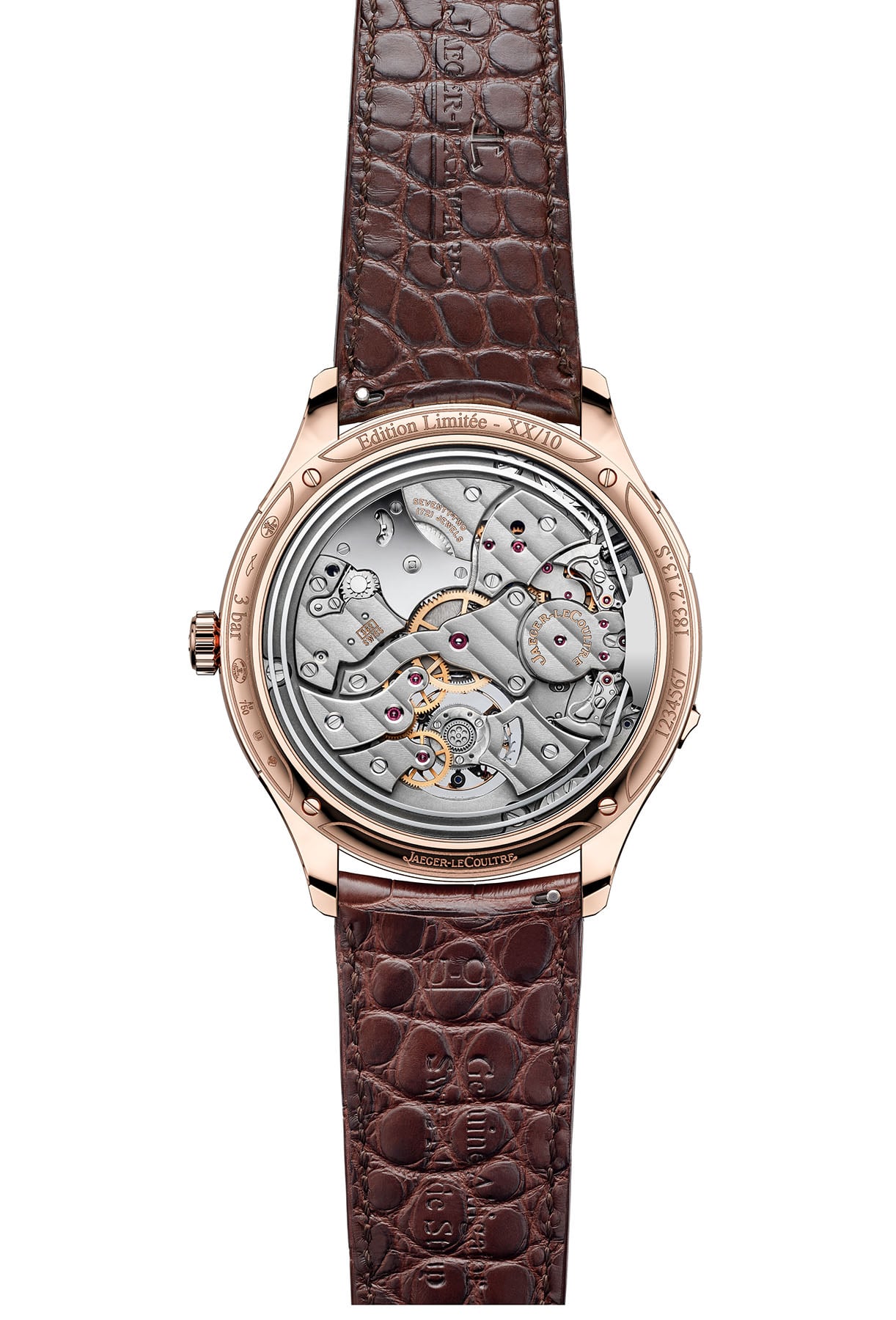
To enhance the gears and plates, JLC uses transparent sapphire bridges to secure critical components. As rotating, lubricated rubies could fracture brittle sapphire, gold chatons encircle these rubies. Essentially, wherever you see gold around a red synthetic ruby, there is an imperceptible sapphire bridge holding it in place. With a mostly silver-toned dial side, the golden touches truly stand out. None does so more than the gear train, which illustrates the power-delivery journey. When activating the minute repeater, certain gears spring to life, releasing power to start the hour, quarter, and minute chimes. The time-lapse function also reduces the pauses between gongs, creating a more fluid rhythm. Visible through the case back, the trebuchet-style hammers are more avant-garde than the typically high-polished hammers seen in most minute repeaters.
Extreme finesse
As expected, the finishing is exquisite. However, the intricacy of the dial garners more appreciation as a technical feat than an object of beauty. The pink gold hands are somewhat lost in the sea of mechanics. However, I do like the frosted white gold minute track and applied gold hour markers between the cutouts. The arched Jaeger-LeCoultre logo at 12 o’clock is fantastically integrated into the display. By integrating the tourbillon, minute repeater, and peripheral rotor from the outset, JLC can make the movement incredibly thin. With a 5mm profile, caliber 362 is the world’s thinnest automatic minute repeater with a tourbillon. This contributes to the overall 18K pink gold case’s relative 8.25mm slimness. With a 41.4mm diameter, excluding the minute repeater actuator at 10 o’clock and the locking feature at 8 o’clock, it’s wearable too. Limited to 10 pieces, this watch comes on a brown alligator strap with a pin buckle.
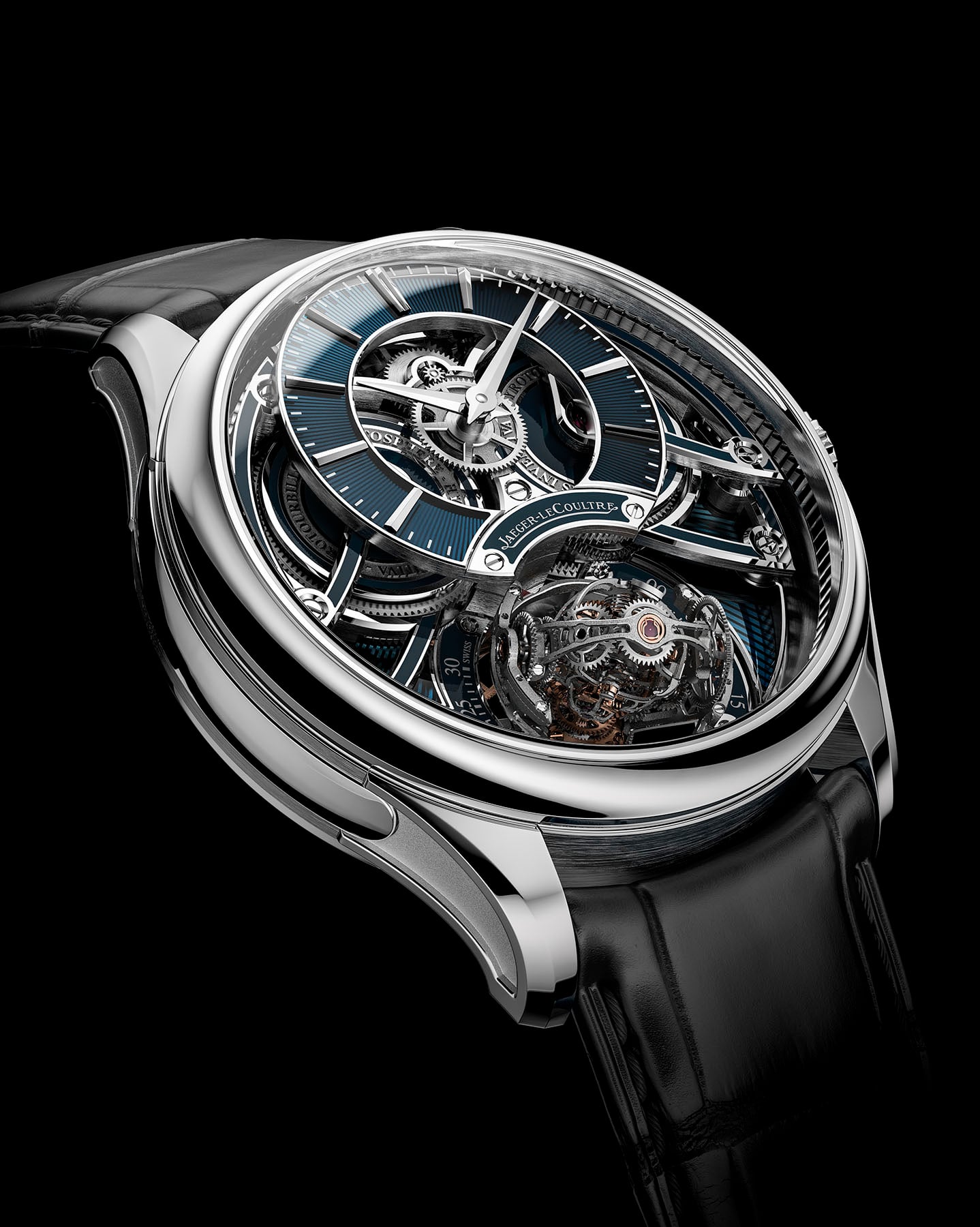
Jaeger-LeCoultre Master Hybris Inventiva Gyrotourbillon À Stratosphère
Last among the high-horology launches is the Master Hybris Inventiva Gyrotourbillon À Stratosphère. Strictly speaking, however, this is the least complicated of the three timepieces. Despite what’s on show, the Hybris Inventiva only tells time by hours, minutes, and seconds. But that does not tell the whole story. The gyrotourbillon at the heart of this timepiece is a marvel. Rotating on a three-dimensional axis, the gyrotourbillon assuredly negates any gravitational forces at almost all angles. While arguably irrelevant for a wristwatch, the gyro is the ultimate expression of the tourbillon’s function. Subjectively, this is also the most beautiful of the three JLC creations announced today. There is a wonderful attention to symmetry and shimmering blue textures. In a 42 × 16.15mm platinum case, this is also the largest and heaviest of the three.
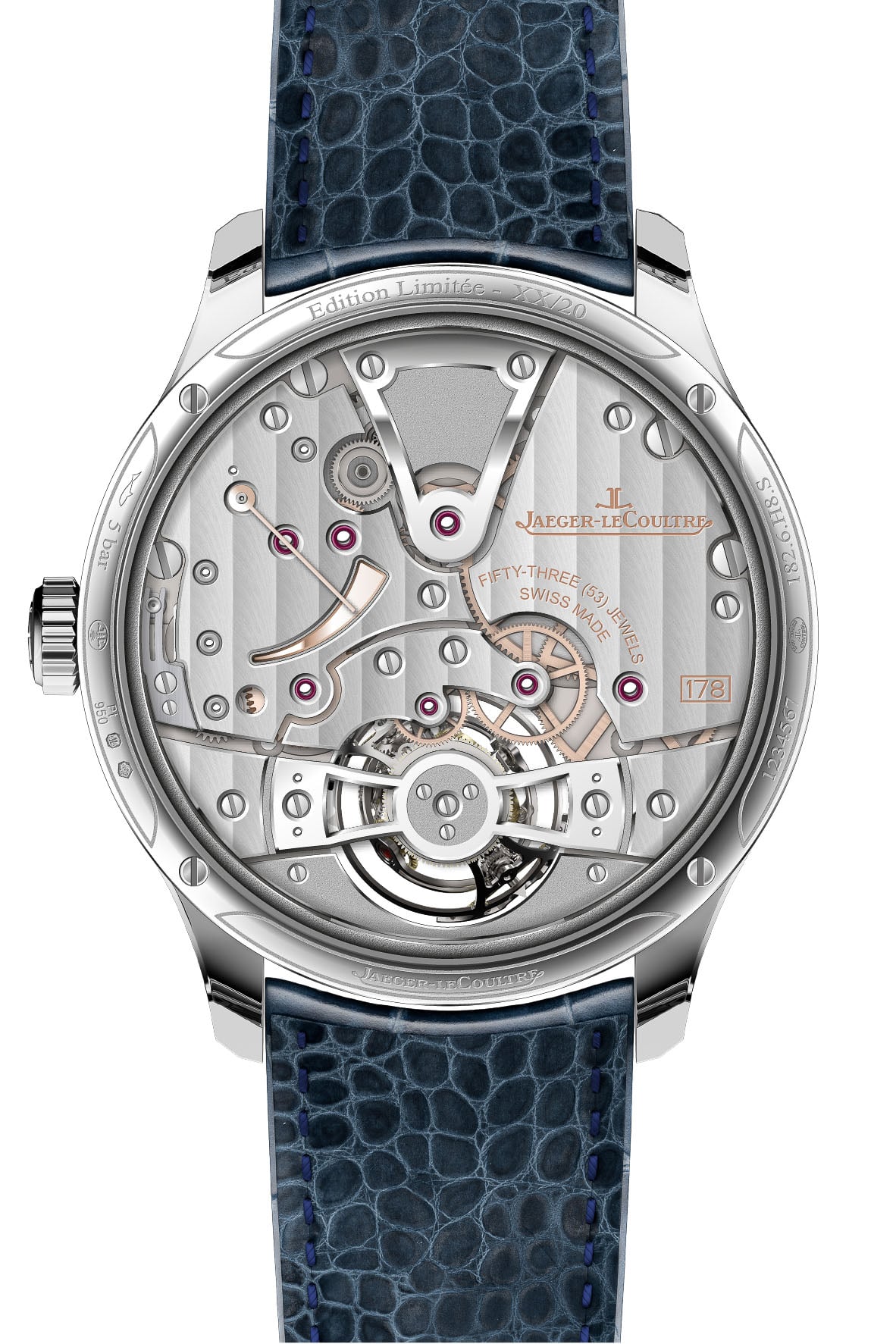
While the thickness is on par with an Omega Planet Ocean, this dimension is justified to house the triple-axis tourbillon. This gyroscopic motion covers 98% of all possible positions for the cylindrical balance spring. Every 30 seconds, red arrows connected to the tourbillon indicate 15 seconds on either side of the aperture. Comprised of 189 components, the titanium gyrotourbillon remains lightweight at 0.783 grams, enabling incredible motion. The dial features white gold markers on a sunray guilloché pattern, overlaid with translucent blue enamel. Alongside this are overlapping structural white gold bridges with blue lacquer matching the tourbillon scale and barrels. Disrupting the main time-telling dial is the arching JLC logo. Consequently, between 25 and 35 past the hour, the miniaturized dauphine hands lack a minute track.

High watchmaking
Caliber 178 is a spectacular tour de force with a 4Hz frequency and a 72-hour power reserve. On the reverse side is a power reserve indicator and Côtes de Genève decoration. However, the dial side is the true showcase of the variety of finishing techniques within JLC’s wheelhouse. The Hybris Inventiva is a limited edition of 20 pieces and comes on a blue alligator leather strap with a white gold folding clasp.
All three watches are listed as POA, but you can anticipate that they’ll be well into the six-figure range. Also, they’re all water resistant to 50 meters, but please try to keep them dry. You can learn more about the watches on the Jaeger-LeCoultre website here.
Which of the three timepieces is the standout? Let us know in the comments below.