Movement And Dial Hand In Hand: Czapek Promenade Transparencies Aqua Blue

Czapek & Cie introduces the Promenade Transparencies Aqua Blue, a new 38-piece limited edition that takes the transparency concept from the Czapek × Fratello Promenade Transparencies Viridian Green and gives it a new color palette and dial execution. The watch combines a 38mm stainless steel case with a blue fumé metallized sapphire dial, allowing Czapek’s in-house skeletonized caliber SXH7 to be visible from the front and through the display case back. The 4Hz movement uses a micro-rotor made of recycled platinum and offers a 60-hour power reserve. Transparency is the main thing here, though. That’s why Xavier de Roquemaurel, CEO of Czapek & Cie, says, “[The] Transparencies [line] plays with the excitement of seeing some details yet not all of them, letting our imagination figure out the rest of the gearing, like the organs of a beautiful body.” This is a very surgical release from Czapek, but more on that in a bit.
The Czapek name has much history behind it, but the modern company is an interesting example of how to revive a historical name without simply trying to recreate the past. François Czapek founded Czapek & Cie in Geneva in 1845 after his partnership with Antoine Norbert de Patek ended, and the original company eventually disappeared in 1871. The name was resurrected in 2012, and Czapek & Cie officially relaunched in Geneva in 2015, following a revival led by watch enthusiasts and collectors. The Promenade collection is a particularly good example of that approach. Launched as a modern, relatively slim, and wearable expression of Czapek, it is a free and safe space for color, materials, and dial techniques. The Aqua Blue, like its Viridian Green predecessor, takes that idea to its logical extreme. Instead of decorating the dial around the movement, Czapek made the movement itself part of the dial.
The transparency is the design
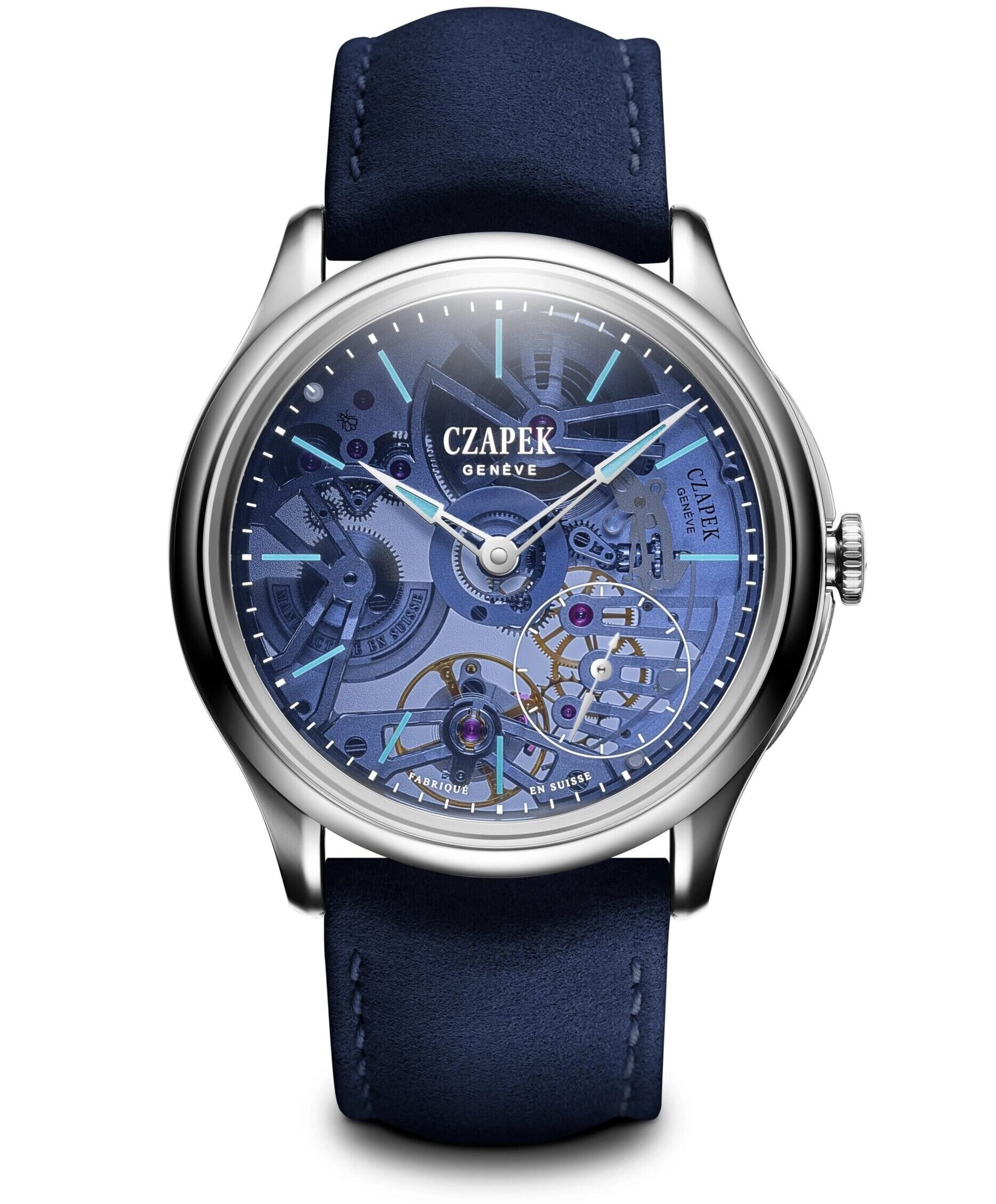
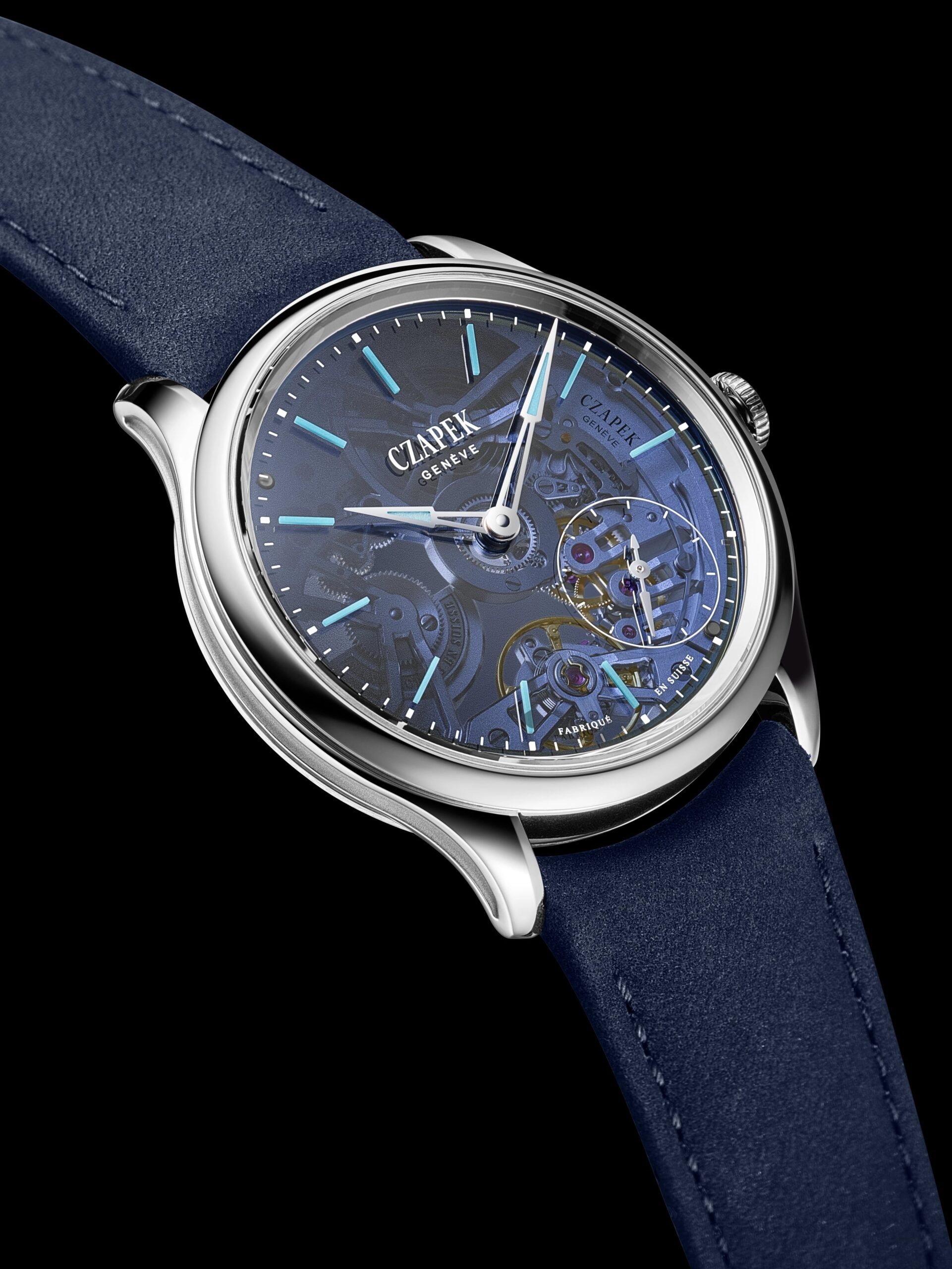
At first glance, the Aqua Blue seems relatively straightforward. It has a blue sapphire dial, a skeletonized movement underneath, and a small seconds display at 4:30. But, as with everything watch-related, a closer look puts the piece in context. The blue isn’t simply there to give the watch some color. Czapek had to control the sapphire’s transparency while retaining enough contrast to make the watch readable. That is where the metallization process comes in. The dial isn’t lacquered, painted, or made of blue sapphire throughout its thickness. Instead, Czapek uses a vapor-deposition process to apply a metallic coating to the underside of the sapphire disc. The coating consists of microscopic dots roughly eight microns across, with their density increasing towards the edge of the dial and decreasing towards the sub-seconds register. The result is a fumé gradient that is more opaque around the perimeter and increasingly transparent towards the center.
The gradient does more than make the dial look pretty. The center remains sufficiently open for the movement to take over visually, while the darker edges give the dial enough structure to frame everything below. Many of these design elements do take us back to the Fratello Viridian Green collab, and that technical distinction I just explained matters. That’s because the Aqua Blue also changes how the dial communicates compared with the first Promenade Transparencies edition. The original Viridian Green used metallic hour markers, while the Aqua Blue uses 3D light blue Super-LumiNova indexes applied directly to the sapphire crystal. These markers also glow blue in the dark. It’s a small change on paper, but visually, it makes a big difference. The blue markers feel almost like they are floating above the movement, particularly when viewed against the darker sections of the fumé sapphire.
The SXH7 and the case are the real story
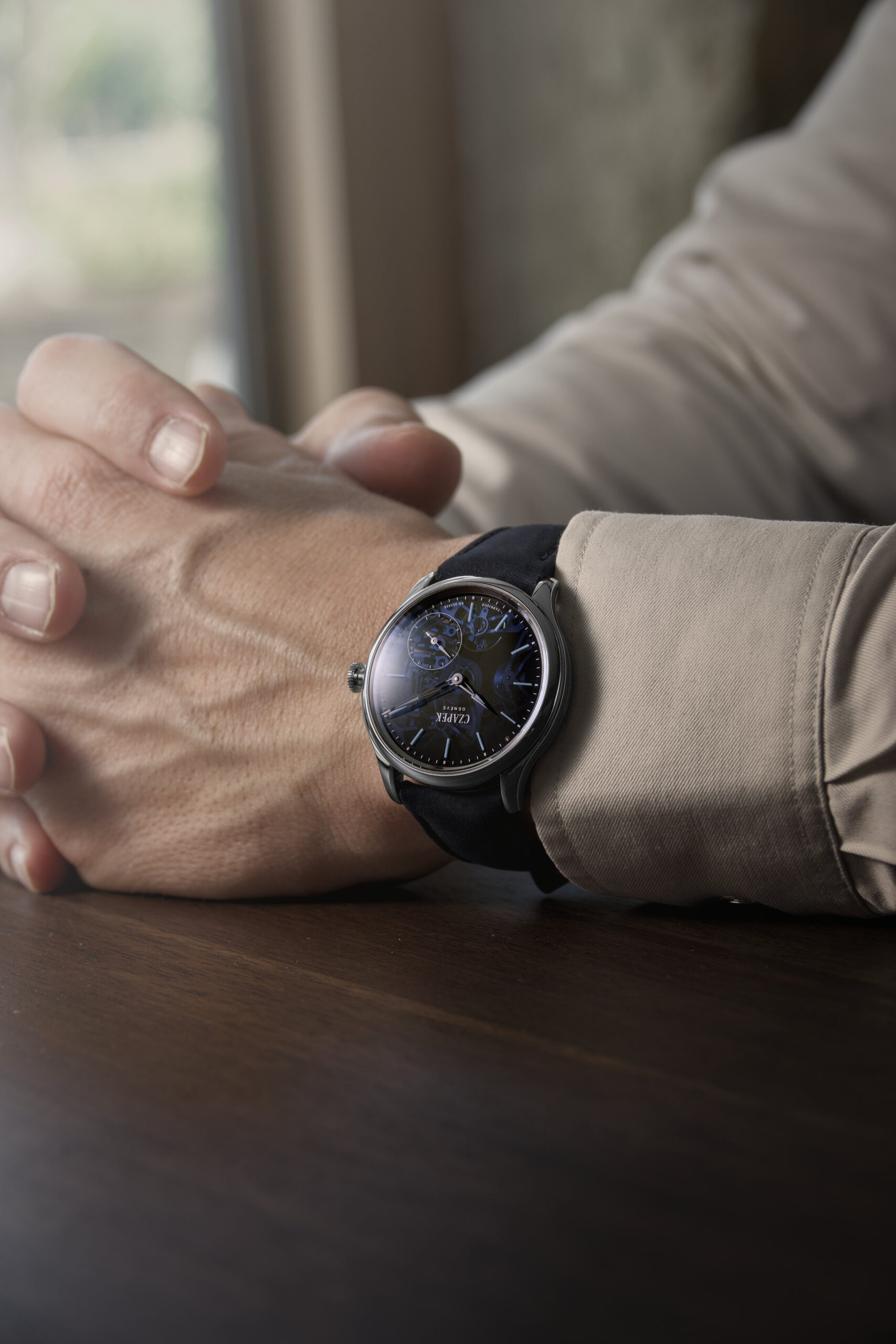
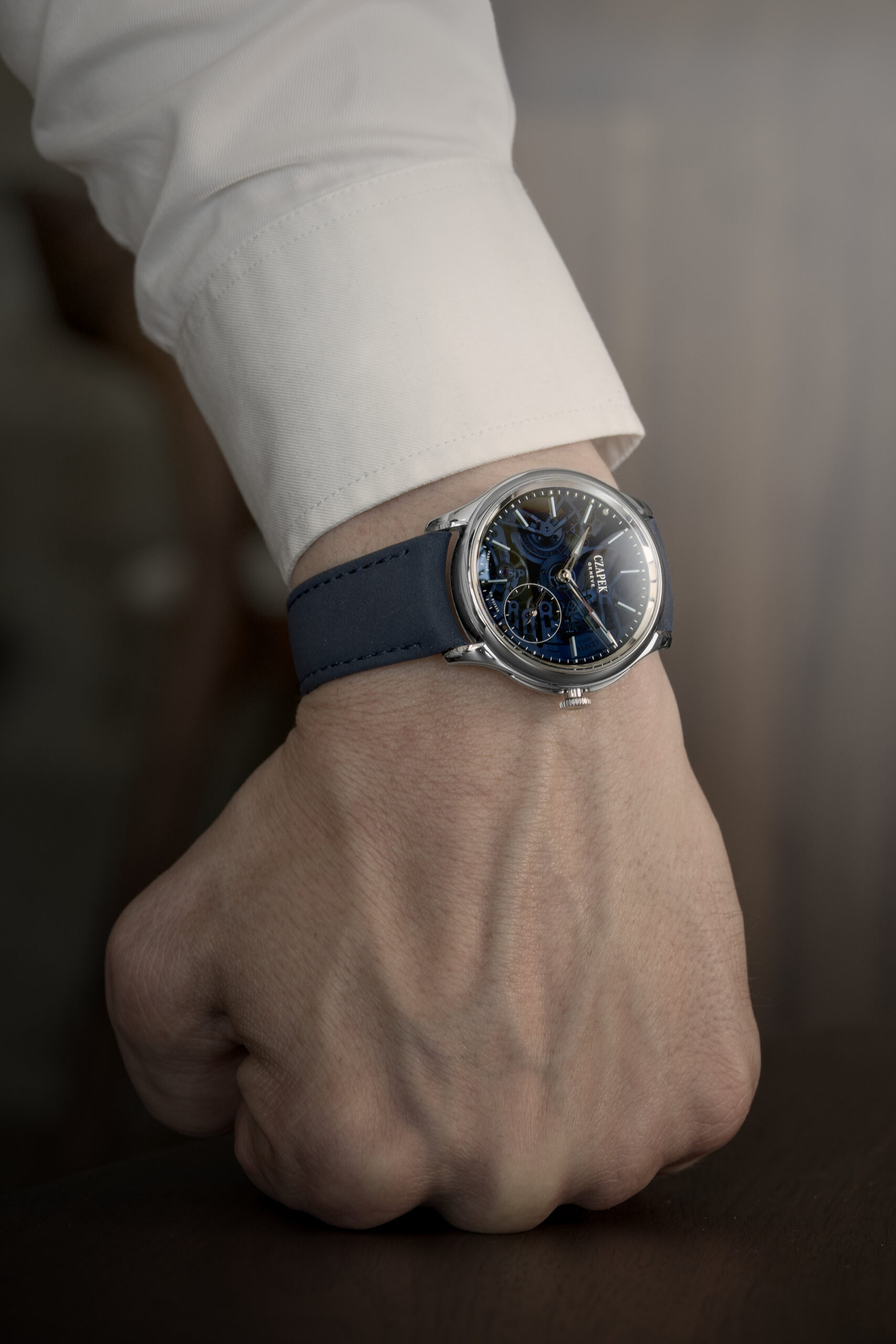
If the sapphire dial is what gets you to stop scrolling, the SXH7 is what should make you stay. Even cooler, it lives comfortably in a case designed to stay out of the way. The 38mm stainless steel case is common in the broader Promenade family, featuring a 10.8mm profile and a 42mm lug-to-lug length. It uses curved lugs and hollowed flanks, while both the box-style sapphire top crystal and display case back receive internal antireflective treatment. Czapek rates the water resistance at 50 meters.
The brand introduced the SXH7 as part of its development of in-house movements. For the Promenade Transparencies project, the engineers didn’t merely skeletonize it and put a piece of sapphire on top. Instead, they reworked the construction itself around the idea of viewing the movement from the dial side. The story goes back to the SXH5, introduced in 2020, Czapek’s first movement to be entirely conceived and developed in-house. When Czapek adapted the architecture for the Promenade, the seven openworked bridges became one of the movement’s defining visual features. Their arrangement shows inspiration from the multiple-bridge architecture found in François Czapek’s 19th-century pocket watches.
The details that make it special
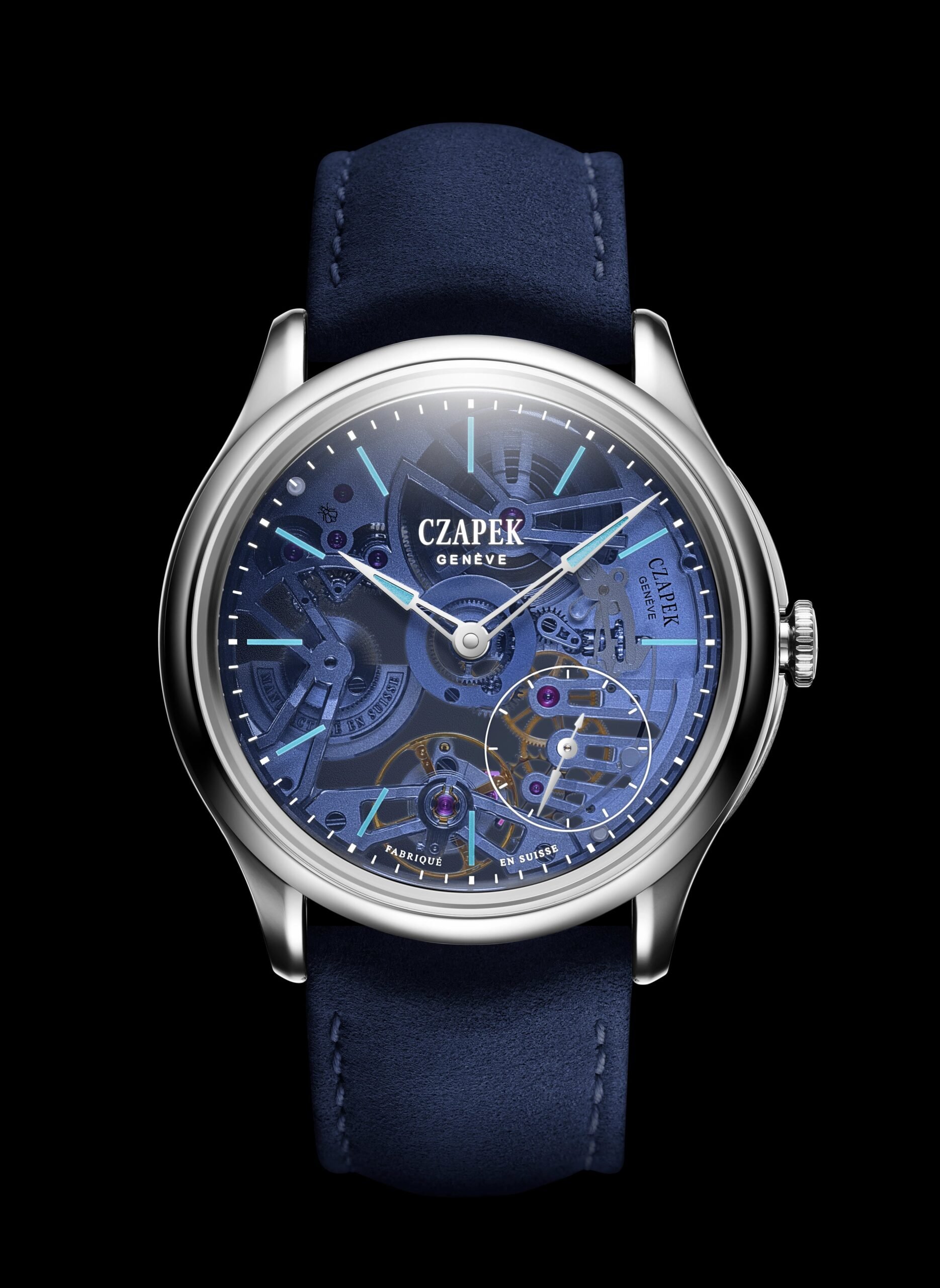
The SXH7 looks thoroughly contemporary, but the basic visual idea isn’t coming from nowhere. The brand is taking an element from its founder’s work and giving it a very 21st-century interpretation. So to make the SXH7 compelling from the front, Czapek reversed the entire escapement, moved the small seconds to 4:30, and arranged for it to be driven directly from the fourth wheel. They also redesigned the crown and keyless works so that they could sit correctly within the new architecture.
This is the detail that separates the Transparencies from the usual “look, there’s a skeleton movement underneath the sapphire” approach. The movement was not merely exposed. Rather, it was redesigned around the way it would be seen. That is why the 4:30 sub-seconds register is more than a design signature. It is also part of the mechanical solution. Czapek’s Promenade collection already uses the off-centered small seconds as one of its defining visual elements, but here, the indication also becomes a consequence of the movement’s architecture.
And then, there’s the finishing…
The SXH7 is 30mm in diameter and 4.2mm thick, with 152 components and 25 jewels. It has a 4Hz beat rate, uses a variable-inertia balance with four gold inertia blocks, and provides 60 hours of power reserve from a single barrel. The micro-rotor itself, a very important component here, is made from recycled platinum. The finishing is very important because the movement is visible from both sides. Czapek uses openworked ratchets, sandblasted bridges, straight-grained flanks and hand-chamfered inward angles, with the finishing carried across the movement rather than concentrated on the back. According to Czapek, that effectively doubles the manual finishing work compared with a movement in which only one side is intended to be seen. And honestly, this is where the Aqua Blue starts to justify its existence. A sapphire dial can be a gimmick. A skeletonized movement can be one too. Put the two together without much thought, and you get a watch that looks impressive in photographs but doesn’t necessarily say much. Here, though, the movement architecture, dial transparency, and finishing all work toward the same goal.
Final thoughts
Transparent watches aren’t exactly new anymore. We’ve had sapphire dials, smoked sapphire, openworked movements, and watches that essentially turn the movement into the dial for years. So I don’t think the interesting question with the Aqua Blue is whether transparency is still cool. It obviously is when done right. The better question is whether Czapek has given it a reason to exist. The Aqua Blue isn’t simply a new colorway of the Viridian Green. The metallized sapphire changes how the movement is perceived, the blue Super-LumiNova markers alter the dial’s visual character, and the SXH7 itself has been reworked specifically to make the front of the movement worth viewing. That last point is the one I keep coming back to.
There is also something very Czapek about the way the watch balances history and modernity. The seven-bridge architecture takes inspiration from François Czapek’s 19th-century pocket watches, while the execution is unmistakably contemporary. At CHF 28,800 before taxes, this is obviously not a casual purchase. But Czapek isn’t really competing in the casual-watch category anyway. What makes the Promenade Transparencies Aqua Blue interesting is that it doesn’t need to rely on the fact that only 38 people will own one. The technical work is already there. The limited production simply makes a very particular piece of independent watchmaking even harder to get.
What do you think of the Czapek Promenade Transparencies Aqua Blue? Do you think it holds its weight in the transparent/skeletonized watches category? Would you want to be one of the 38 who could get it? Dear friends, let’s chat!