Do New Dials And Colors For Hamilton’s Khaki Navy Scuba Lineup Do The Trick?

When I hear the name Hamilton, dive watches aren’t the first things that come to mind. The Swiss brand with American roots is mostly known for its great lineup of military field watches. On top of that, the classic Ventura and the Intra-Matic Chronograph are among its more famous offerings. That said, the Khaki Navy series has been a steady part of the brand’s collection for years, perfectly fitting Hamilton’s adventurous side. For 2026, Hamilton updated its Khaki Navy collection. The Khaki Navy Scuba Auto diver and the Khaki Navy Scuba Auto GMT get new dials and new colors. As a bit of a sceptic regarding the Khaki Navy collection, I wanted to find out whether the series has improved as a result.
I have a huge soft spot for Hamilton. The Khaki Field line is one of my favorite affordable series of watches, and I’ve had the pleasure of wearing several models from that range. The ones that immediately come to mind are the Khaki Field Mechanical Bronze and the Khaki Field Murph. The one that left a lasting impression, however, was the collaborative effort with Engineered Garments. This Khaki Field Titanium Limited Edition was one of my favorite watches I reviewed in 2024. Sometimes, it still pops up in my long list of memorable reviews, and I even consider hunting one down because it was that good.
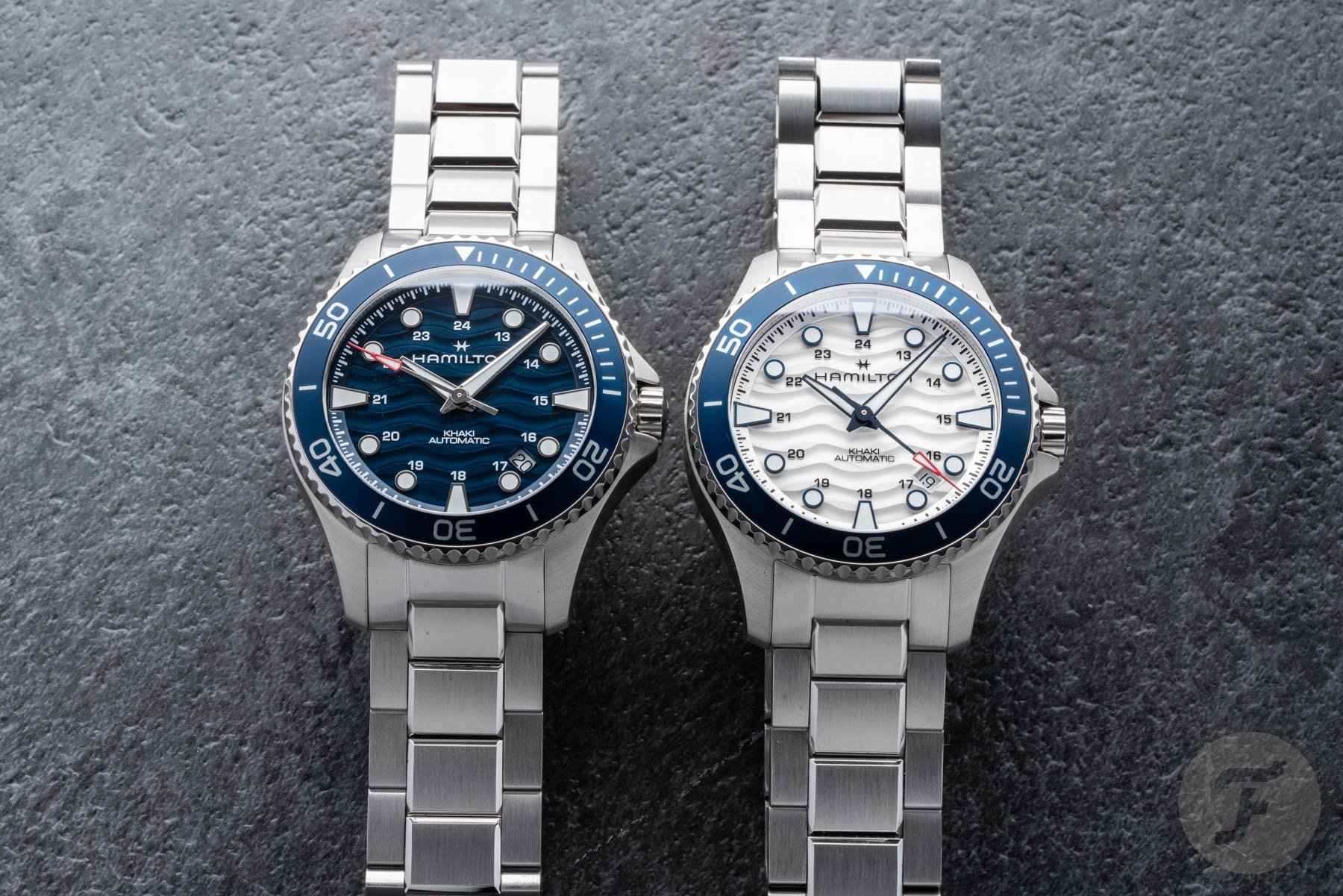
The updated Hamilton Khaki Navy Scuba series
In all honesty, though, I find the Khaki Navy series less relevant. That’s partly due to the abundance of affordable dive watches currently available. As a result, the Khaki Navy models have many competitors, including those from other Swatch Group brands. Certina, Mido, and Tissot offer great divers that are among the best your money can buy, making it hard for others to stand out. Hamilton does so by positioning these more as adventurers’ watches and choosing designs that differ from its competitors’ offerings.
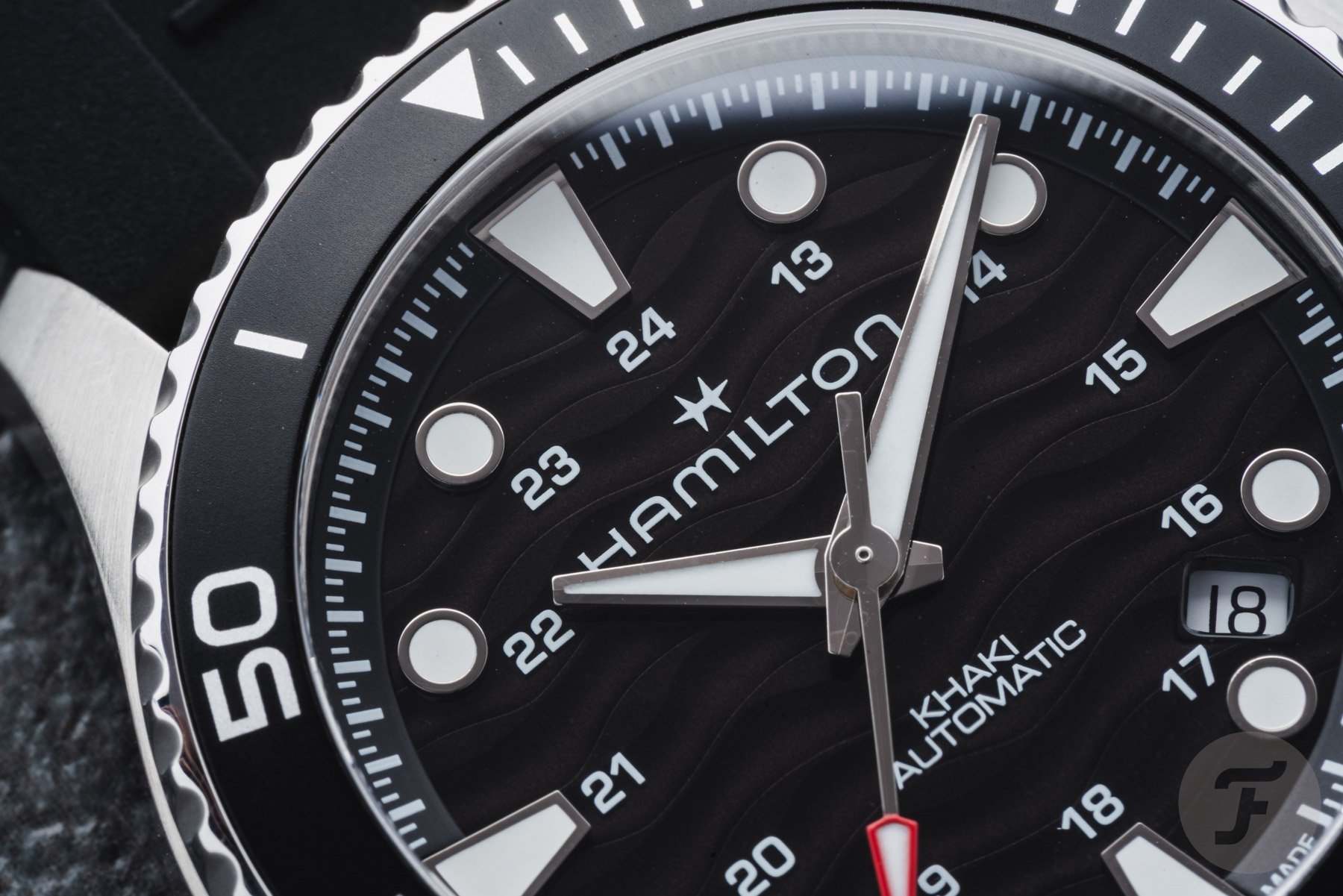
Therefore, I do understand that Hamilton chose to loosely link the design of its Khaki Navy Scuba to the Khaki Field by putting a 13–24-hour scale on the dial. It’s a signature element that sets it apart from the multitude of dive watches on the market. But that’s also the element that has kept me less attracted to the Khaki Navy Scuba series and more inclined to the Khaki Navy Frogman Auto, which has a cleaner look and is a proper dive watch. But maybe that will change with the updated design that Hamilton introduces for the Khaki Navy Scuba line. I had a chance to try four new three-hand models and two new Khaki Field Scuba Auto GMT variants. The former get new dials, while the latter come in new colors.
The Hamilton Khaki Navy Scuba Auto
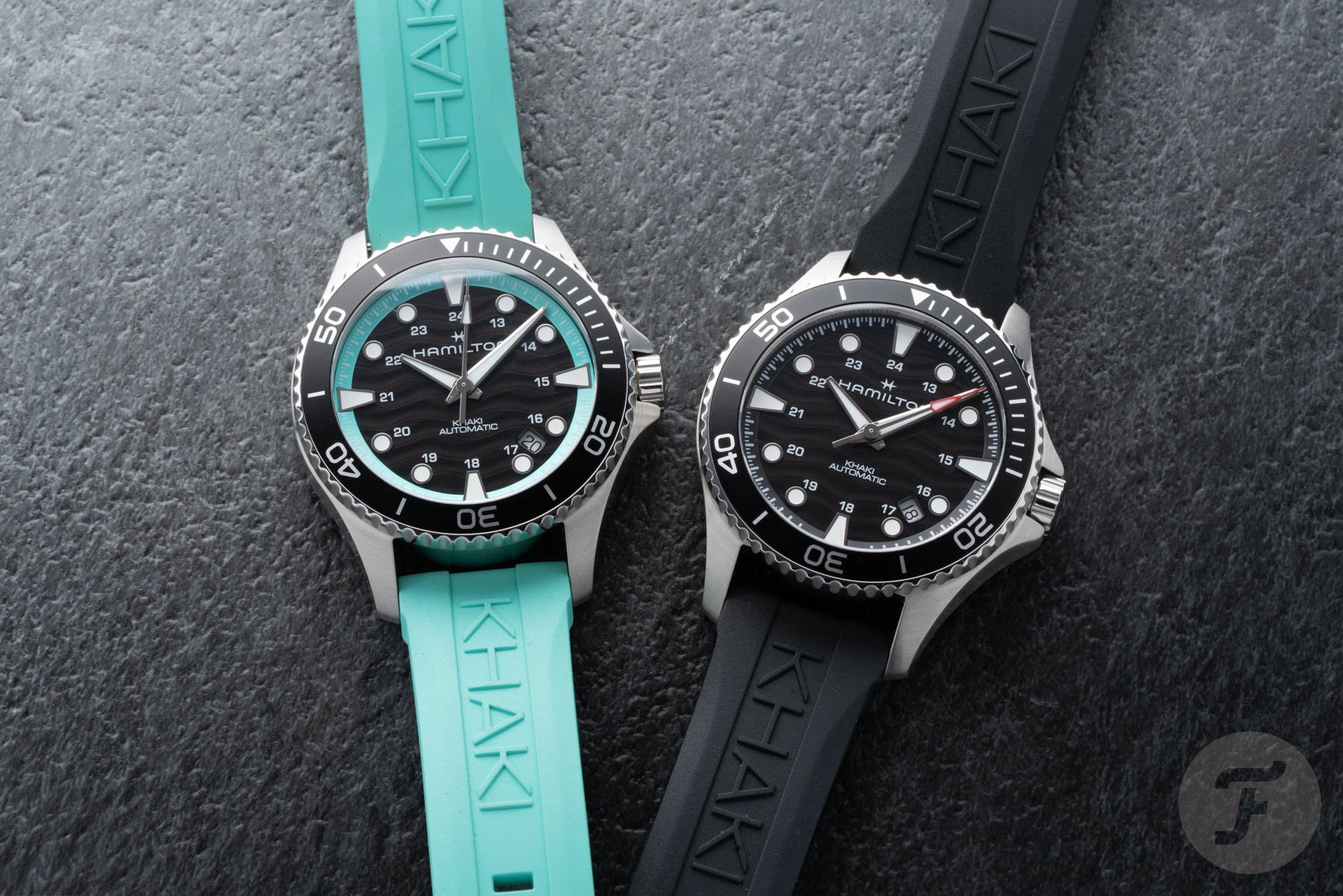
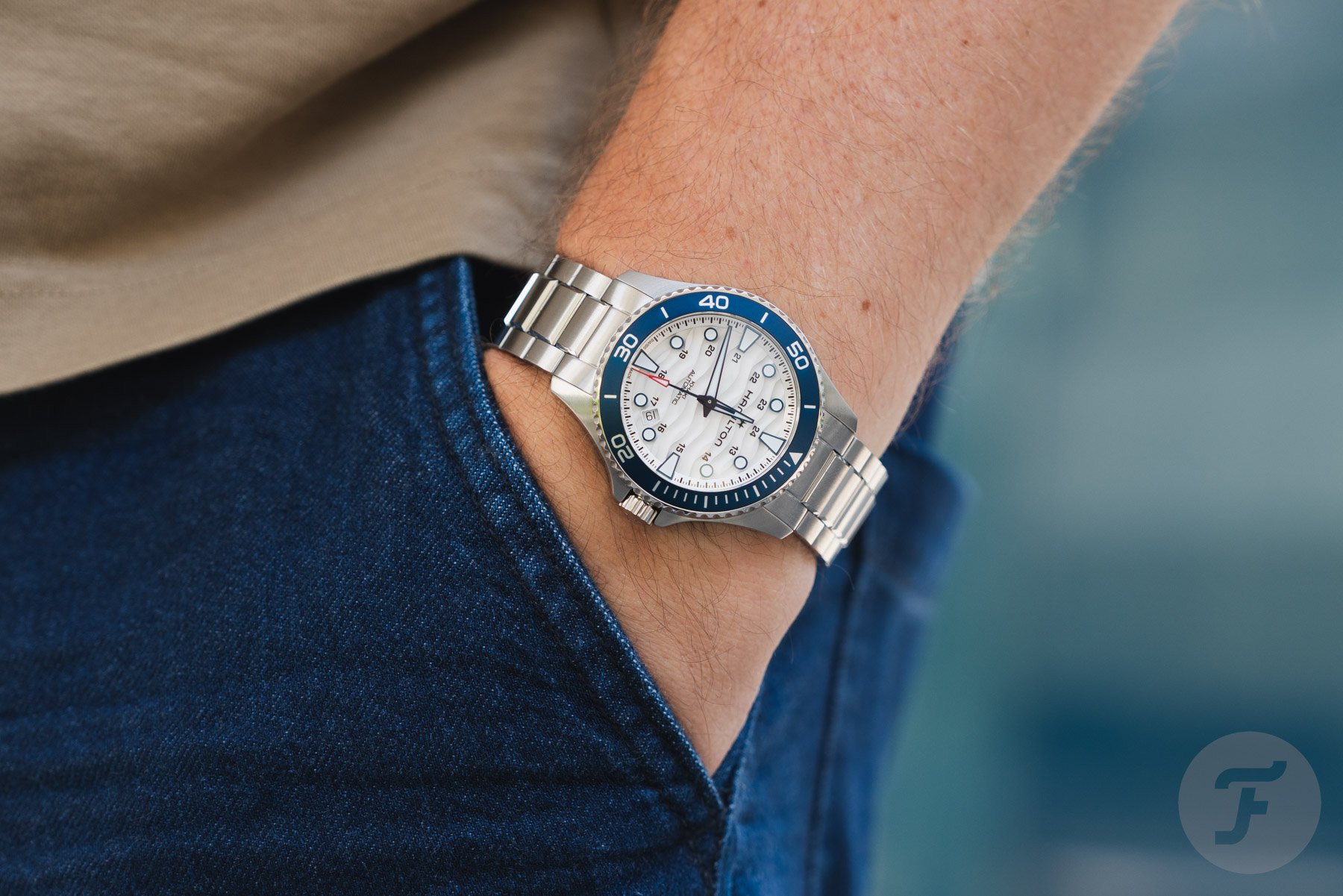
Let’s start with the regular dive watch. The updated Hamilton Khaki Navy Scuba Auto features the same stainless steel case as the previous generation, with a 40mm diameter, 12.95mm thickness, and 50mm length. It features a brushed finish and a 100m water resistance rating. The unidirectional rotating bezel contains a blue or black aluminum insert with a 60-minute dive scale. Hamilton updated the font on the diving scale to make it look more modern and easier to read.
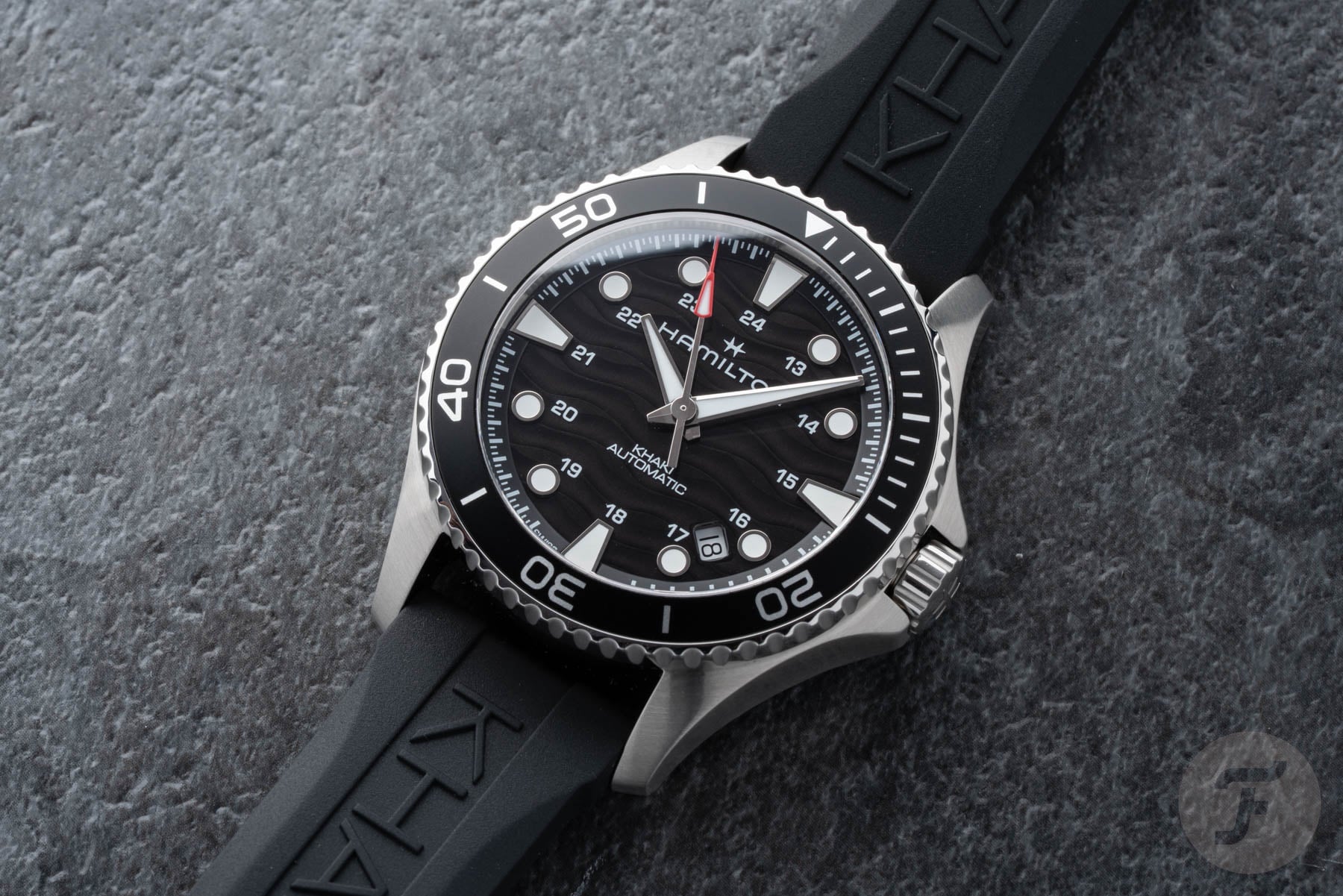
The biggest update, though, is the new set of dials. First, all watches now come with a stamped, lacquered dial with a wave texture. It’s a pattern we know from the Omega Seamaster Professional 300M, which adds extra decoration to these utilitarian divers. Furthermore, other than the colors, the designers at Hamilton made all the dials across the different versions identical. In the past, we have seen colorful models in the series with rectangular indexes different from those of the regular models.
The same design for all the updated dials
Now, all feature a set of round indexes accompanied by wedge-shaped markers at 12, 3, 6, and 9 o’clock. Those four start inside the rehaut, which holds the minute track, while the round indexes sit a bit more toward the center. Located further inward still is the signature 13–24-hour scale. Lastly, a date window sits between 4 and 5 o’clock.
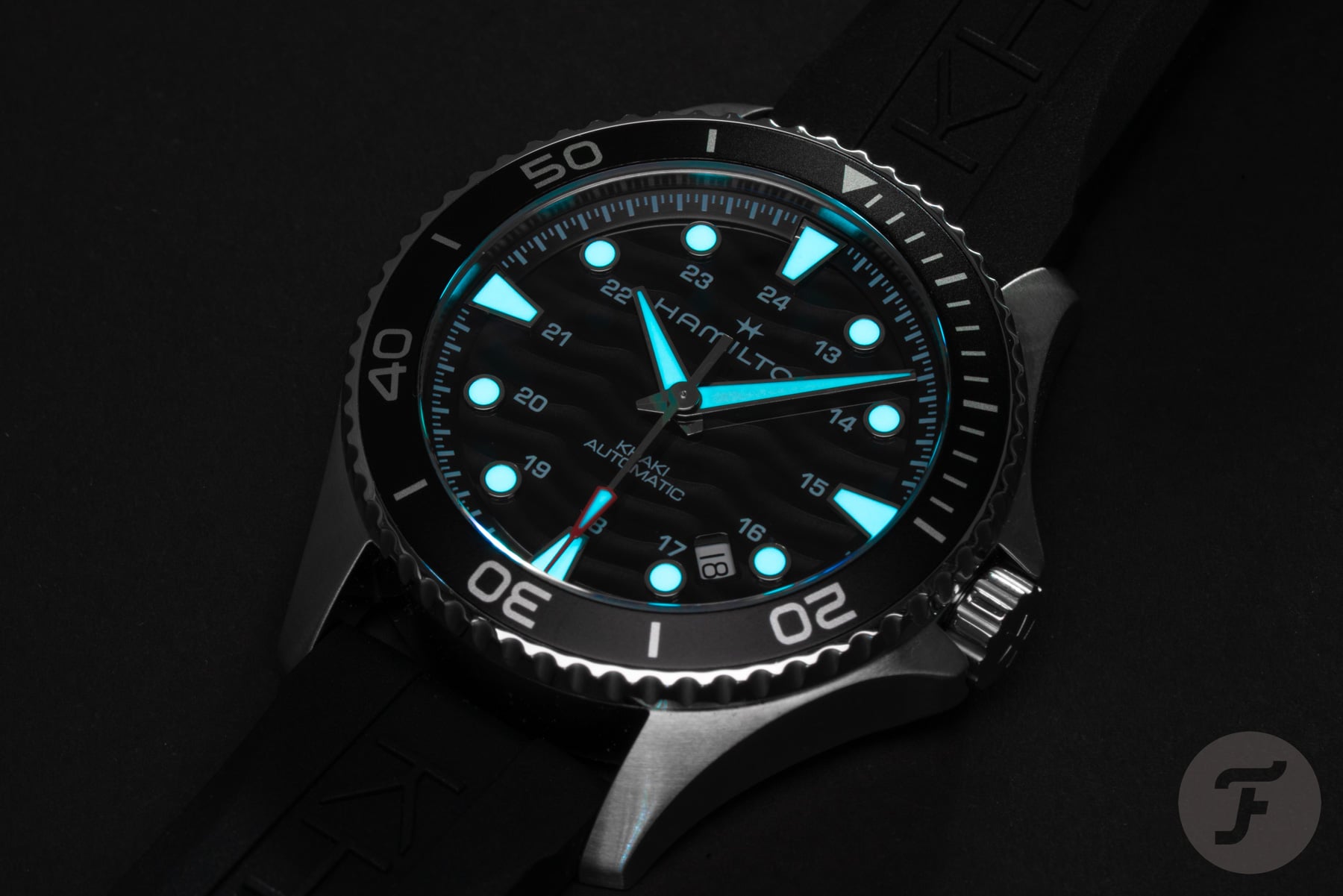
Hovering over the dial are the same hands as on the previous generation. The tip of the seconds hand is red on the regular black, navy, and white dials, whereas the turquoise model does not feature a colored tip. All the hands and hour markers feature Super LumiNova that lights up blue in the dark.
The Hamilton H-10 caliber
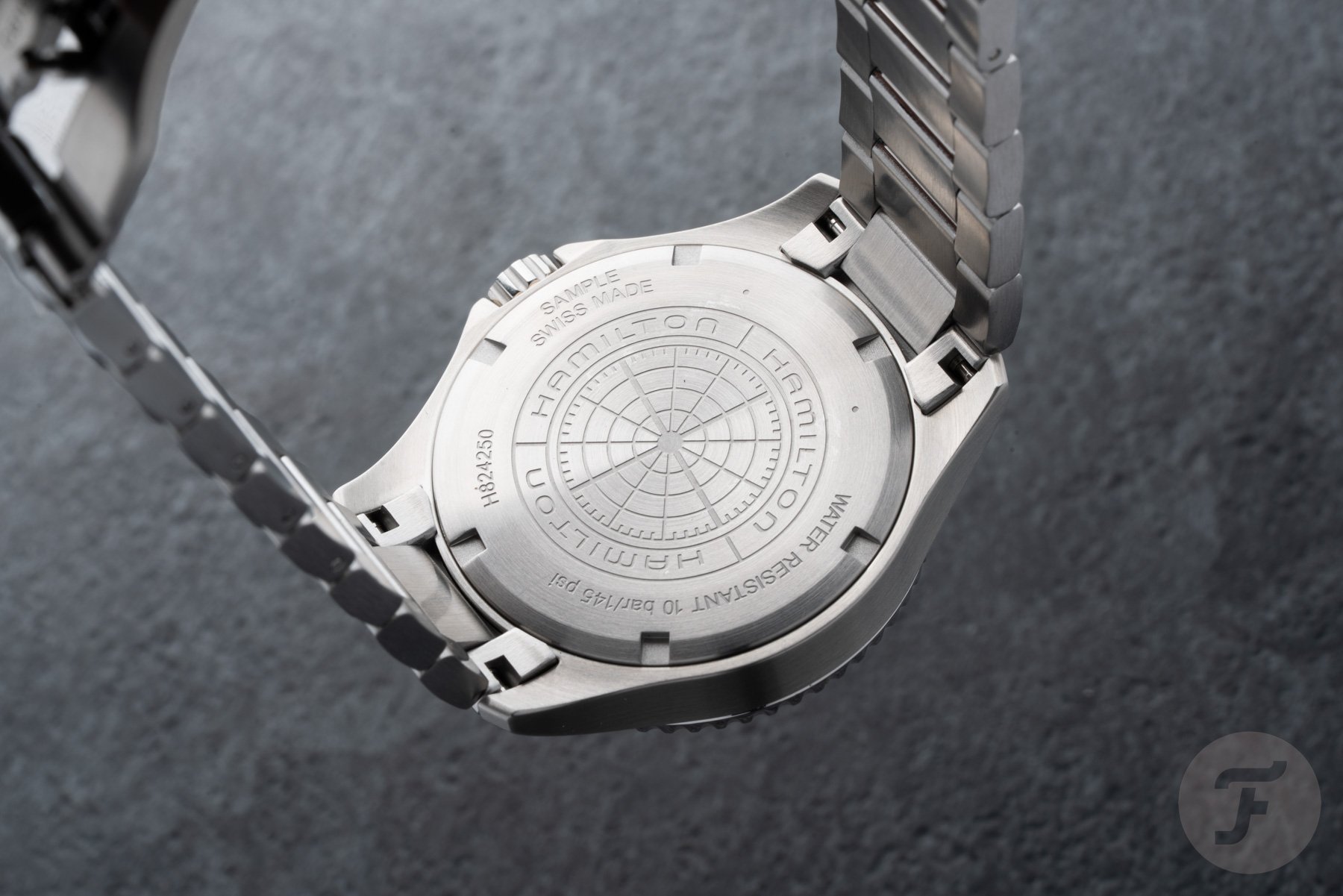
Powering the Khaki Navy Scuba Auto is the same Hamilton H-10 caliber from the previous generation. This is Hamilton’s version of the popular Powermatic 80, which many Swatch Group brands use for their watches. The automatic movement operates at 21,600 vph and offers an 80-hour power reserve. It is a fitting powertrain for these dive watches, so there’s no need for an update there.
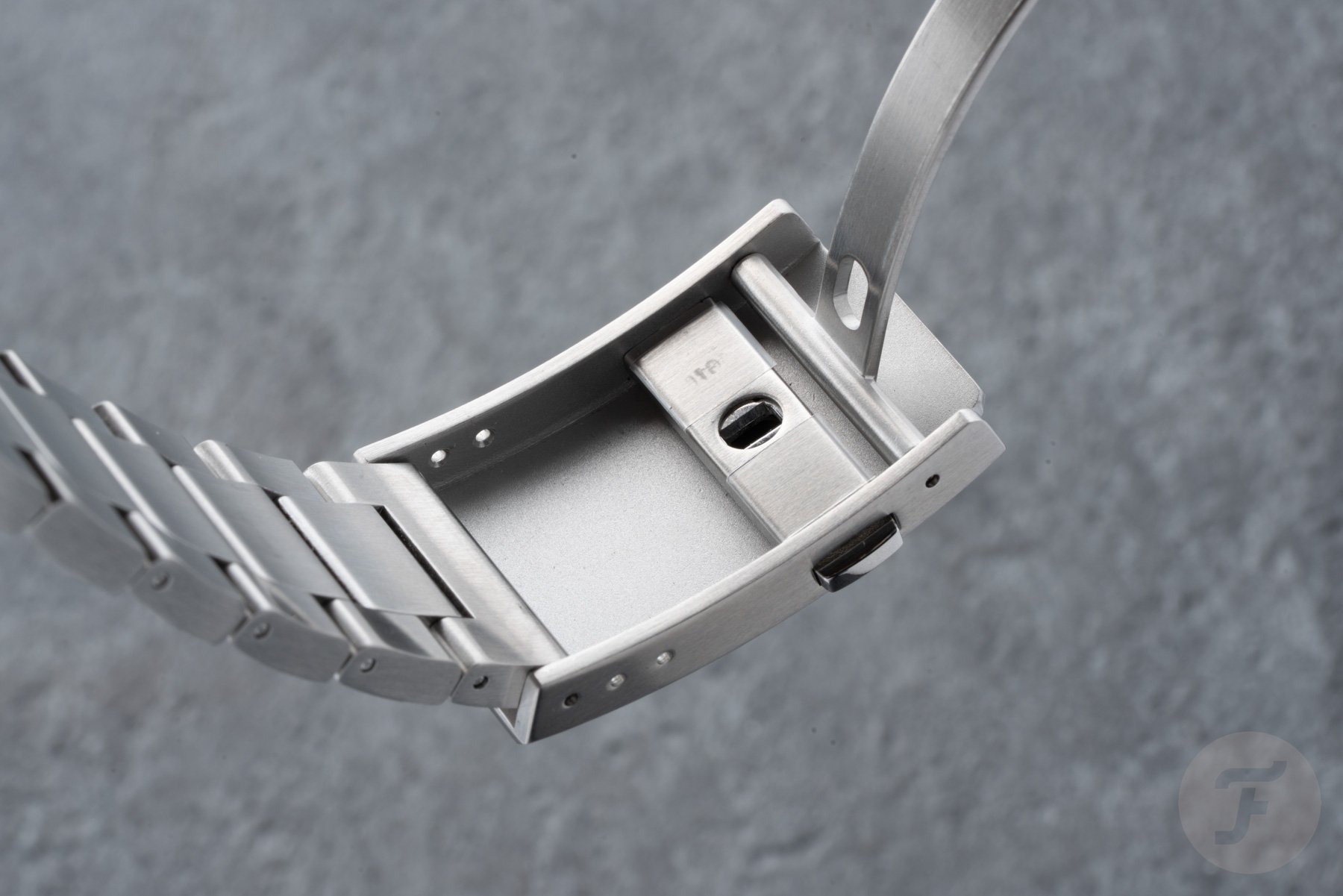
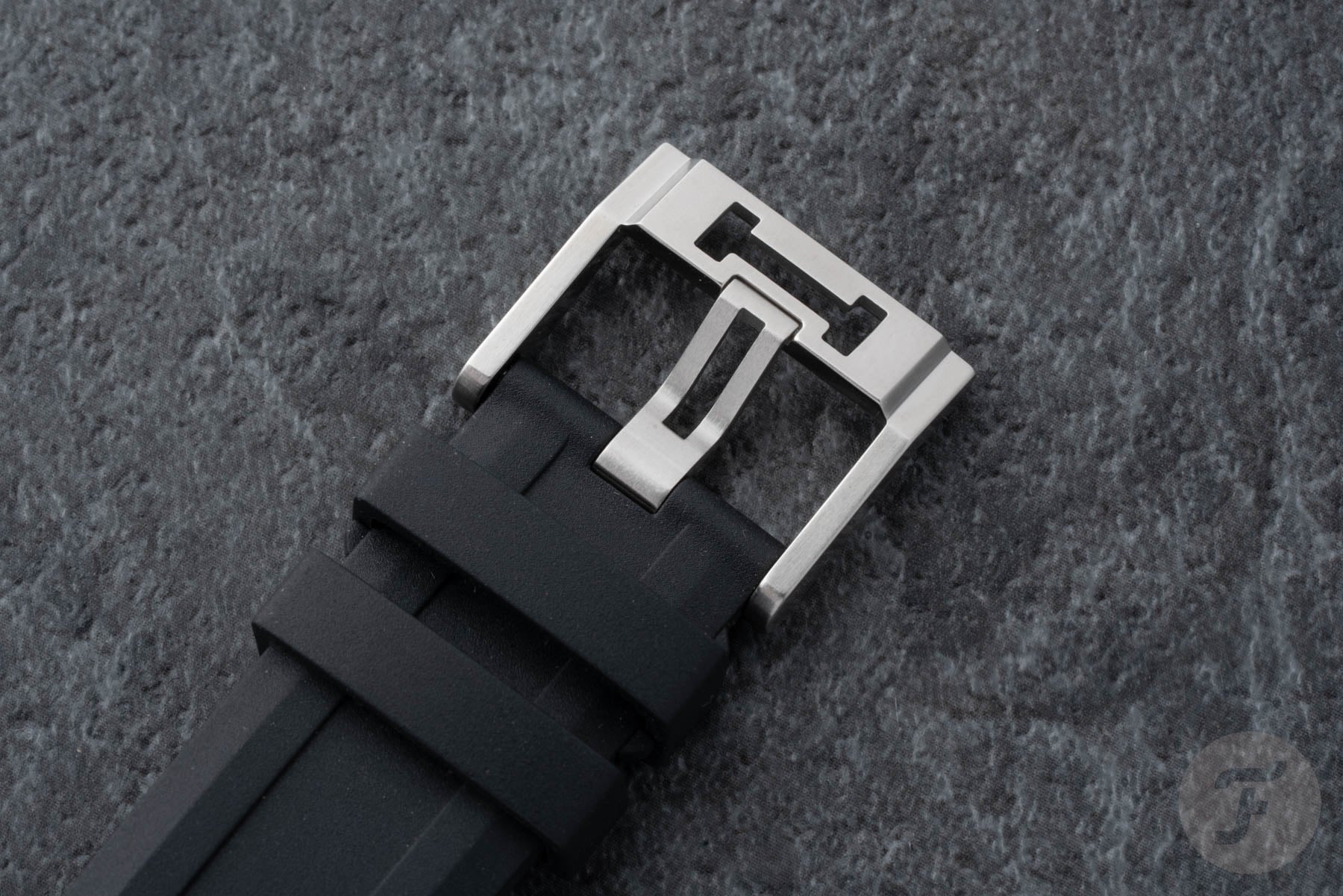
Finishing the look is either a stainless steel bracelet with a folding clasp or a rubber strap. The blue-bezel models come with either a dark blue or white wavy dial. Meanwhile, the black-dial model we had came on a rubber strap, but you can also buy it on a stainless steel bracelet. Lastly, the version with the black and turquoise dial comes with a turquoise rubber strap.
Speaking of the bracelet, it’s a 20mm three-row type with a brushed finish plus polished bevels on the central link. The downside is that it doesn’t taper, so it’s pretty massive all the way to the clasp. Furthermore, the quality is decent at best, and the clasp is very basic. Given market developments, especially among smaller brands, it would be helpful if Hamilton updated the bracelet.
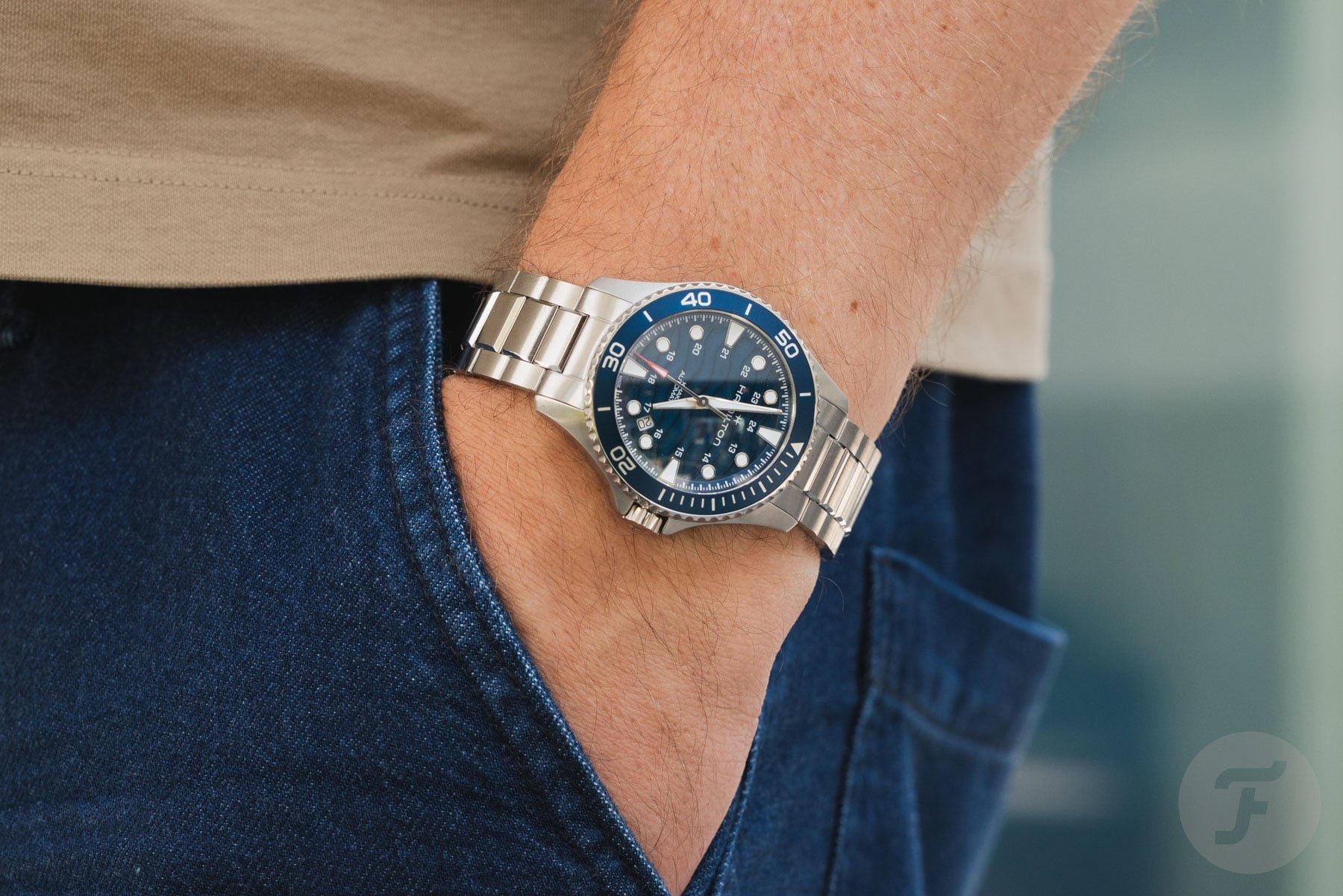
Wearing the Hamilton Khaki Navy Scuba Auto
On the wrist, though, the watches feel sturdy and ready for anything you throw at them. But due to the lack of tapering on the bracelet, I preferred the models with the rubber straps, which taper nicely to 18mm at the pin buckle. The 20mm bracelet feels rather straightforward without the taper, and that’s why I gravitated towards the black and turquoise variants fairly quickly.
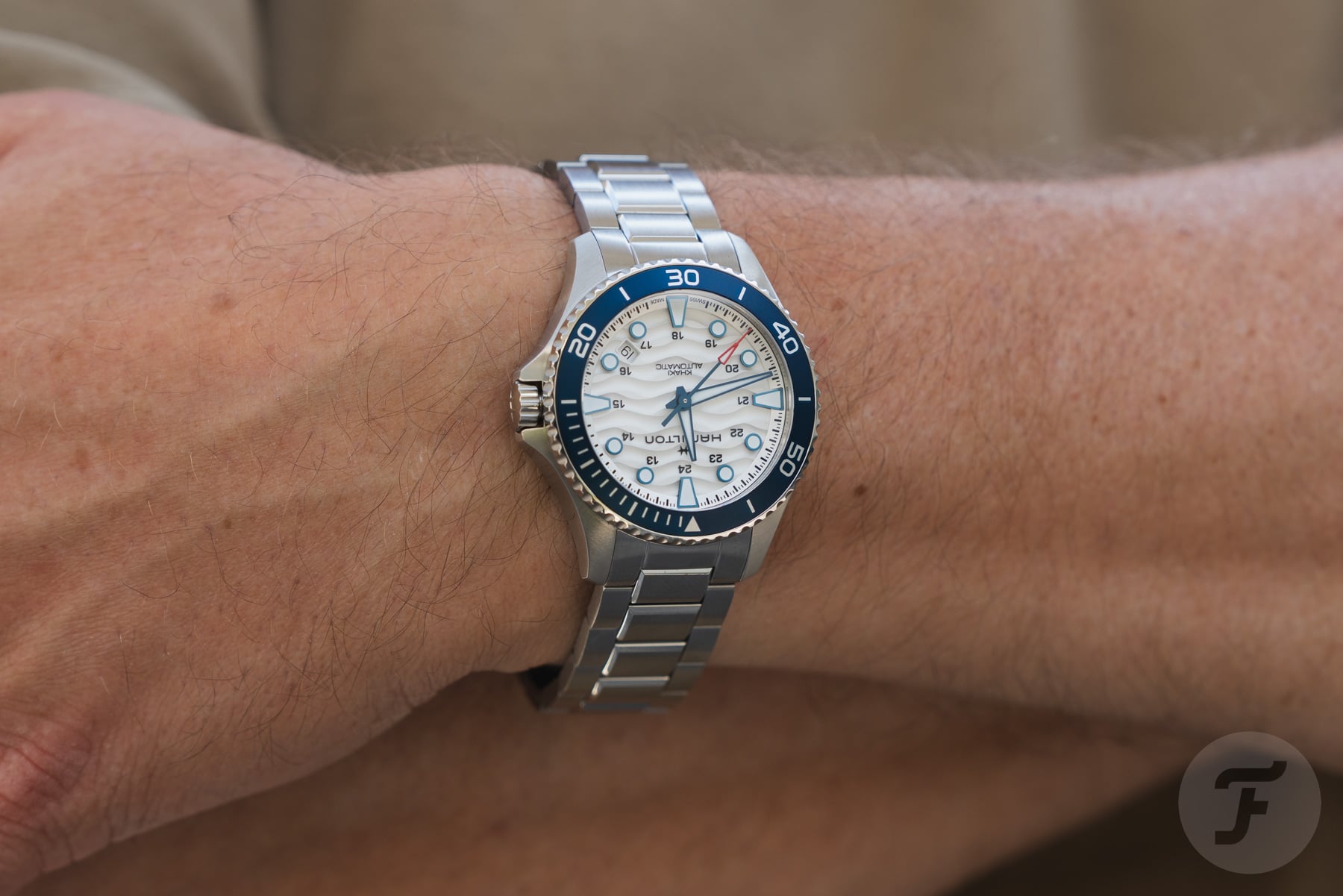
The latter, in particular, has a charm that easily beats its predecessor’s design. The updated dial works well and is a welcome improvement over the previous generation. The watches feel nicely made and sit well on the wrist thanks to the curved lugs. Changing the time and date is simple once you have unscrewed the crown, and the bezel is easy to grip, making it easy to rotate.
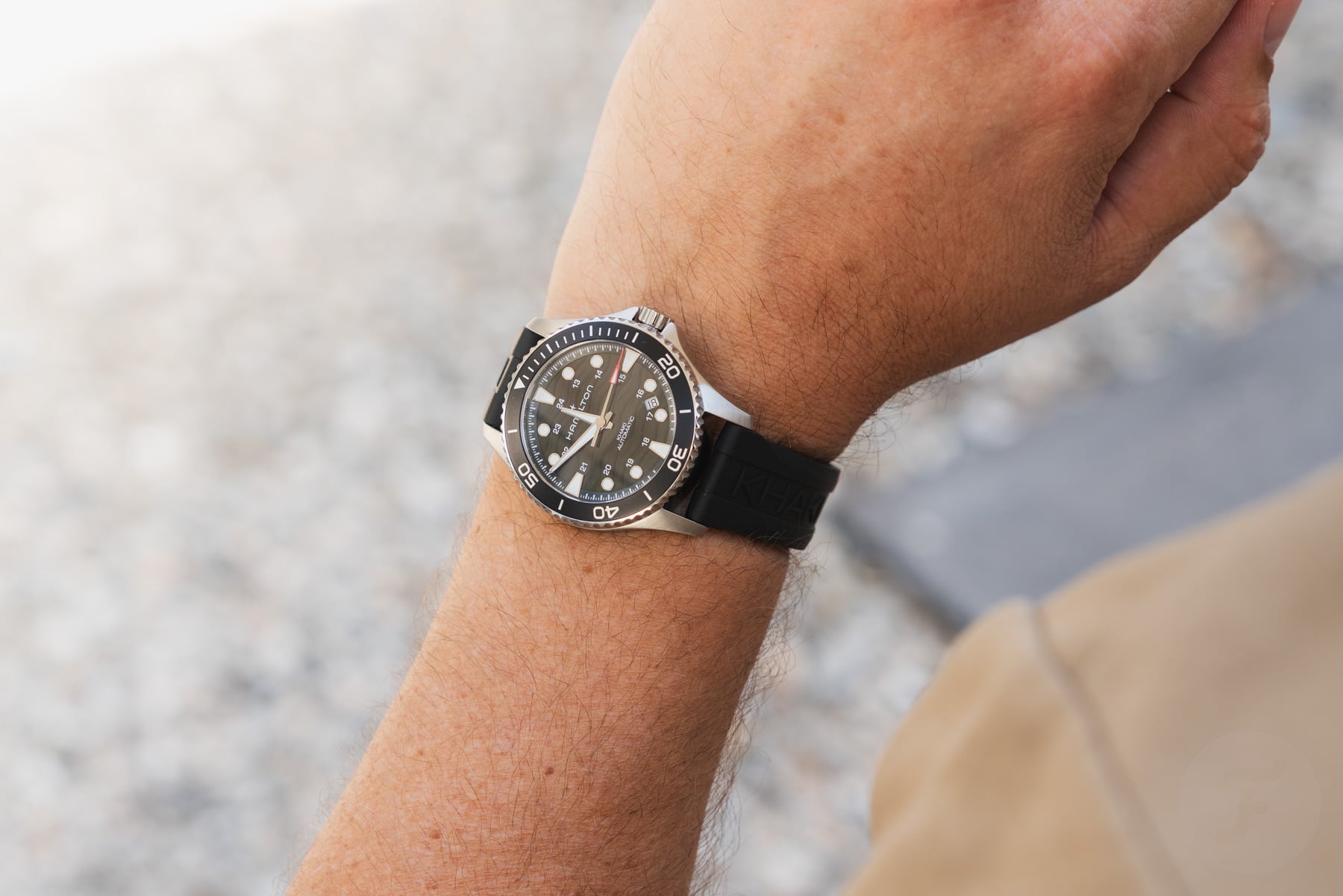
Remarkably, the wave pattern doesn’t really stand out much. You’ll see it if you focus on it, but when I took the watches for a spin, it felt more like a decorative detail than an inevitable eye-catcher. If you ask me, that’s also how it should be, so I consider it a job well done by the Hamilton designers.
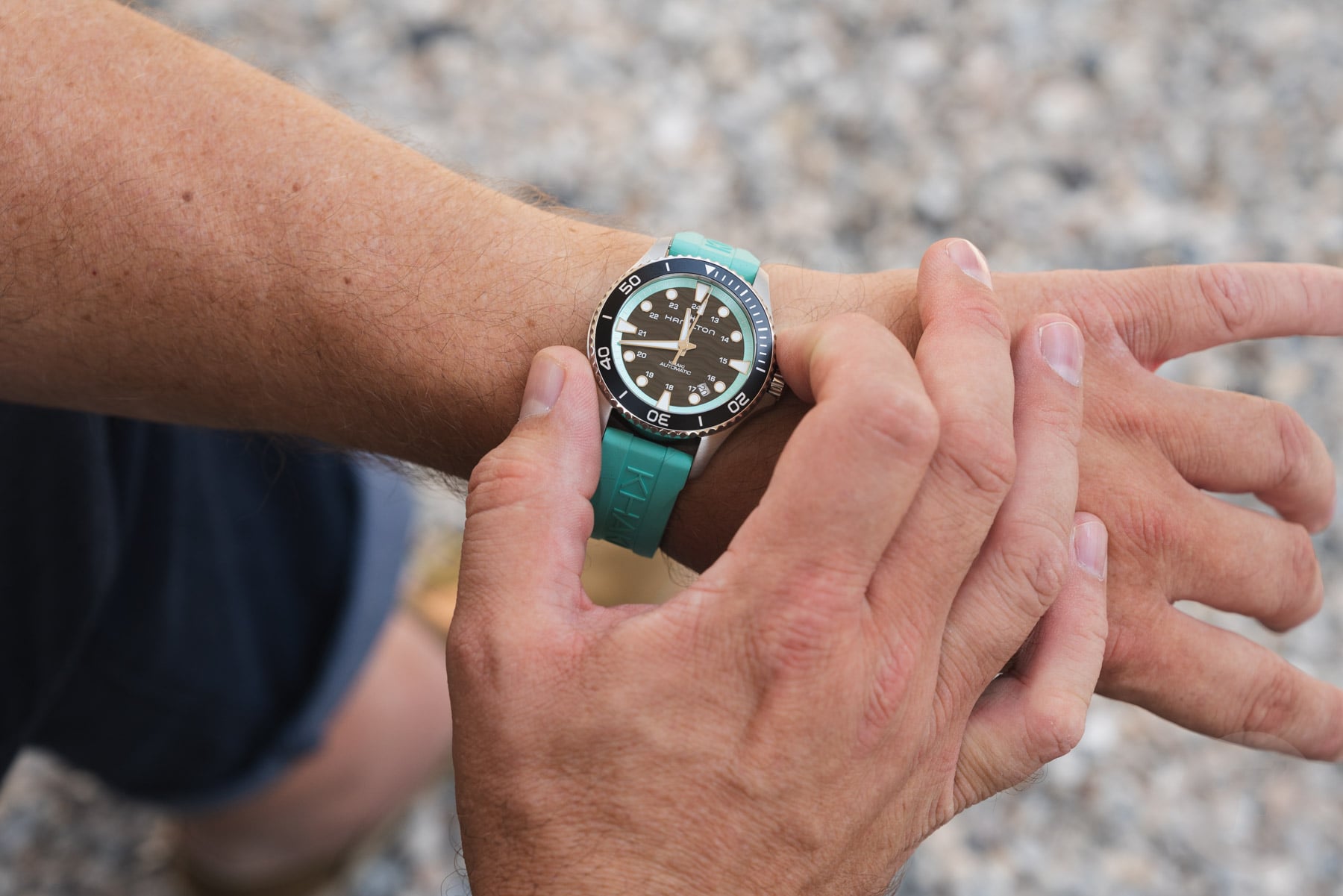
Among the available versions, I preferred the colorful turquoise one. It could’ve easily made the list of 10 colorful divers that we published not too long ago. It also features updated hour markers and looks much better than its predecessor. That’s the overall feeling that stuck with me. This update is sensible and makes the Khaki Navy Scuba range look better than the previous generation, so it’s definitely a welcome change.
Hamilton Khaki Navy Scuba Auto GMT
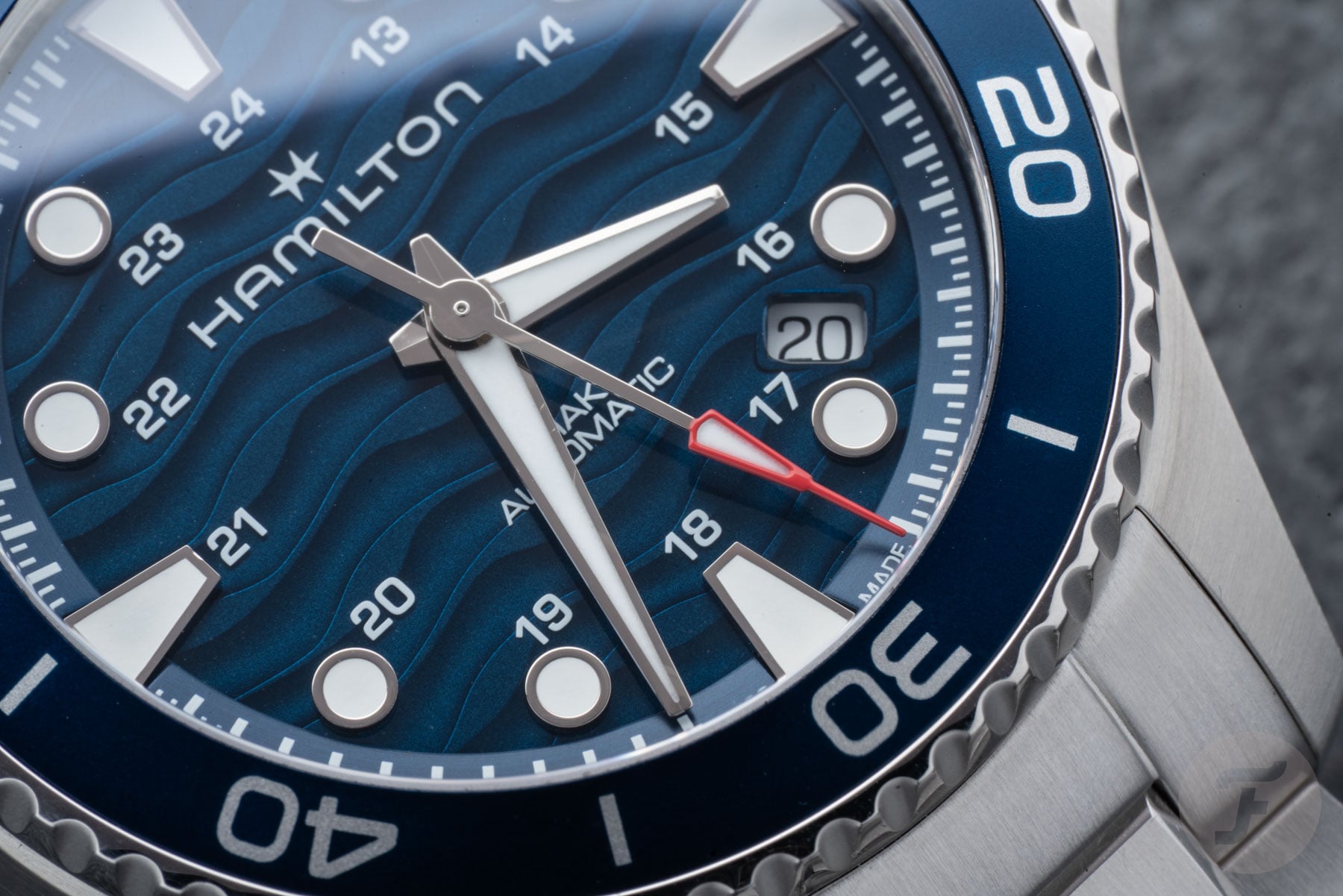
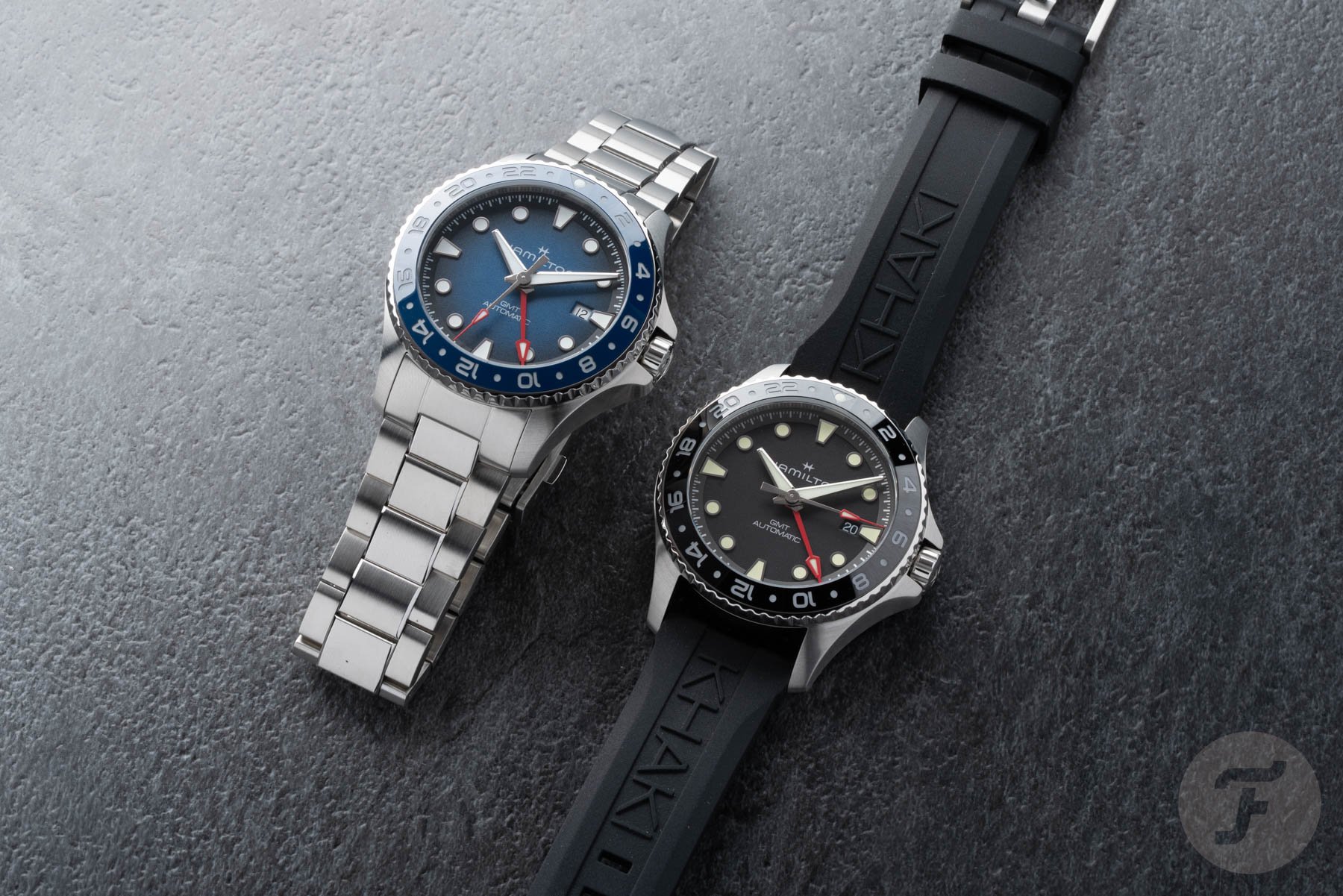
We also received two new Khaki Navy Scuba Auto GMTs. Hamilton launched this model range last year. Thomas reported on the striking bronze version and a nice stainless steel model with an off-white and black dial. Now, Hamilton adds a black-dial model, available on a rubber strap or a stainless steel bracelet, alongside a version with a navy-blue dial and bezel. Unlike the regular divers, these new watches follow the design of last year’s GMTs, so they don’t have the new wave pattern on the dial.
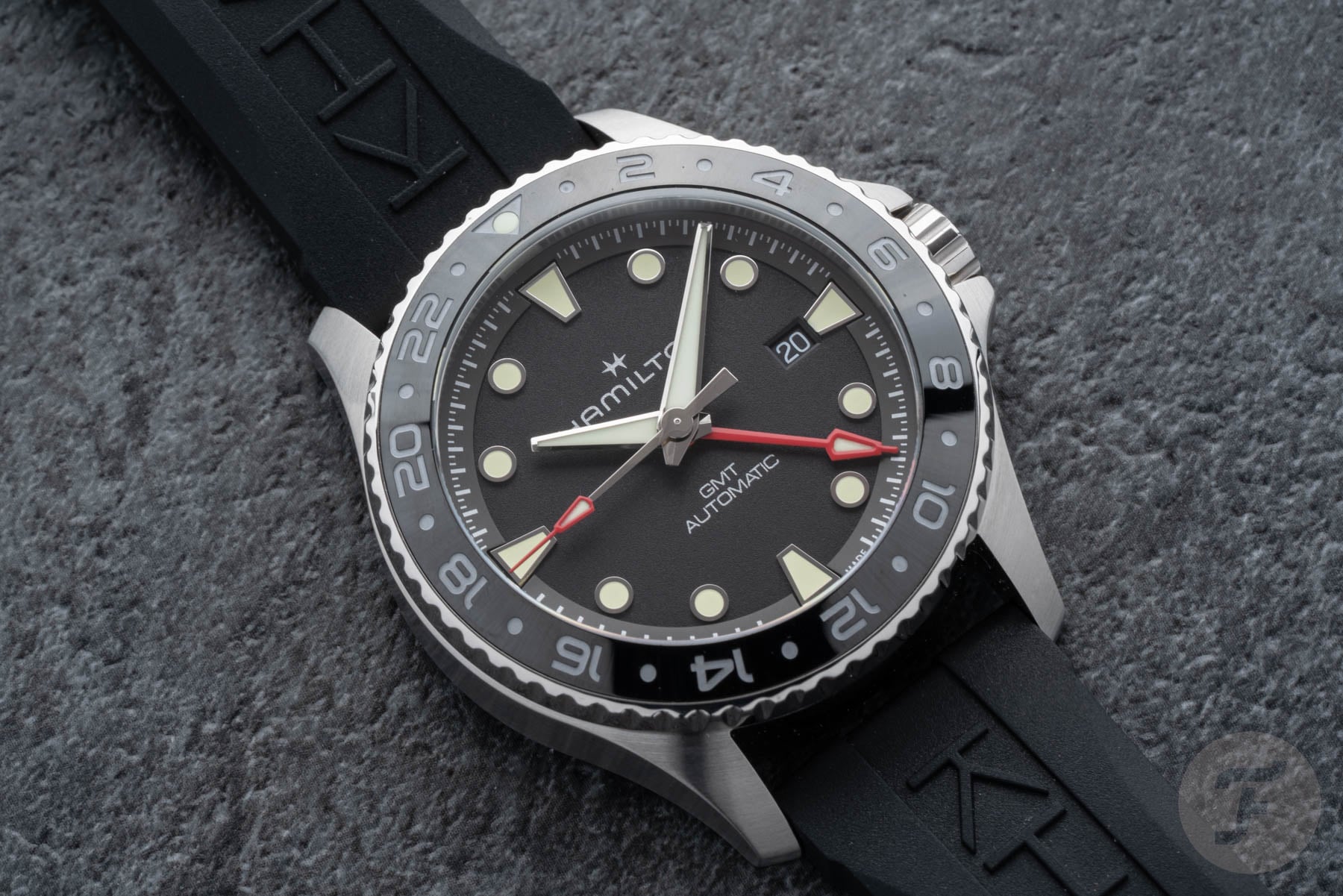
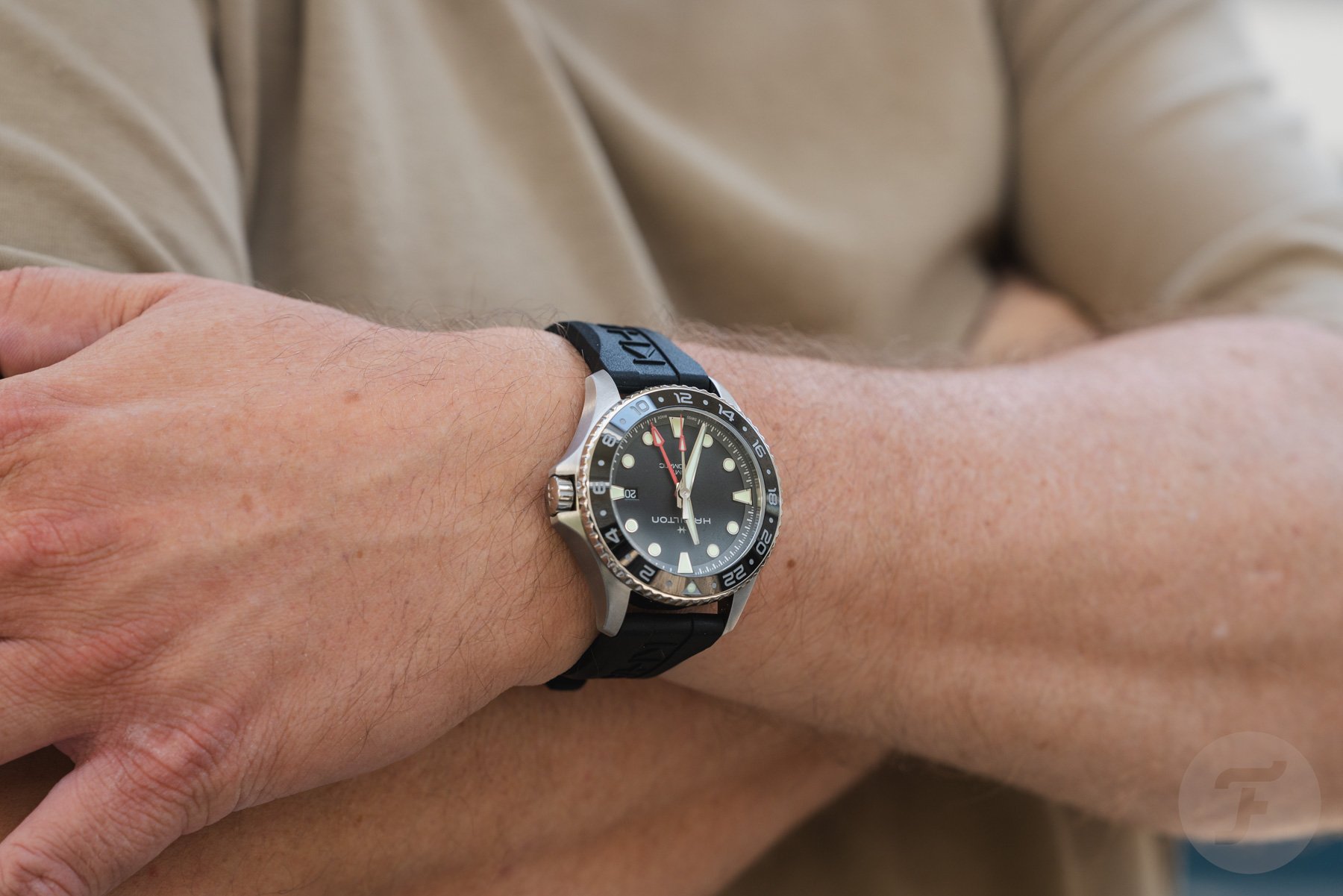
They do each have a 43mm stainless steel case with a 13.9mm profile, a 52mm lug-to-lug, and a 300m depth rating. Topping the case is a bidirectional bezel with a ceramic insert in either navy blue or black. It features a 24-hour GMT scale that displays the wearer’s home time in conjunction with a bright red GMT hand that hovers over the dial.
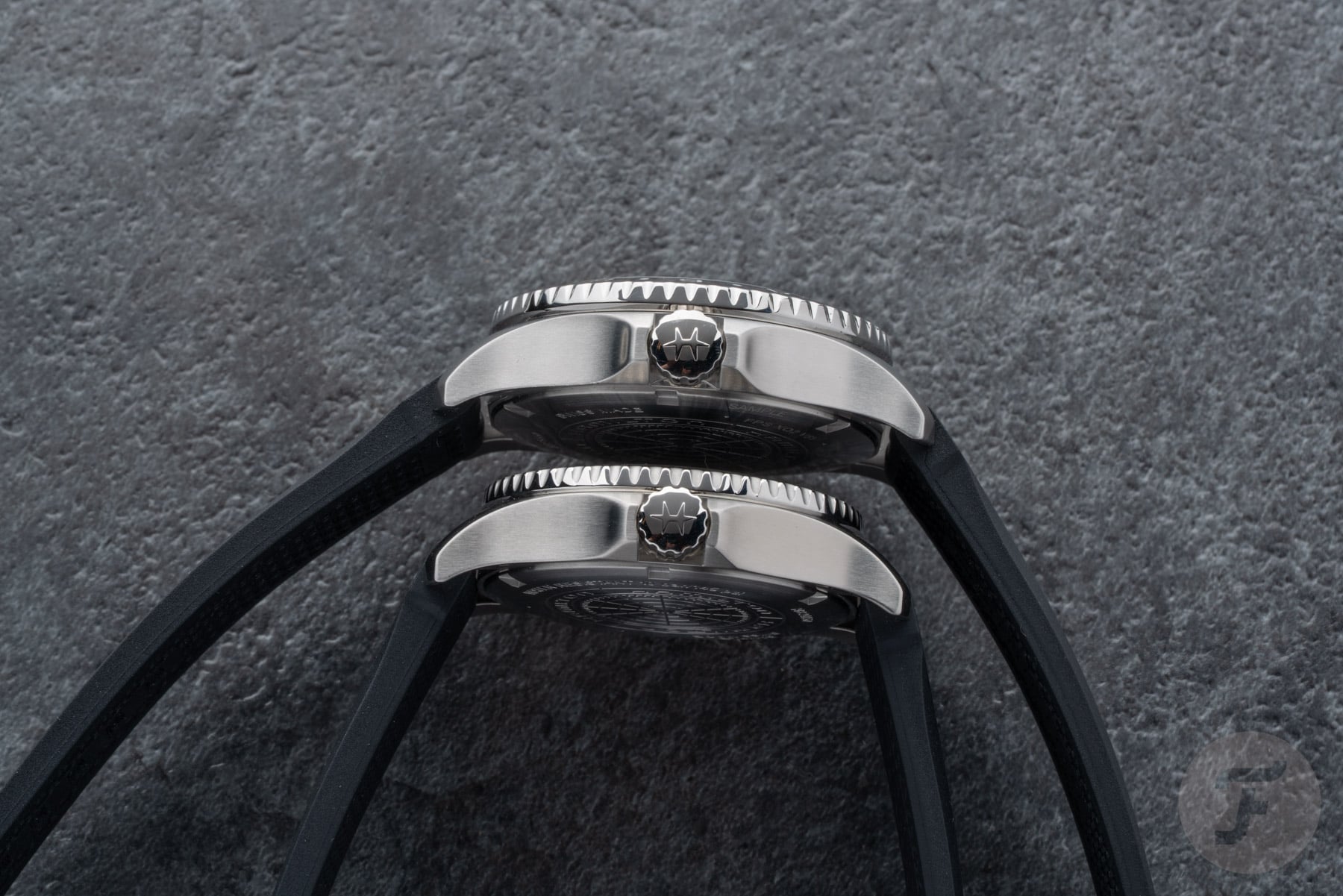
Hamilton Khaki Navy Scuba Auto GMT (top) and three-hand Auto (bottom)
The first of the new variants features a black dial with a matte texture and a black ceramic bezel insert. As mentioned, the second has a navy-blue dial, but this one has a matte gradient finish and a navy-blue ceramic bezel insert.
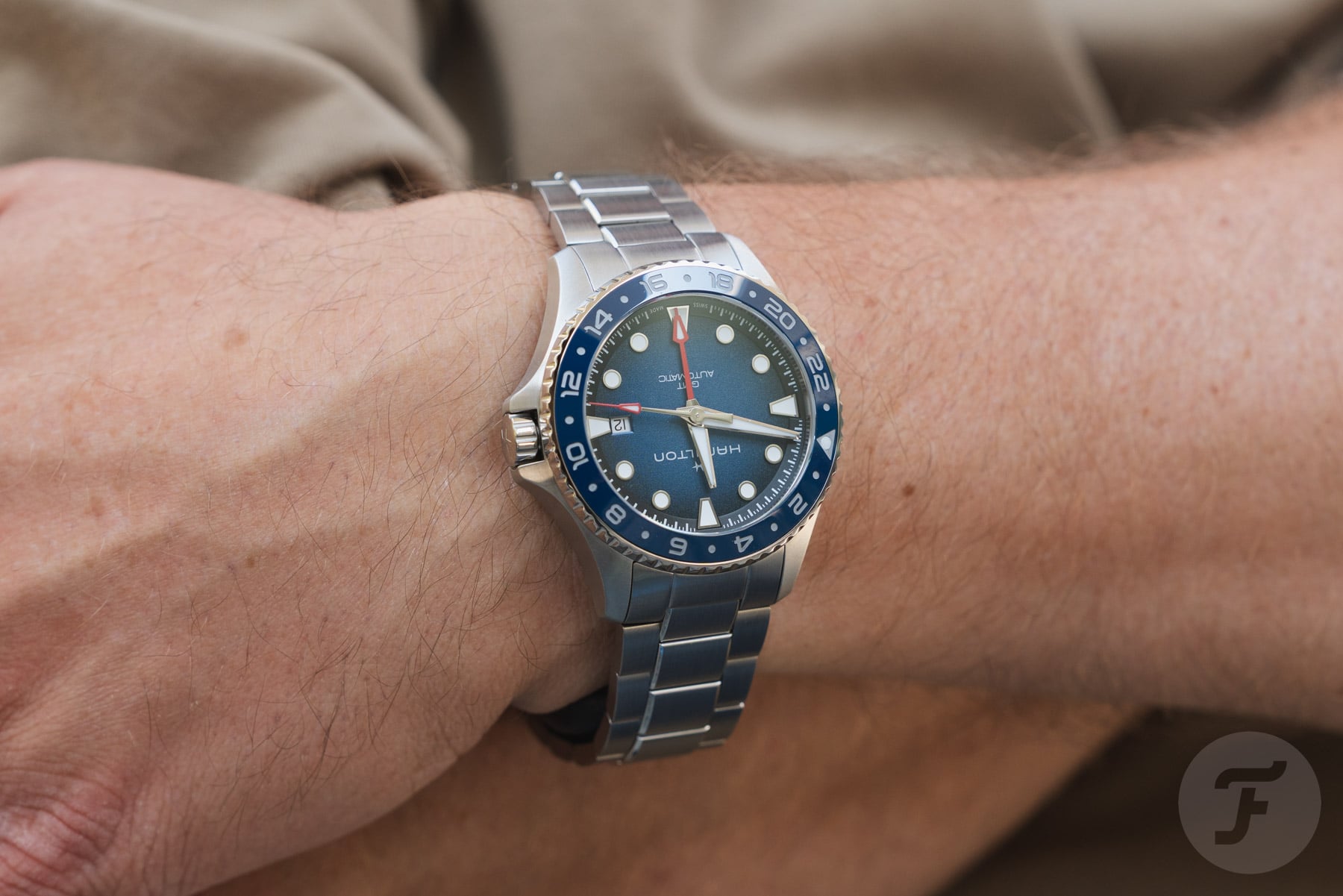
These GMTs have the same style of indexes as the new 40mm Khaki Scuba Auto three-handers. Therefore, they feature mostly round hour markers plus wedge-shaped indexes at 12, 3, 6, and 9 o’clock. However, rather than having the date window between 4 and 5 o’clock, the watches’ larger diameter allows it to stay at 3 o’clock. On the black version, the date wheel matches the dial, while the blue version features a white date wheel with black numerals. Both dials eschew the 13–24-hour scale, and I much prefer the cleaner overall look.
Completing the exterior is a 22mm stainless steel bracelet or a black rubber strap. Just like the divers’ bracelet, this one doesn’t taper, which makes it massive. Whereas the 20mm bracelet is still okay to wear, in my opinion, a 22mm bracelet without a taper is too much.
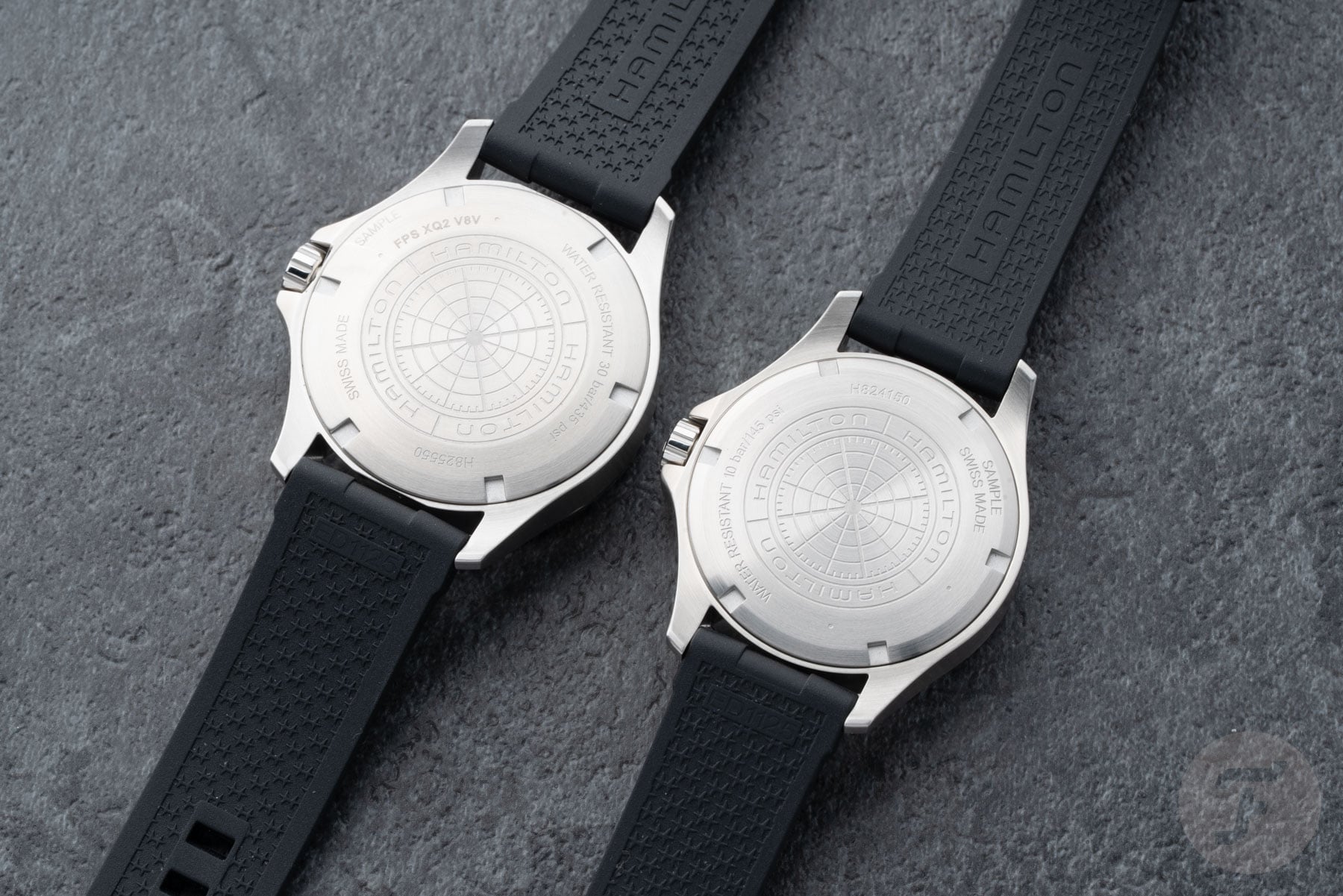
The Hamilton H-14 GMT caliber
Hiding behind the steel case back is the Hamilton H-14 caliber. This caller-style GMT movement operates at 21,600 vph and offers an 80-hour power reserve. As with the H-10, this is another Hamilton version of the Powermatic 80, also used by Certina and Tissot.
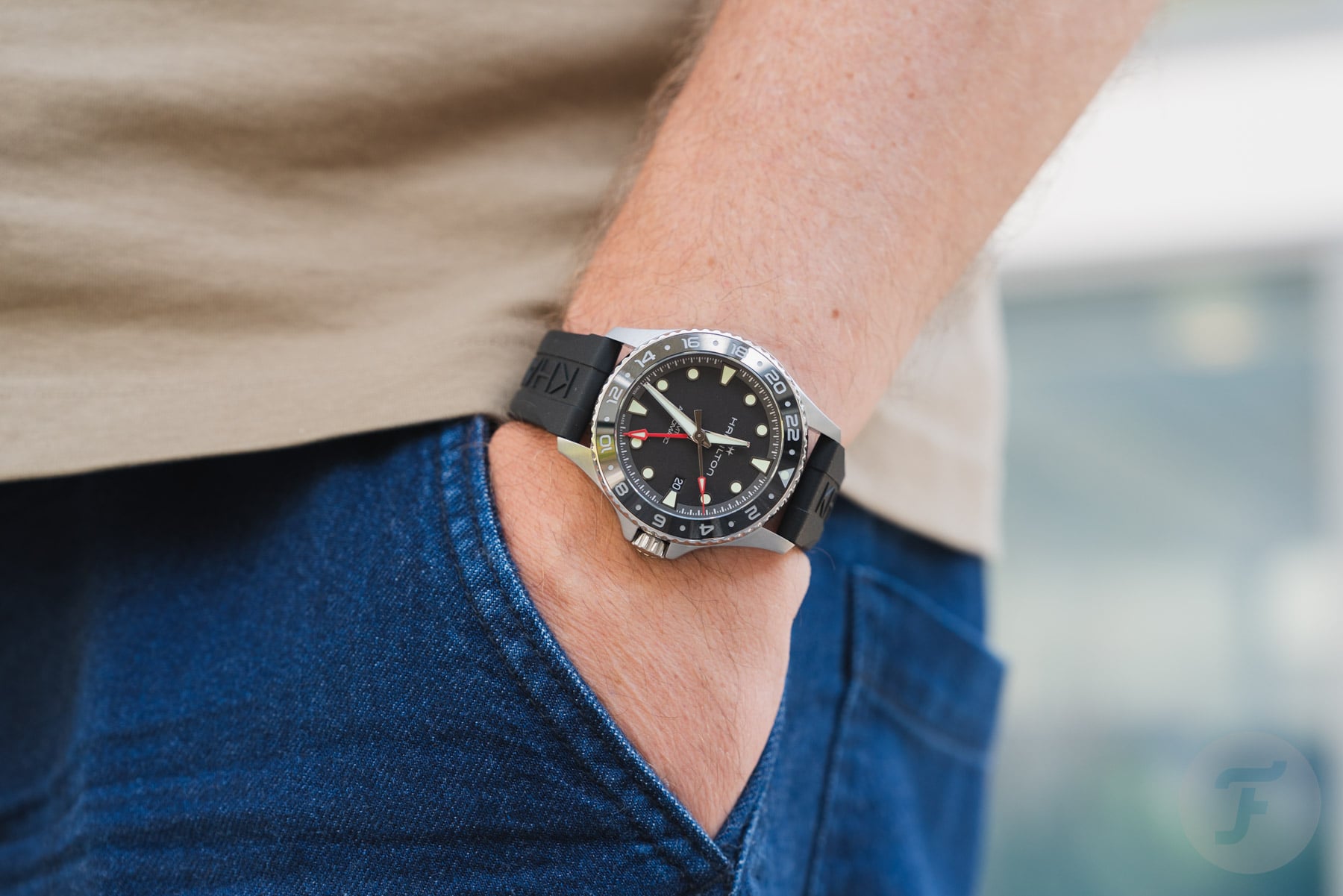
Wearing the new Hamilton Khaki Navy Scuba Auto GMTs
On the wrist, the two GMTs feel fairly big. With their 43mm diameter and 52mm lug-to-lug, they are substantially larger than the 40mm divers. It raises the question of why Hamilton made that choice. I don’t mind a 43mm dive watch because that is a size that I can easily wear. Still, it felt somewhat odd that there is such a big size difference between the two models. In all fairness, Hamilton also offers the regular diver in a 43mm case, but the brand hasn’t updated the dials for those models yet. In that context, the 43mm GMTs make more sense.
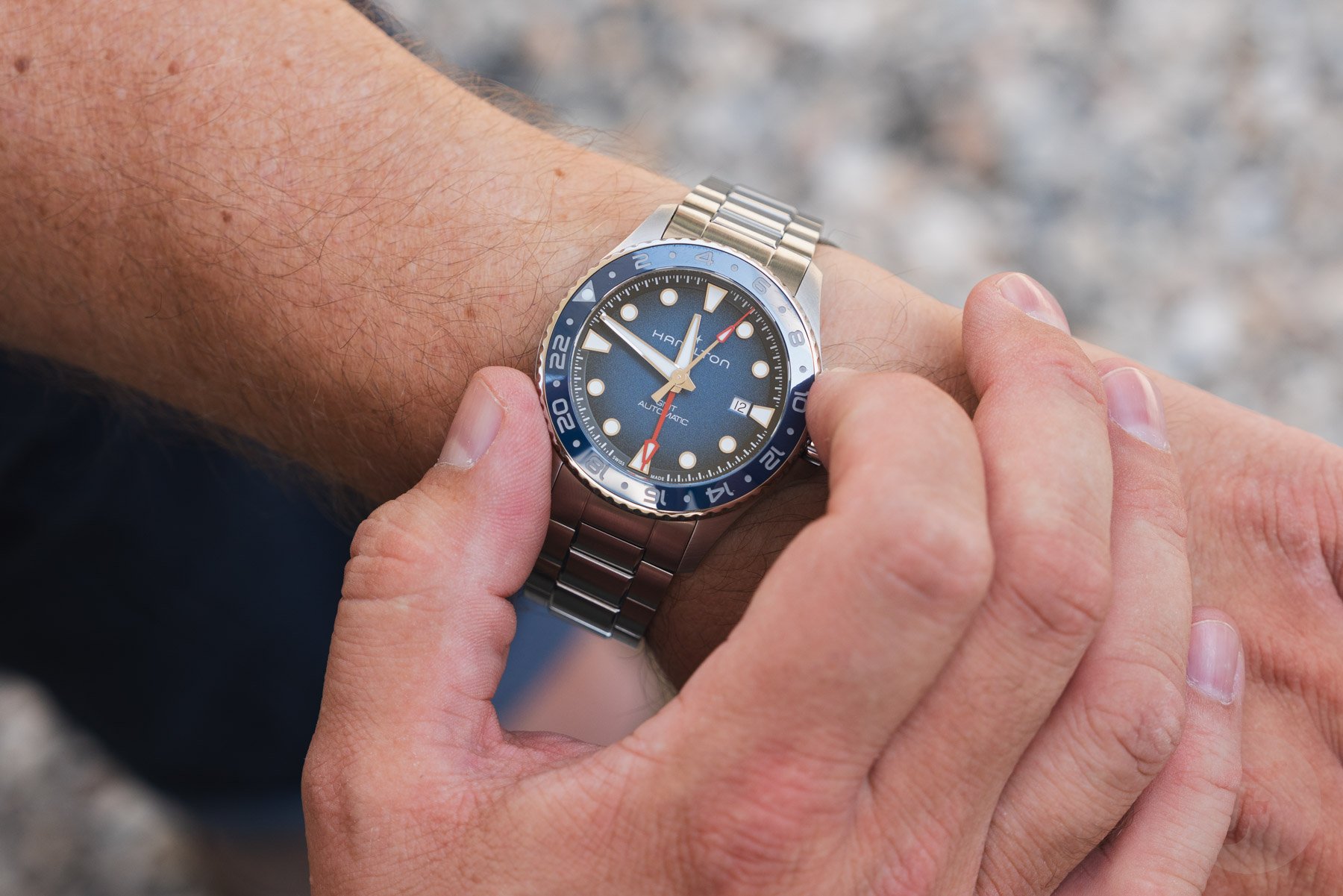
But I would have loved to see a 41mm version of this watch because I think it would look awesome and wear better. As it stands, the combination of the case with the 22mm bracelet affects the overall comfort. Admittedly, though, it creates a watch that feels super sturdy and can take a beating. The new dial variations are logical expansions of the collection, as black and navy blue are popular colors. Along with the available stainless steel model with the off-white and black dial, and the bronze version, Hamilton offers a nice, varied lineup.
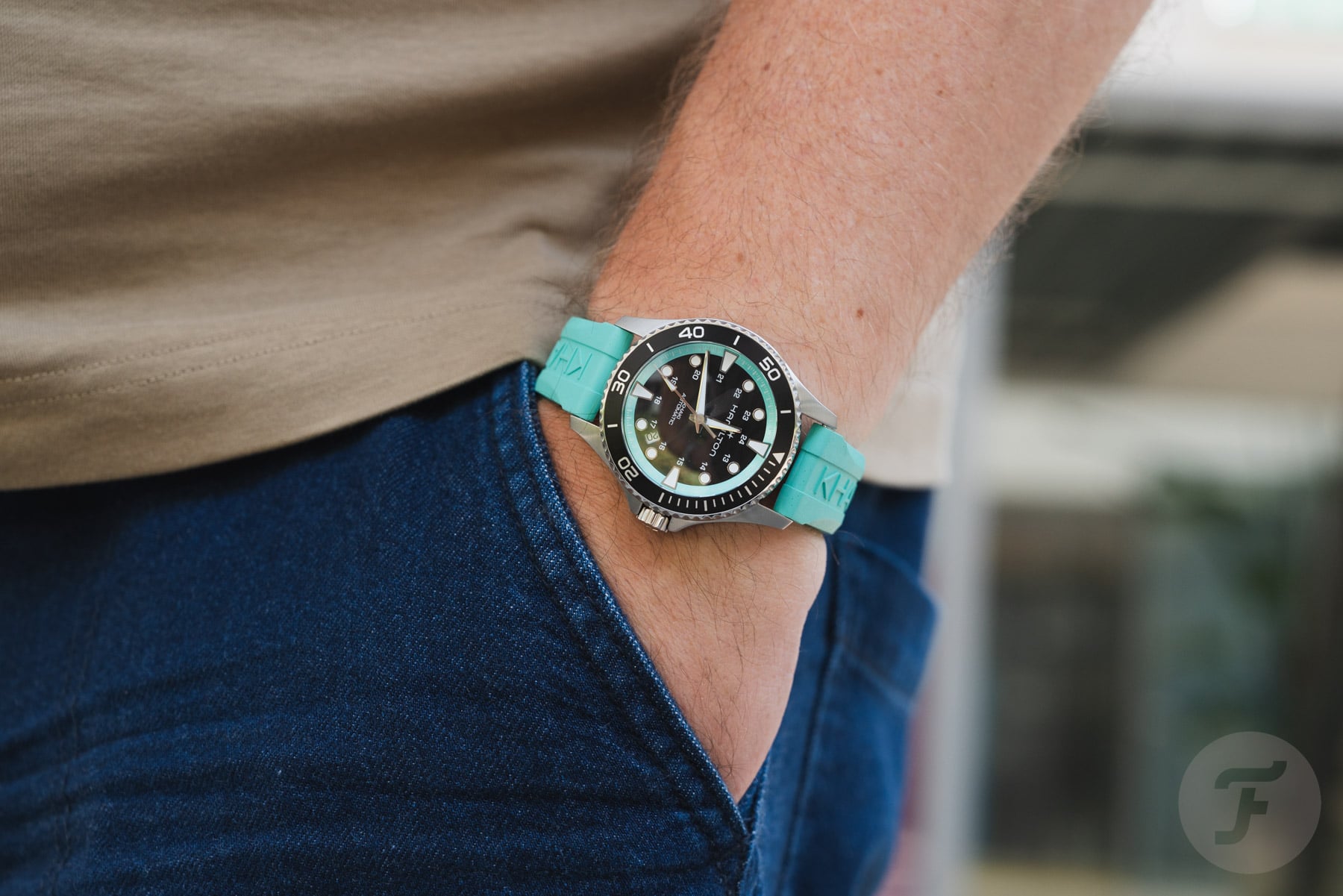
Final thoughts on the new Hamilton Khaki Navy Scuba Auto models
Overall, the changes made on the 40mm Khaki Navy Auto are a welcome update. The new dial design, with its wave pattern and round indexes, looks better than the previous generation. I especially liked the turquoise version, as it offers a nice, summery take on the 40mm three-hander that I could easily see myself wearing. What remains is the question of whether I would prefer these new divers over their counterparts from Certina and Mido. In all honesty, I would probably pick a Certina DS Action Diver or a Mido Ocean Star over these new Khaki Scuba Autos. Then again, some people love Hamilton and the design of a dive watch with a 13–24-hour scale on the dial. For them, the update is a significant step forward, making the Khaki Navy Scuba Auto a great, affordable diver at €895.
When it comes to the Khaki Navy Scuba Auto GMT, the two new additions are logical next steps for the series. The two colors will be popular with fans of this collection. My overall feeling is that I would love to see a smaller 40mm or 41mm model alongside these 43mm ones. We know that it is possible, as we have seen the same caliber used for smaller GMT divers within the Swatch Group.
If Hamilton made the version with an off-white and black dial in a smaller size, I would be a fan. That would be an awesome, affordable GMT. For now, these new additions will appeal to people who like their watches slightly bigger. And we know there is indeed a great demand for larger watches, so I’m sure these new models will be popular at €1,445. Overall, Hamilton fans will probably welcome these updates with open arms. For people broadening their scope to a wide range of brands, these updated Khaki Navy Scuba watches make the choice increasingly difficult because they offer something different from their counterparts.
This is a preferred-position post. Learn more.