The UR-10 Spacemeter Is the Most Traditional Urwerk Yet… Sort Of

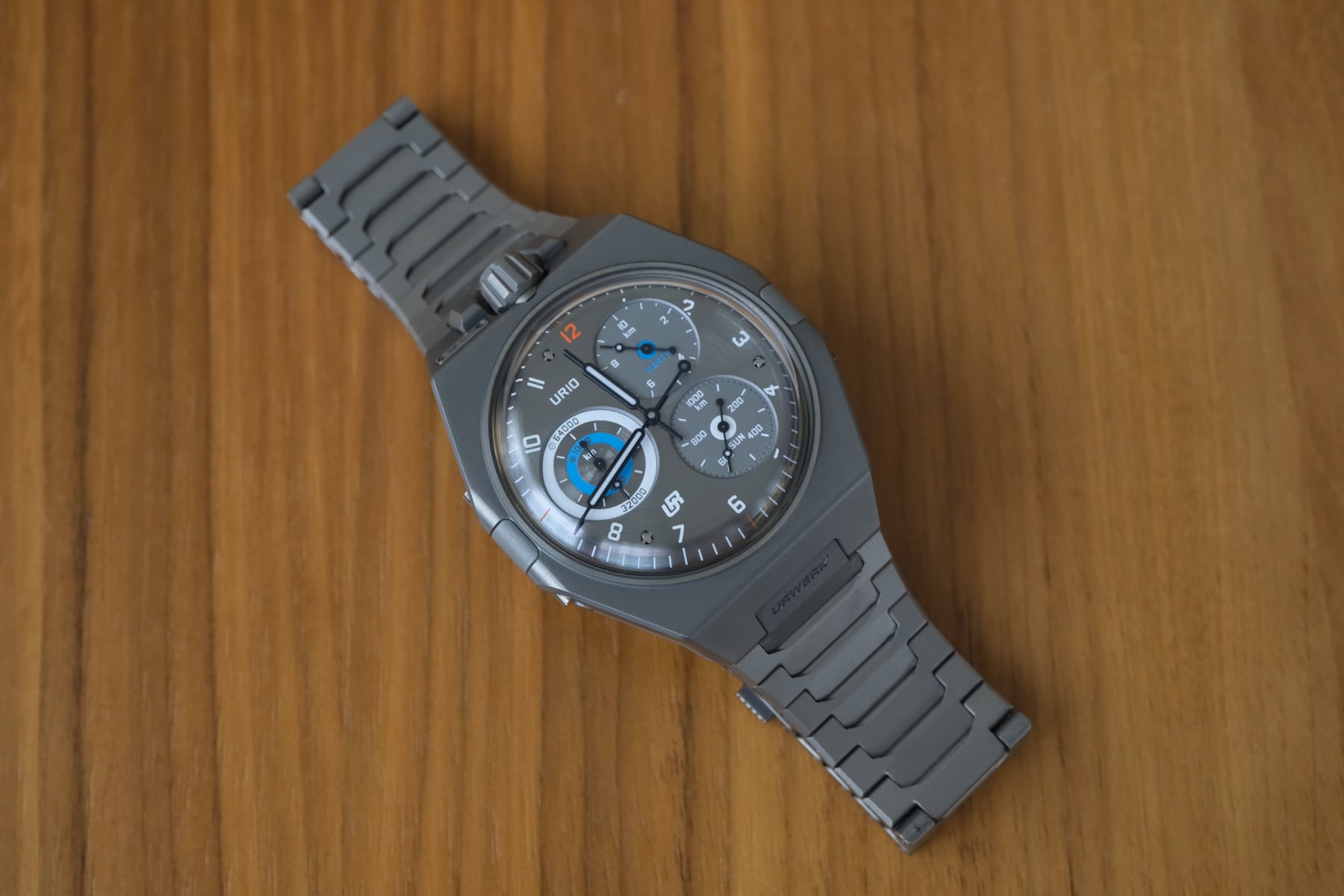
Calling an Urwerk traditional feels a bit ridiculous, but here we are. The new UR-10 Spacemeter gets closer to that territory than just about anything the brand has done before. And yes, we did get a traditional Urwerk before we got Grand Theft Auto VI. Sure, Urwerk has used hands in pieces like the EMC and AMC, but this feels different. This is the first time a mechanical Urwerk has leaned on centrally mounted hour and minute hands as the main event. For a brand that made its name with wandering hours, satellites, and displays that looked more like sci-fi instruments than dials, that’s a pretty big moment.
What I like about the UR-10 is that it doesn’t feel like Urwerk trying to tone itself down. It just feels like the brand’s taking a different route to the same destination. The time display is the familiar part this time. The oddness sits around it instead. So yes, at first glance, this is a calmer-looking Urwerk. It’s also more straightforward — but only up to a point. Spend a little time with it, and it becomes clear that this thing is still every bit as peculiar, thoughtful, and slightly unhinged as you’d want an Urwerk to be.
Familiar, but only in Urwerk terms
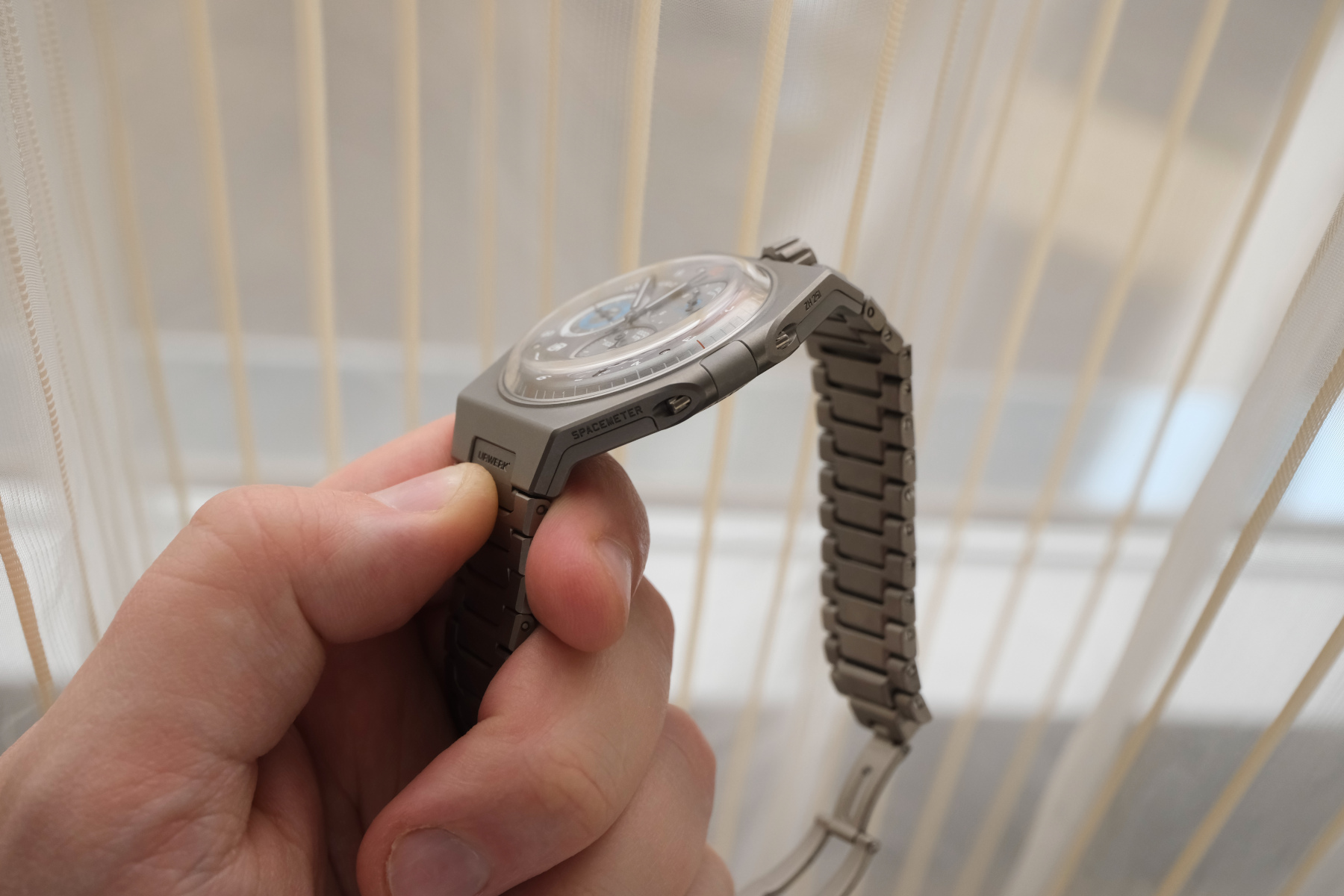
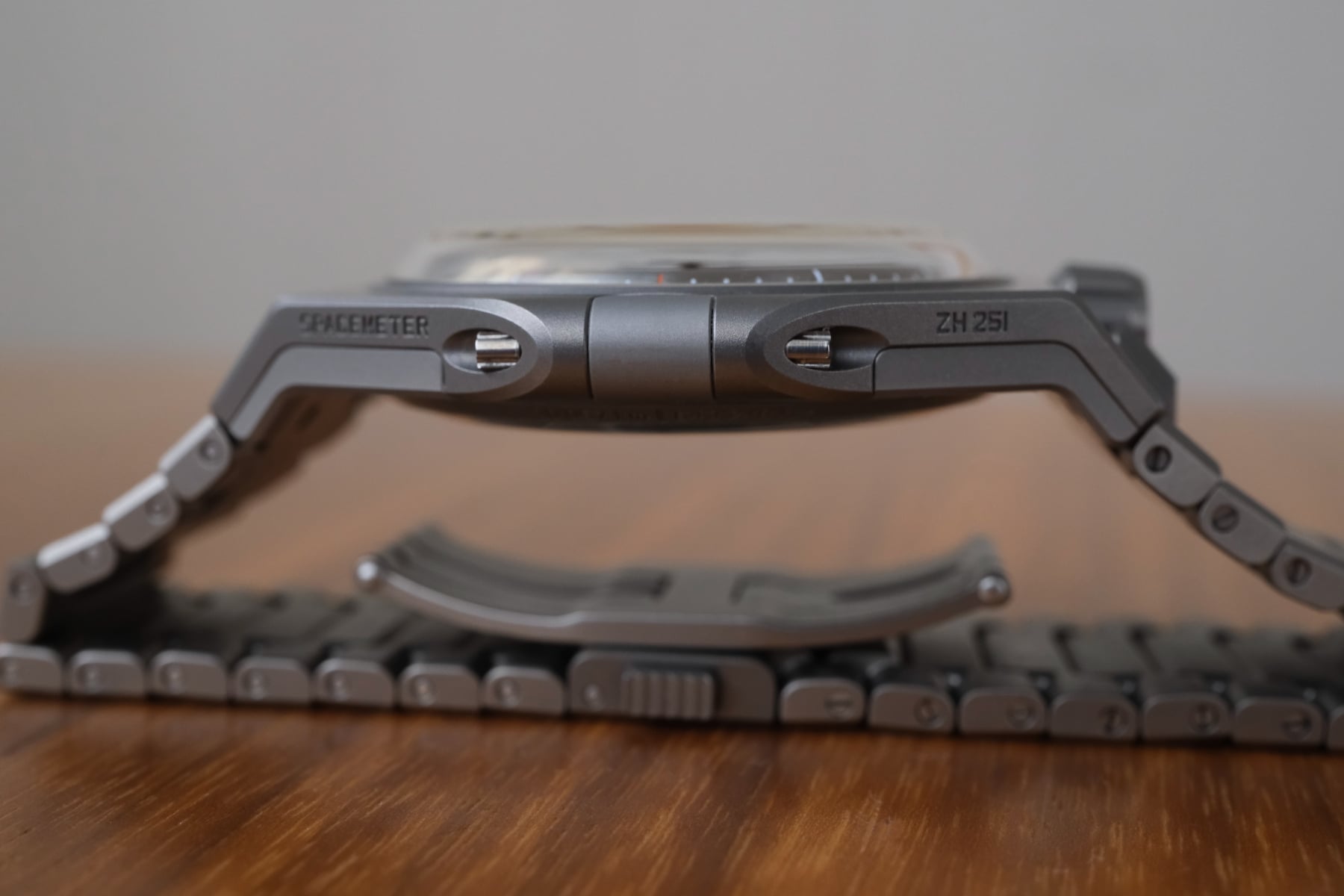
Although the UR-10 debuted as a new collection late last year, the case felt familiar to me almost straight away. There is something of the UR-100 about it. Maybe it’s just the overall stance and the way it sits visually, but there’s definitely a sense of lineage there. It’s broad, low through the middle, and very obviously engineered rather than styled. The case is formed from an upper and lower section, with the two parts secured from the sides by wing-like structures and visible bolts. It gives the whole thing a slightly exposed, assembled feel, which suits Urwerk down to the ground.


One of the first things that struck me was how slim the watch looks in the metal. The mid-case itself is only around 5.5mm thick, which is kind of wild for something with this much visual presence. On my calipers, the full thickness, including the proud box-style sapphire crystals on the front and back, came out at 12.5mm. That makes sense because so much of the thickness is in the crystals, with a little added by the stainless steel part of the case back. Visually, that gives the watch a much slimmer look on the wrist than the full measurement might suggest.
That domed box-style sapphire helps a lot visually as well. It gives the dial room and makes the whole thing feel a bit more open. It also works nicely with the dial’s slight dome. There is depth here, but it’s not in the usual over-the-top Urwerk way. It feels a bit more restrained. Add the crown at 12 o’clock, which keeps it out of the way and enhances the case’s vertical symmetry, and the whole watch ends up feeling more wearable than you might expect.
The main display is only half the story
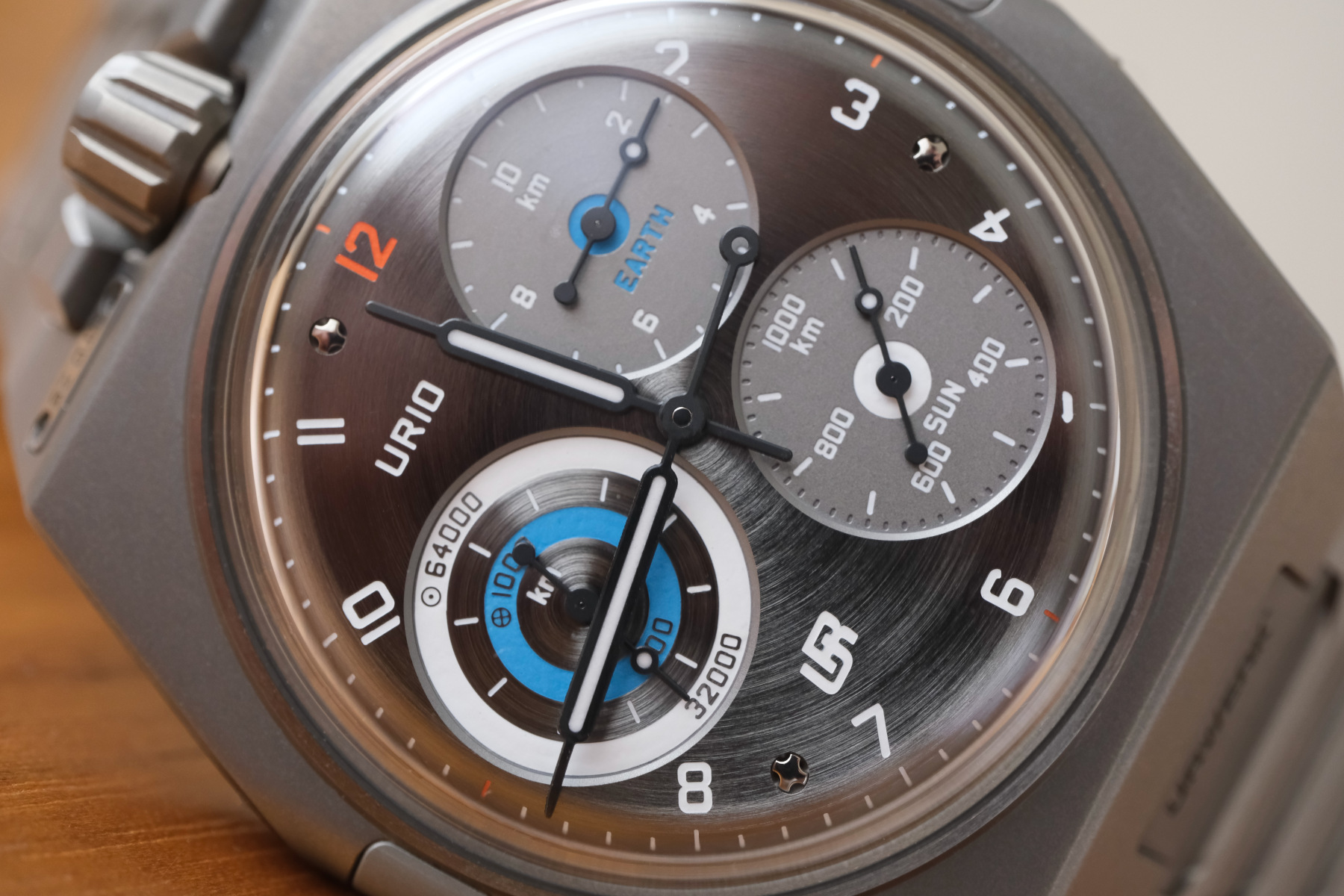
The obvious talking point is that the UR-10 uses regular hands. That’s not what makes the watch interesting, though. The real point of it sits around that central display. The three sub-dials all relate to Earth’s movement, and because of that, the watch starts to make more sense as an Urwerk. At 2 o’clock, you have the “Earth” display, which completes one full rotation for every 10 kilometers of our planet’s daily rotation at the equator. Urwerk rounds that to 22 seconds, so it moves surprisingly quickly and gives the dial a real sense of activity. At 4 o’clock, the “Sun” display completes one rotation every 34 seconds, representing every 1,000 kilometers Earth travels in its orbit around the Sun. Then, the final sub-dial at 9 o’clock ties those ideas together, its hand rotating once every 36 minutes to reflect either 1,000 kilometers of the Earth’s rotation or 64,000 kilometers of its journey around the Sun.
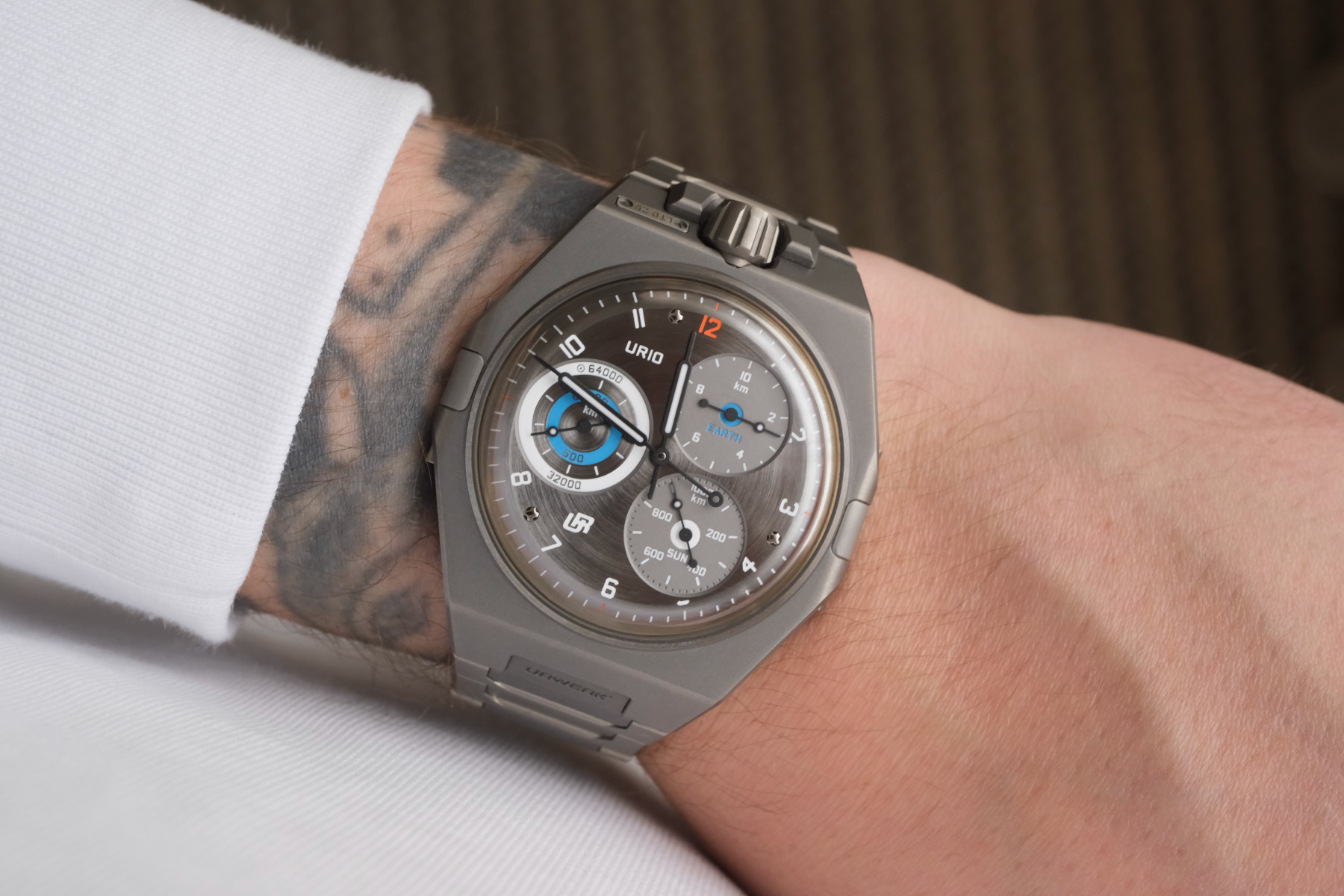
It’s hugely nerdy, but it’s also important to understand what Urwerk is doing with it. This is not a watch trying to be some perfectly calibrated scientific instrument. In fact, part of the point is that it isn’t. These displays are more interpretive than absolutely exact, which actually suits the whole concept. This watch is less about turning astronomy into a technical flex and more about framing our existence on Earth within something bigger. That makes the UR-10 feel less like a pure instrument and more like a mechanical reflection on time, motion, and our place within both.
To me, that only makes the watch more interesting. Urwerk is taking huge, practically impossible-to-grasp planetary movement and turning it into something playful, poetic, and wearable. The point is not absolute precision; it’s perspective.
Bigger on paper than on the wrist
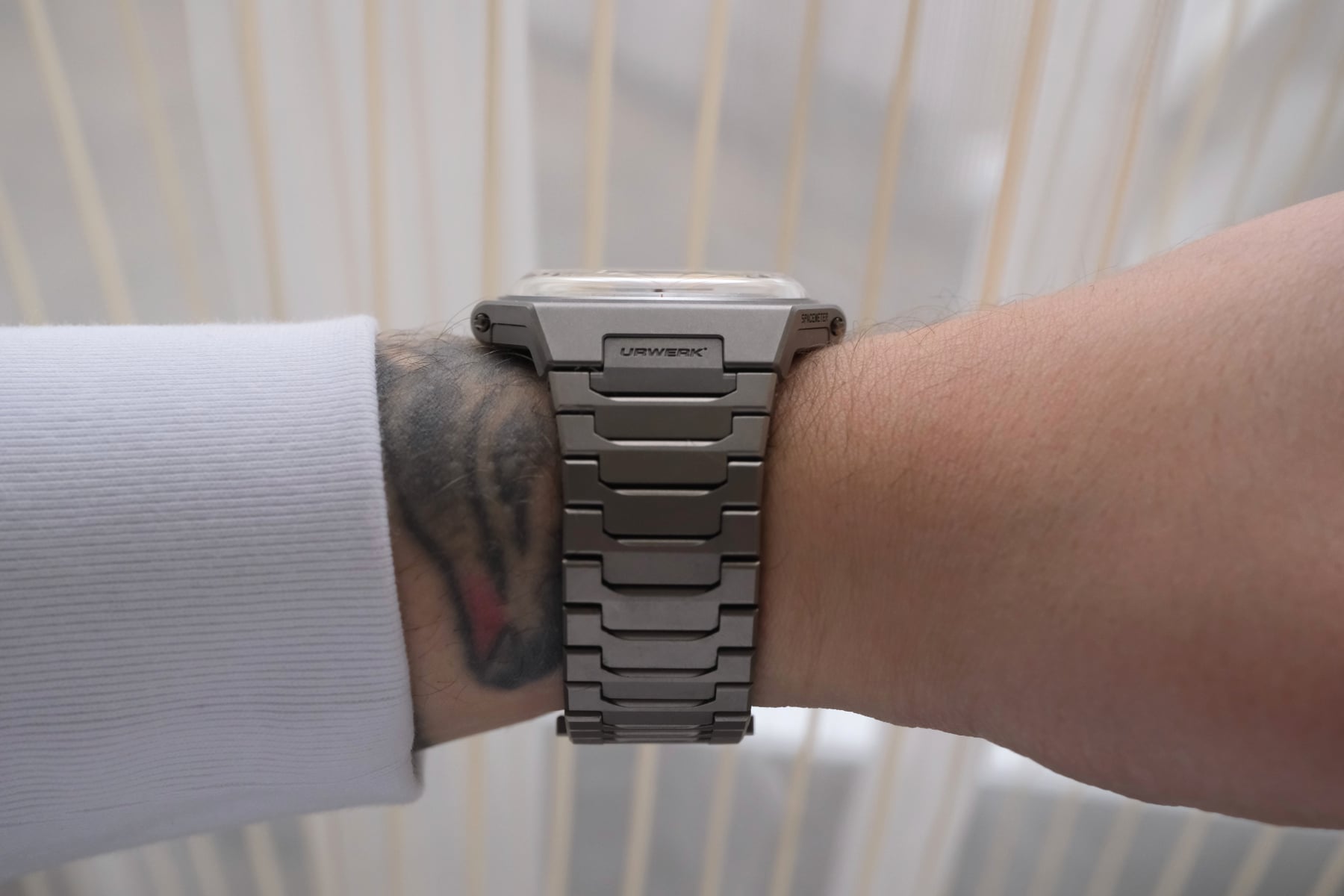
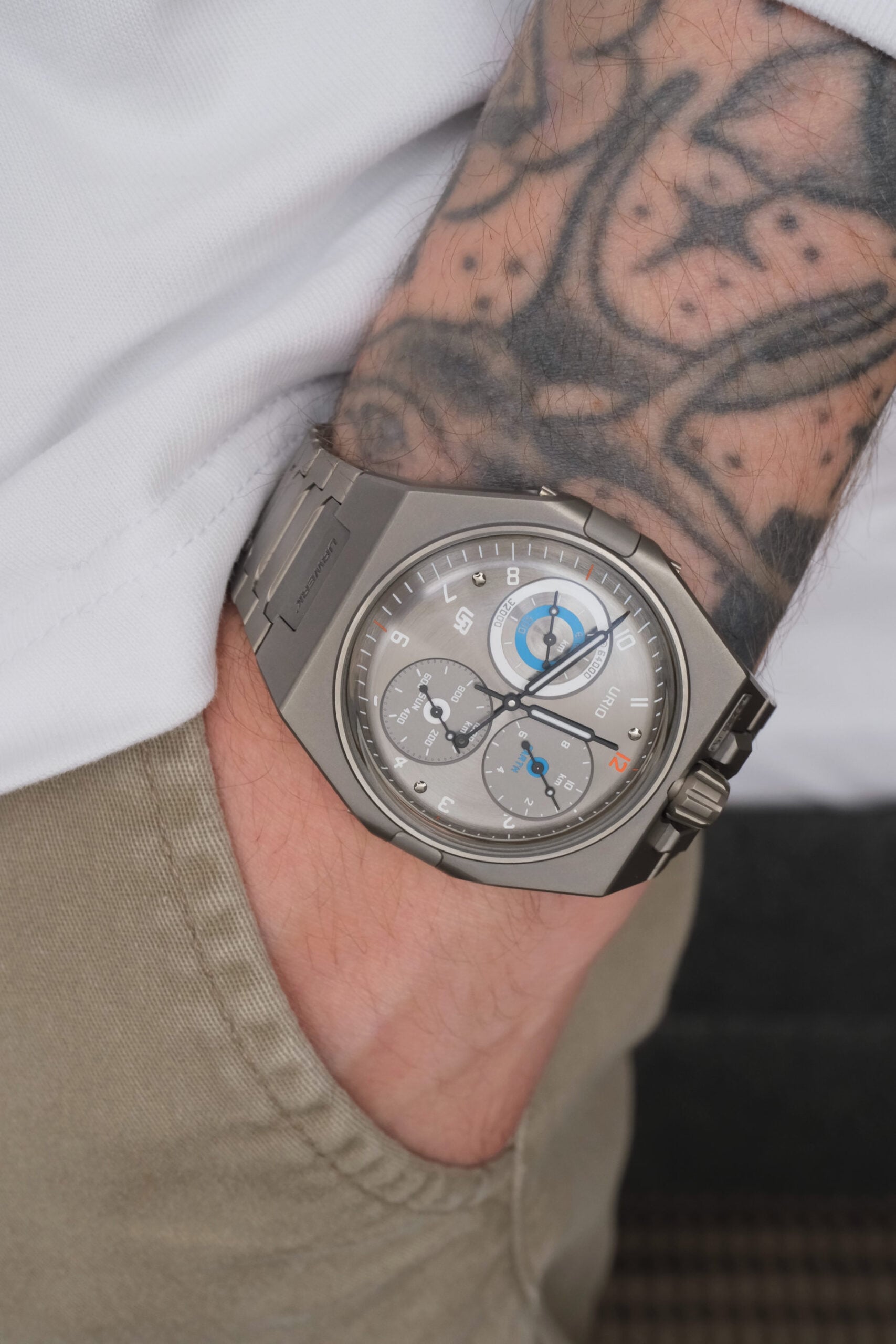
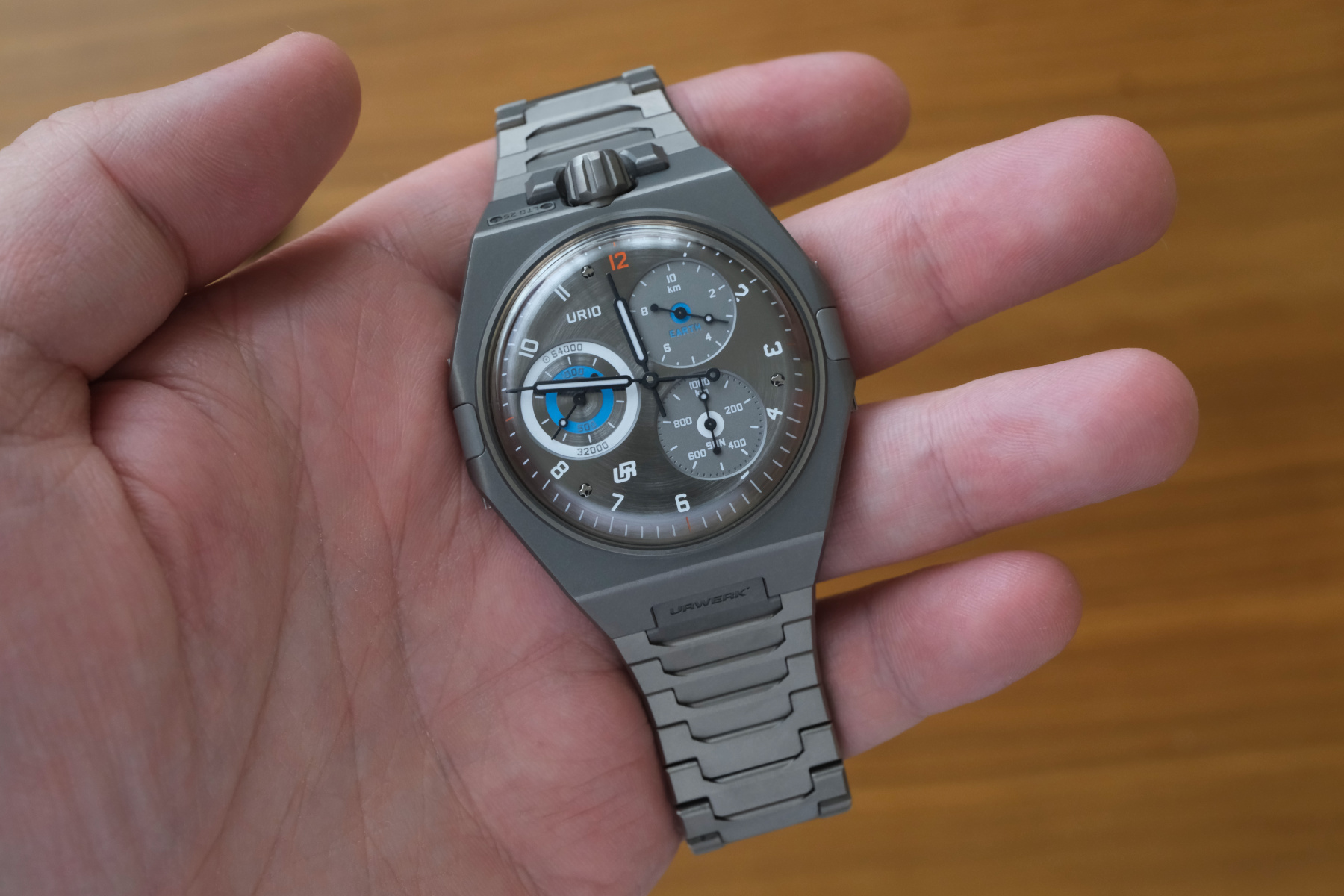
The UR-10 is not a small watch. Measured across the widest point, it comes in at 45.4mm, but much of that is due to the protruding ears at the sides of the case. The actual lug-to-lug is right around 53mm, which sounds large on paper, but it doesn’t tell the full story because of how the bracelet integrates.
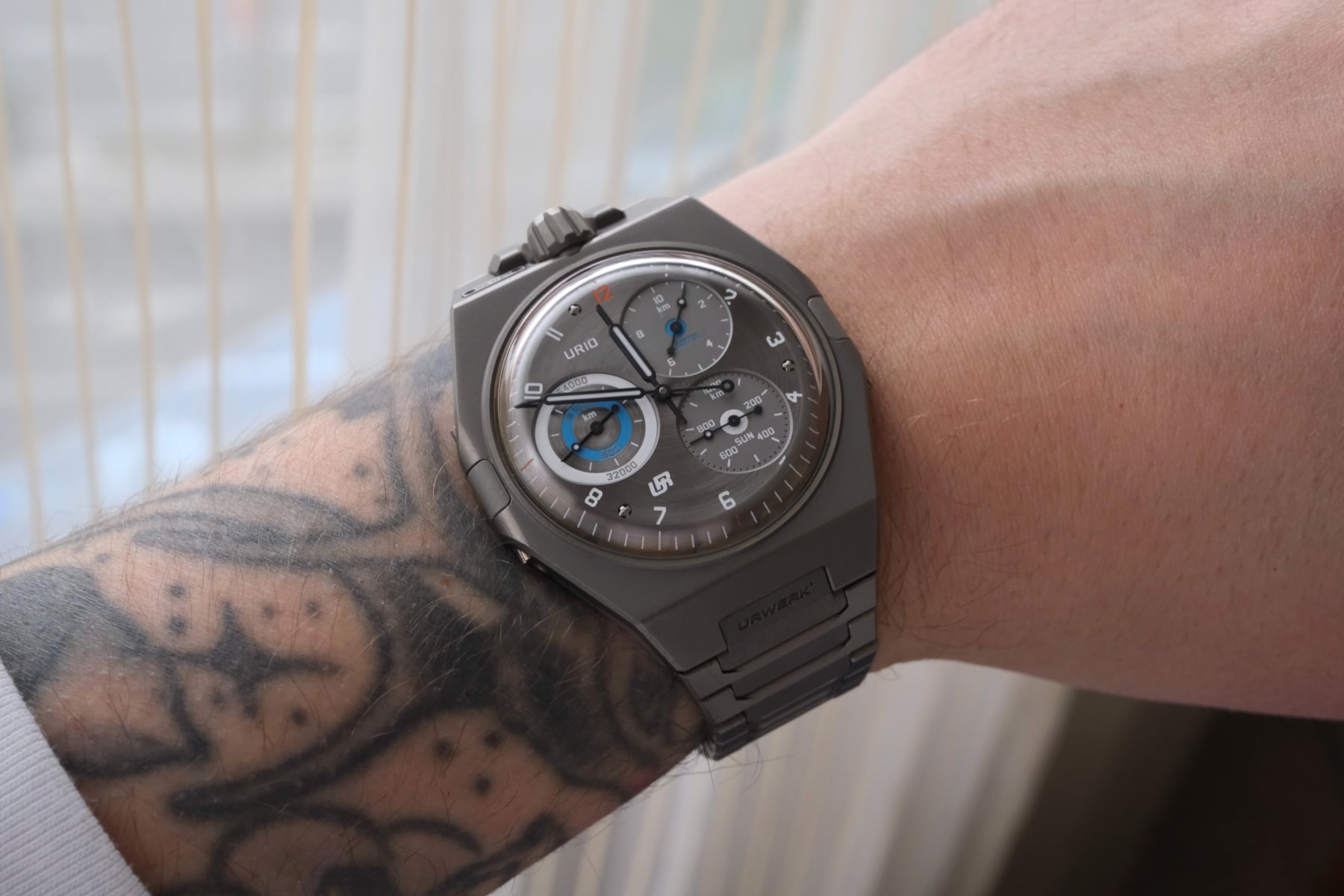
Really, the more relevant measurement is where the first links begin to bend down around the wrist, and from that point, the watch wears more like 59mm across the wrist. Even that sounds substantial, but this is one of those watches that proves once again how limited on-paper measurements can be. Put it on, and the slimness of the case and the ergonomics of the bracelet make those numbers sort of melt away. It still has width, of course, and like many Urwerks, it isn’t trying to disappear, but it wears much better than the specs suggest.
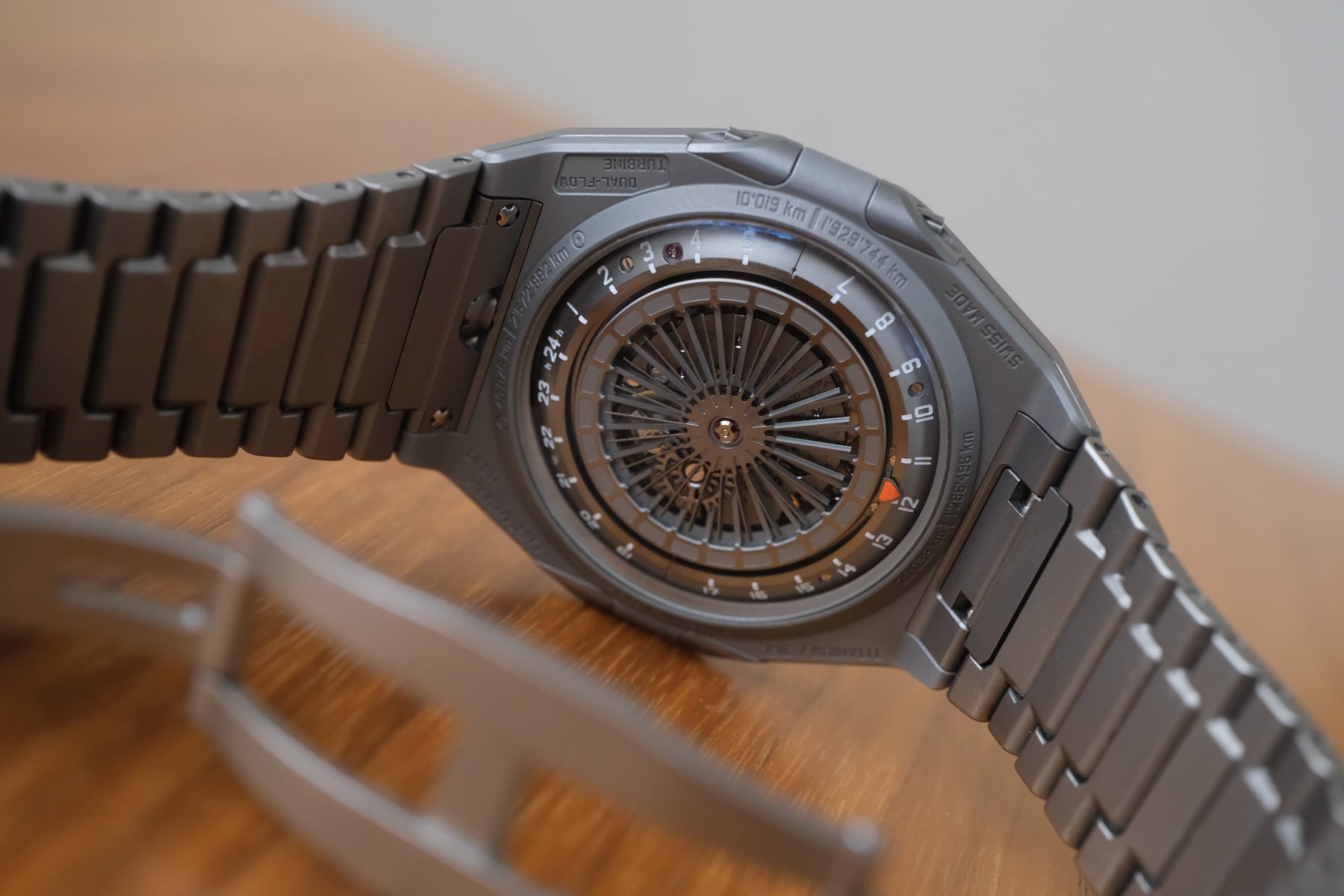
The bracelet is excellent too. I thought the same thing when I reviewed the UR-100V FTJ, and I feel no differently here. Urwerk really should make bracelets more often because when the brand does, they tend to be superb. The links are small, and the articulation is smooth, which lets the watch naturally settle onto the wrist. There is no on-the-fly adjustment, which would have been nice, but the fit is still easy to fine-tune because of how short the links are. In simple terms, it’s just very comfortable, and that matters a lot on a watch like this.
Around the back of the UR-10
Turn the UR-10 over, and things feel a bit more recognizably Urwerk again. On the case back, there is a 24-hour indication running around the edge. It’s linked directly to the main hour hand, so this is not a GMT in any practical sense. It’s better thought of as a 24-hour display. That feels very in keeping with the rest of the watch. Even on the back, Urwerk is not trying to overload the watch with extra utility for the sake of it. The display is there to support the bigger concept, not distract from it.
You also get a view of the rotor, and that’s one of my favorite details on the watch. Urwerk always seems to find a way to make this sort of thing feel more mechanical and considered than it needs to be. Here, the rotor setup is designed to reduce the speed at which it returns in the non-winding direction, helping to manage movement and wear rather than just spinning away unchecked. It’s not just there to look dramatic. It’s doing something useful, and that balance between visual impact and real-world usefulness is something Urwerk usually gets right.
A different kind of Urwerk
The UR-10 Spacemeter is an undeniably cool watch, but more importantly, it’s a interesting one. It shows that Urwerk can shift the way it communicates without losing what makes the brand feel like Urwerk in the first place. Going to central hands could easily have felt like the brand toning things down too much or drifting toward something safer. Instead, it feels more like Urwerk’s choosing a different way into the same sort of idea.
That is what I like most about it. The UR-10 doesn’t try to be weird for the sake of it, and it doesn’t feel like a compromise either. It still has that slightly offbeat, conceptual quality that makes Urwerk worth paying attention to, just wrapped in a format that is a little easier to read and a bit easier to live with.
At CHF 70,000 and limited to 25 pieces per dial color, it is still very much a niche object, exactly as you would expect from Urwerk. But that’s fine; it should be. The important thing is that, even with hands and a more familiar layout, it still feels properly, convincingly Urwerk. That is not something every brand could pull off.